



“The human being is the organ through which the universe knows itself.” — Johann Wolfgang von Goethe
Threshold
There is a faculty latent in every human being — dormant, precisely as a seed is dormant — that, when awakened, transforms the act of perceiving from a passive registration of surfaces into a living participation in the creative intelligence of Nature herself. This faculty is tripartite: Imagination, Inspiration, Intuition — three successive degrees of one unfolding capacity, each a genuine organ of cognition, as real in the economy of the soul as the eye is real in the economy of the body.
Most people, hearing these words, reach for the familiar territory: imagination as daydream, inspiration as the pleasant sensation preceding a good idea, intuition as a useful hunch. These interpretations are accurate, as far as they go — which is to say, they describe the shadow cast by a reality several orders of magnitude more substantial than the shadow itself.
Rudolf Steiner, lecturing in Berlin in 1904, was explicit: “Just as in the body, eye and ear develop as organs of perception, as senses for bodily processes, so does a man develop in himself soul and spiritual organs of perception through which the soul and spiritual worlds are opened to him.” He was describing something developmental and consequential — a genuine expansion of the range of what our human instruments are capable of receiving. And behind Steiner stands Goethe, who had already demonstrated in his botanical morphology and his phenomenological investigation of color that the careful cultivation of perception does in fact reveal dimensions of the natural world that analytical reduction permanently occludes.
The claim of this article is precise: Imagination, Inspiration, and Intuition are the three ascending registers of a single perceptual faculty — one that every human being carries in embryonic form, and one that, with cultivation, transforms the natural philosopher into a participant in Nature’s own cognition of itself.
“Neither a work of Nature nor one of art do we get to know when they have been finished; we must surprise them in the process of being created so as to understand them to some degree.” — Goethe, Goethe's World View: Presented in His Reflections and Maxims (1963)
The World’s Missing Dimension
Begin with an observation, phenomenological, requiring no prior commitment.
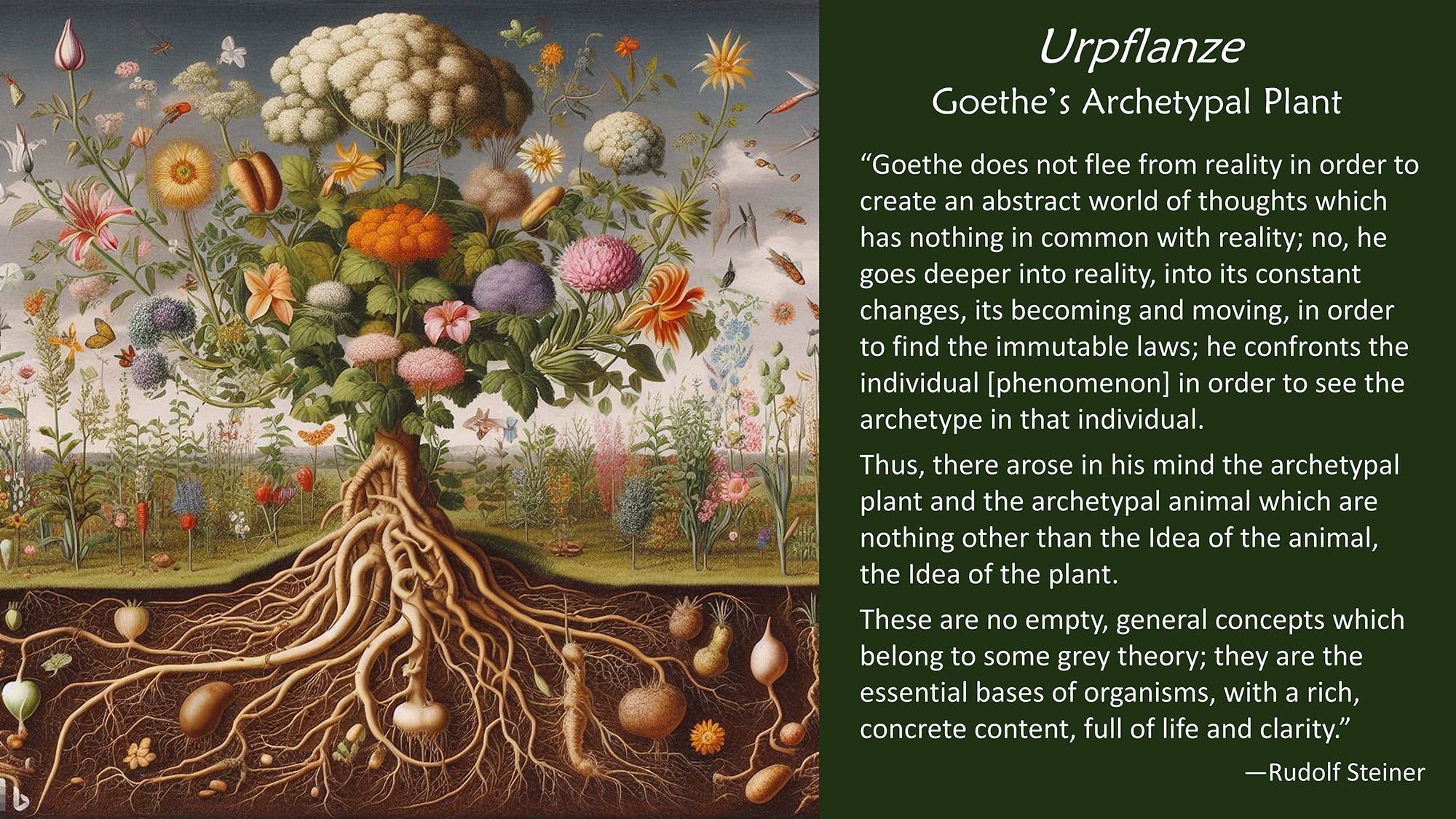
Stand before a flowering plant — any plant will do, though something with visible metamorphic complexity rewards attention most richly. A rose. A foxglove. Even a common dandelion. Observe the root, anchored and dark. Observe the stem’s upward impulse, its gathering of substance into structured column. Observe the leaf — one leaf — its veining, the subtle thickening at the midrib, the precise angulation of its emergence from the stem. Observe a second leaf, higher up, and note what has changed: the form has shifted. And a third. And the modification deepens. Observe the flower — how everything the leaf seemed to be trying to become, the flower is: pure color, pure gesture toward the light, a form that has abandoned the protective materiality of the leaf entirely in favor of expression.
“Colour is the soul of Nature and of the entire cosmos.” — Rudolf Steiner
What have you witnessed? A sequence of forms arranged in space. The conventional anatomist stops there. But Goethe went further, and what he discovered changed his understanding of natural science at its root: the sequence of forms is itself a form — a higher form, extended in time, invisible to the eye that can only register spatial positions. The metamorphosis of the plant, from root through leaf through flower through seed, is a gesture, a single coherent gesture, expressed across time, just as a musical phrase is a single coherent reality expressed across time. The plant means something with its forms. And that meaning is perceivable, once the organ of perception for temporal-dynamic form — Imagination — has been developed.
Goethe called the developmental archetype behind all plant forms the Urpflanze — the primal or archetypal plant. Crucially, he was at pains to specify that this was exact sensorial imagination — exakte sinnliche Phantasie — precise, disciplined, grounded in the phenomena. “They are not the shadowy phantoms of a vain imagination,” he wrote of these archetypal forms, “but possess an inner necessity and truth.” The imagination he cultivated was nothing like daydream. It was a heightened observational faculty that allowed the temporal dimension of form — the developmental process — to become as legible as the spatial dimension.
Here is the missing dimension of our current scientific picture of the world: process, living, metamorphic, directed process, apprehended as directly as we apprehend static form. Imagination, rightly developed, supplies this dimension. And once supplied, the world is never again quite the flat assembly of objects it appeared to be before.
The Three Readers of Nature’s Script
There is a useful image: Nature writes in a script, and the three organs — Imagination, Inspiration, Intuition — are three successive levels of reading that script.
Imagination reads the letters and words: the living dynamic forms, the metamorphic gestures, the archetypes behind the visible forms. This is already a transformative capacity — it places the reader in participatory relationship with the phenomena rather than in the position of external observer. But there is more to read.
Inspiration reads the meaning of the words in their context — what the phenomena are communicating in their relationship to one another, what intention or intelligence is expressed through the organization of form-processes into living wholes.
Intuition reads the author — apprehending the being or principle that is speaking through the text, dissolving the boundary between knower and known in an act of genuine identity.
These three are successive, and the sequence is developmental: Imagination is the necessary preparation for Inspiration, and Inspiration for Intuition. One does not skip levels in genuine cognitive development any more than a child skips walking in the development in order to run.
Imagination: The Soul’s Eye
The word carries a burden of misuse. Let us restore its precision.
In Steiner’s technical sense, Imagination (capitalized, as he wrote it) designates a mode of consciousness in which the thinker moves from abstract, static concepts to living pictures: dynamic, inwardly mobile representations that carry within themselves the generative principle of the things they represent. An imaginative picture of a growing plant is more than a still image — it contains the movement, the tendency, the gesture of becoming. It is, in a sense, a compressed film that the mind can run forward and backward, can slow and examine, can hold in the inner field of attention and allow to speak.
The transition from ordinary concept-thinking to imaginative thinking feels, to those who have begun to cultivate it, like the difference between holding a dried, pressed botanical specimen and holding a living plant. The specimen is accurate. It is genuinely the plant. But something essential is absent — the vitality, the directed developmental force that made the specimen what it is. Imaginative cognition restores that vitality, within the cognitive act itself.
Steiner described the physiological substrate of this shift — with the care of a researcher who had examined the process empirically — as the loosening of the etheric body's forces from their exclusive anchoring in physical metabolism, allowing those forces to reorganize into etheric vortices capable of registering non-physical form. These vortices are counterspatial in the precise geometric sense: peripheral in origin, centripetal in action, converging toward what George Adams identified as the star-point — the living focus of a formative field that works inward from the cosmic circumference rather than outward from any material centre. In Adams’ own words: “We apprehend the cosmic point as an ethereal sphere grown infinite. We feel it no longer in its trivial aspect as a dead physical point, but to quote Rudolf Steiner's words once more, as a point which has the area of an infinite sphere.” This is the plane-pole of nature in its most intimate biological expression — the imploding, form-creating force that gives coherent structure to living substance.
In practical terms: the cultivation of Imagination begins with the discipline of exact observation — Goethe’s foundational move. One observes the phenomena with thoroughness, attending not only to the static form but to its boundaries, its transitions, its emergent tendencies. One then reproduces this observation in the inner field of attention with the same precision and completeness — building, in the mind’s interior, a representation as accurate as the original observation. And then — this is the decisive step — one holds that inner representation with the same quality of attentive openness one would bring to the observation of a living thing, allowing it to move, to develop, to reveal what static observation could not. The Urpflanze arises precisely this way: as the living inner form behind all the plant’s outer metamorphoses, perceivable when the soul has made itself a sufficiently clear medium.
The result — and this is verifiable, by anyone willing to practice — is that the world begins to speak in gestures. Every form becomes the outward expression of a formative process. The branching of a river delta and the branching of a lightning discharge and the branching of blood vessels and the branching of a tree reveal themselves as variants on a single dynamic: the fractal discharge of accumulated potential through a branching path of least resistance. The spiral of the nautilus shell and the spiral of a hurricane and the spiral of a galaxy share not merely a shape but a dynamic identity — each is an expression of the same rotational field dynamic, operating at different scales, at different densities of medium, with different time constants. The doctrine of as above, so below moves from metaphor to direct observation once Imagination is operative. The structural principles that govern the cosmos operate at every scale — and Imagination is the organ that sees the principle through its multiple instantiations.

“The beautiful is a manifestation of secret laws of Nature, which but for this phenomenon would have remained hidden from us forever.” — Goethe
Inspiration: Hearing the World’s Word
If Imagination restores the temporal dimension of form — the gesture — then Inspiration restores something yet more interior: the intentionality behind the gesture. The shift is from seeing to hearing, and Steiner was precise about this: Inspiration involves the inner reception of what he called the language of the spiritual world — a world of relationships, communications, and mutual addresses among the beings and processes that animate the physical cosmos.
This may seem to stretch into mysticism too quickly. Let us remain phenomenological.
Consider the experience of listening to music — real music, heard attentively. The skilled listener receives not individual notes but relationship: how this phrase tensions toward resolution, how the theme stated in the first movement means something different — something it already contained — when it returns inverted in the third. The whole speaks through the parts. The parts, in retrospect, were always speaking the whole. This is Inspiration in its everyday analog: meaning received through listening rather than form perceived through looking.
Steiner placed Inspiration explicitly in the acoustic domain. The Tone Ether — the third of his four ethers, corresponding in the physical domain to the liquid state, the bearer of wave propagation — is the medium of this level of the world’s self-communication. Sound, in the esoteric tradition Steiner was drawing upon and extending, is primary in creation: in the beginning was the Word. The Pythagoreans knew it as harmonia; the alchemists knew it as the fiat that organizes chaos into cosmos. The Vedic tradition called it nada brahma — the world is sound.
What the inspired perception receives is precisely this: the world speaking itself, the cosmic logos expressing itself through the relationships among phenomena. The thunderstorm becomes legible as a communication — a discharge event in a global electrical circuit, yes, but also an event with significance in the context of the atmospheric field as a whole: a polarity reaching resolution, a tension accumulated over days across hundreds of kilometers releasing in a matter of hours, altering the electrical state of the soil, the chemistry of the near-atmosphere, the biology of everything living within range. The storm is a word in the language of the planetary electrical system. Inspiration is the faculty that receives it as such.
Robert Becker’s work on the DC bio-electrical field systems of living organisms — demonstrating, with careful measurement across decades, that living tissue maintains and responds to coherent electromagnetic field patterns that conventional electrophysiology’s AC-focused instrumentation simply cannot register — points toward the same reality from the empirical side. The body listens to the electrical field of the environment. The perineural DC current system, running along the nervous system and throughout the connective tissue matrix, functions as a receiver of environmental field information. Inspiration, as a cognitive faculty, is the consciously developed analog of this already-operative biological listening — the activation, at the level of awareness, of the same receptive capacity that functions continuously at the level of tissue.
The cultivation of Inspiration requires the disciplined quieting of personal mental noise — of the continuous internal commentary, the self-referential mental traffic — sufficiently for the signal of the world’s self-communication to become audible. This is the contemplative dimension that every genuine research tradition, both scientific and spiritual, has insisted upon. Goethe called it becoming a humble servant of Nature. Tesla described it as the cultivation of the passive, receptive mode of mind in which insights arrived as receptions rather than as products of deliberate reasoning. The discipline of Inspiration is the discipline of listening: making the inner field quiet, coherent, and receptive enough for the world to speak into it.

Intuition: Union with the Archetype
The third stage moves beyond the polarity of observer and observed entirely.
In ordinary cognition, even Imagination and Inspiration maintain a structural distinction between the knower and the known: I see the dynamic form; I hear the world’s word. Intuition dissolves this boundary. The knower does not merely perceive the archetype — the knower becomes the archetype, entering into an identity with the principle being known that is analogous to how the archetype itself is identified with what it generates.
Steiner was careful to specify that this is the highest and most demanding stage of the three, requiring — beyond the cognitive disciplines of Imagination and Inspiration — what he called a moral preparation of the most thoroughgoing kind. The surrender of egoic will that genuine Intuition demands is proportional to the depth of participation it achieves. To think the leaf while being the plant, as Goethe aspired to: this is intuitive cognition — the mind entering the generative principle of the plant so completely that the distinction between the thinking and the thing-thought-about momentarily resolves.
This is the ground the Goethean tradition has always occupied — and it requires no endorsement from quantum mechanics to stand. The commonly cited “observer effect” of the double-slit experiment is a physical interaction between an electronic detector and a particle, not a demonstration that conscious attention alters matter; that particular conflation belongs to popular mysticism rather than to careful science. The Goethean dissolution of the subject-object boundary operates at an altogether different level. It is closer to what the Vajrayana tradition calls Mirror-Like Wisdom — the state in which the perceiving awareness has become sufficiently clear and still that it reflects reality as it actually is, without the distortions of projection, preference, or preconception. Subject and object do not so much interact as reveal themselves to have been aspects of a single undivided field all along. The cultivated natural philosopher does not collapse a wave function by looking at it. The cultivated natural philosopher becomes clear enough to see — and in that clarity, the apparent boundary between knower and known shows itself for what it always was: a habit of attention, not an ontological wall.
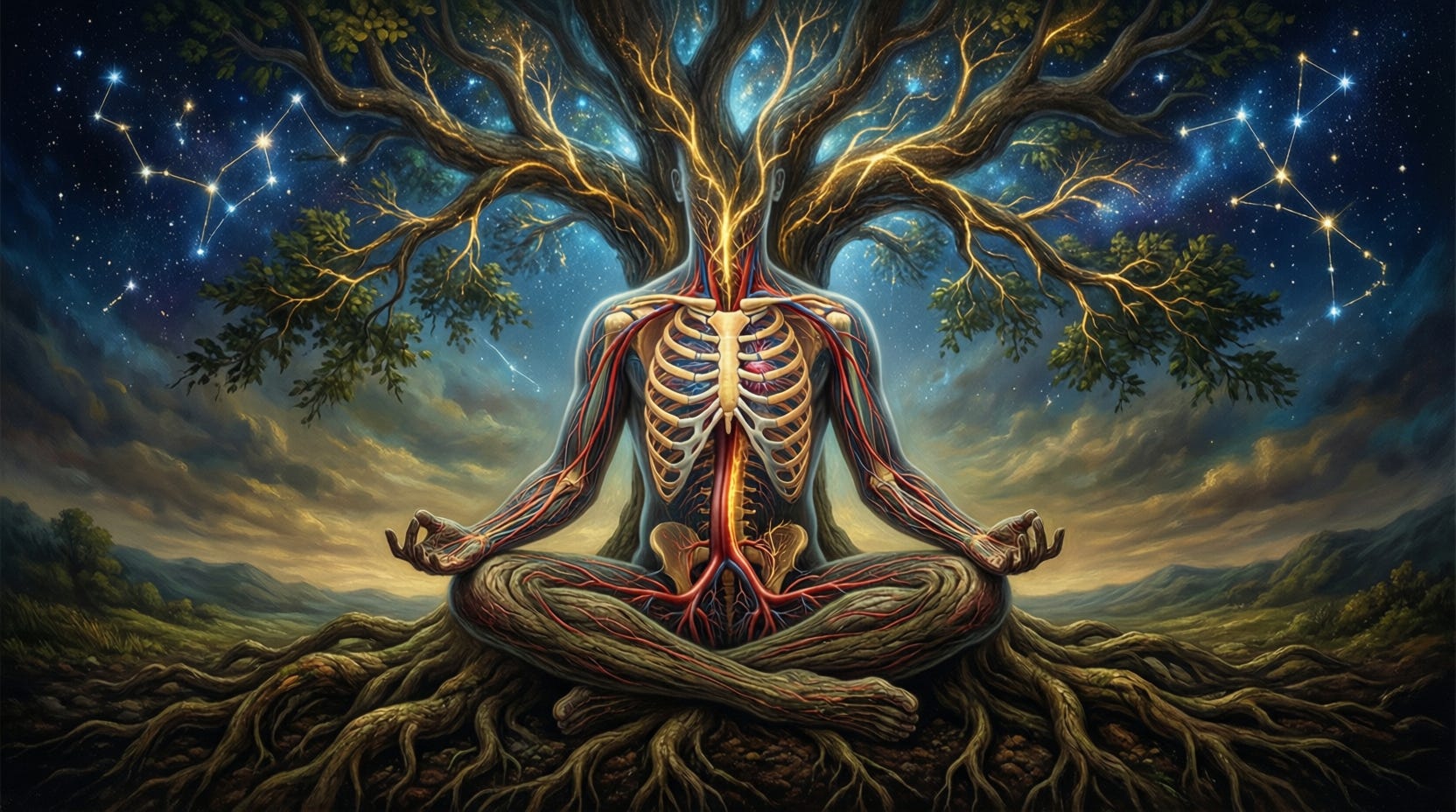
Intuition carries participation to its completion. The knower does not observe the archetype from outside or listen to it speak — the knower enters the generative principle itself and knows it from within, as the principle knows itself. What this means in practice becomes clear through an example drawn from the most fundamental level of living chemistry.
Carbon — the fourth most abundant element in the cosmos, the skeletal substance of every living organism on this planet — is, at the atomic scale, the enactment of a single geometric principle: the tetrahedron. Four binding directions simultaneously available, equally distributed through space, creating the maximum possible connectedness from a single centre. This is not a property carbon has; it is what carbon is. The intuitive cognition of carbon does not register this as a fact about bond angles. It enters the tetrahedral principle itself — the fourfold binding gesture — and recognises it as the bilateral hinge made molecular: the tetrahedron whose four vertices, as George Adams and N.C. Thomas demonstrated in the projective geometry underlying Edwards' path-curve research, straddle the boundary between centric and counterspatial reality, two real and two imaginary, the √−1 threshold crystallised into the bonding geometry of every carbon atom in every living organism. The same gesture operates across every scale: in the single carbon bond reaching simultaneously toward four neighbors, in the hexagonal rings of organic chemistry, in the geodesic perfection of buckminsterfullerene, in the planar lattice of graphene. The same gesture, the same being, at every order of magnitude. The diversity of carbon chemistry — which is to say, the diversity of life’s physical architecture — flows from this single inexhaustible tetrahedral identity. Intuition perceives the identity directly, as one recognises a face rather than deducing it from a description.
Now extend the same faculty to the opposite pole of the scale spectrum. The plasma state — Steiner’s Warmth Ether, the most primary of the four, the existential threshold at which matter first becomes permeable to counterspatial working — presents itself to intuitive cognition as formative fire: not combustion, but the organizing intelligence that Z-pinch dynamics express in a laboratory discharge, that Birkeland currents express across interstellar distances, that the rotational coherence of galactic filaments expresses at the largest scales the cosmos makes available to observation. The same principle that binds carbon in four directions simultaneously is the same principle that organises plasma into coherent filamentary structure — both are expressions of the formative, centripetal, counterspatial pole of nature asserting coherent form against the entropic tendency of mere energy release. Intuition does not infer this correspondence. It perceives the single intelligence operating through both, as a musician hears the same harmonic relationship whether it is played on a string or a pipe.
This is what our electric universe actually is, seen from within rather than modelled from without: a living field of formative intelligence, self-similar across every scale, its coherent structures the visible signature of counterspatial working in a physical medium. The researcher who has developed intuitive cognition does not need to be persuaded of this by accumulated evidence, though the evidence is abundant. The faculty, once operative, reads the cosmos directly — the way a fluent reader reads a page, receiving meaning rather than decoding symbols.
What does the natural world look like, when these three faculties are operative together?
It looks like what it is.
The first thing the educated eye encounters — the Grammar of nature in the Trivium sense, the phenomena in their wholeness before any analysis is attempted — is the biosphere as a single living being. The floral and faunal, fungal and microbial kingdoms present themselves, to perception disciplined by Imagination, as organs of one superorganism rather than as populations of separate creatures competing for resources within a neutral container. The mycorrhizal networks threading through the soil — now documented by forest ecologists as continuous chemical and electrical signaling systems connecting individual trees across hectares — are the nervous tissue of the forest body. The atmospheric exchange of oxygen and carbon dioxide between the photosynthetic layer and the animal kingdom is a respiratory cycle, not a coincidence of metabolic byproducts. The oceanic phytoplankton, generating more than half the planet’s oxygen while fixing carbon at the sea surface, are not isolated organisms but a distributed organ of planetary chemistry operating at scales only visible from space. What Goethe perceived in the metamorphic unity of the plant — one gesture expressing itself through root, leaf, flower, and seed — the natural philosopher perceives at the planetary scale: one living being, differentiated into kingdoms and species the way an organism is differentiated into tissues and organs, each expressing the whole from its own particular station. This is what I have called the Gaian Superorganism — a term intended with full biological precision, not as metaphor.
Inspiration then receives what Imagination has prepared: the meaning of the relationships, the communication moving through the superorganism’s body. The global electrical circuit presents itself to this level of perception as the energetic physiology of the planetary being — as precisely functional as the DC bio-electrical field systems Robert Becker measured in living tissue, operating at the scale of the entire atmosphere. The ground plane maintains its negative potential relative to the ionospheric ceiling; the thunderstorm systems distributed across the tropics drive the potential difference continuously, generating on average forty to fifty lightning strikes per second; and the fair-weather return current descends through the entire column of air everywhere between storm cells, completing the circuit in a continuous planetary pulse. Every living organism on the surface is coupled to this field through its own bioelectrical body — the perineural DC current system Becker mapped, the cellular membrane potentials that respond to geomagnetic and atmospheric electrical variations, the circadian rhythms entrained to the Schumann resonances that the cavity between Earth and ionosphere sustains at 7.83 Hz and its harmonics. The planet does not merely house life within an electrical environment. The planetary electrical system and the biosphere are one integrated field, each modulating the other continuously — the Gaian Superorganism conducting its own internal communications through the medium of atmospheric electricity, the thunderstorm as word, the global circuit as the nervous system through which it speaks.

“In nature we never see anything isolated, but everything in connection with something else which is before it, beside it, under it and over it.” — Goethe, Maxims and Reflections
The four ethers name what is actually operating through this integrated field — and naming them precisely is an act of cognitive clarification, not of mystical decoration. The Warmth Ether, Steiner’s first and most primary — the existential threshold at which matter first becomes permeable to counterspatial working — is the plasma condition: the state in which substance loosens from rigid centric organisation and becomes available to the formative forces working inward from the cosmic periphery. Every lightning discharge, every solar wind interaction with the ionosphere, every volcanic exhalation is the Warmth Ether active at the planetary scale. The Light Ether — the plane-pole force in its most direct expression, surfaces of force converging inward from the absolute plane — is the photosynthetic activity of the biosphere: the living capture of peripheral light-force into the chemical substance of organic matter, the leaf’s entire morphology an organ for receiving what the cosmic circumference continuously offers. The Chemical Ether, the ether of rhythm and periodicity, is legible in the Schumann resonances themselves, in the tidal periodicities of the atmospheric electrical field, in the circadian and seasonal rhythms through which every organism participates in the planetary pulse. And the Life Ether — the deepest counterspatial working, the formative force that builds organisms from the periphery inward toward their own star-points — is what maintains the coherent living form of the Gaian Superorganism against the second law’s continuous pressure toward equilibrium. These are not four poetic categories applied to phenomena already adequately described by physics. They are four distinct modes of the space-counterspace interplay, each with a specific geometric character and a specific range of natural phenomena as its domain — the working vocabulary of the conscious intelligence that the universe deploys in building and sustaining living form.
The geological column, seen through this same participatory perception, resolves into something the standard sedimentary narrative consistently fails to account for: the record of a planet that has undergone profound sequential transformations, each layer not a gradual accumulation but the compressed residue of events. Derek Ager — late Professor of Geology at Swansea, one of the most authoritative stratigraphy specialists of the twentieth century — acknowledged this with the candor of a scientist whose evidence had outrun his theoretical commitments. In The New Catastrophism (1993), he stated plainly that the geological record is overwhelmingly the product of episodic catastrophic events separated by long intervals of non-deposition and erosion. The strata speak of events, not of gradualism.
Within this metamorphic planetary biography, the carbon record presents its own profound revision. The term fossil fuel encodes an assumption that the evidence consistently strains to support: carbon is the fourth most abundant element in the cosmos, present in interstellar space, in cometary nuclei, raining as methane onto the surface of Saturn's moon Titan — a world no one has proposed was once inhabited by oil-forming organisms. Thomas Gold's abiogenic theory, developed at length in The Deep Hot Biosphere (1999) and pursued in my own Curtain Call for Fossil Fuels, proposes instead that primordial carbon upwells continuously from deep earth reservoirs, transformed by chemical and bacteriological processes in its migration toward the surface — the slow exhalation of a living planet cycling its own substance through geological time. The Goethean eye reads the column as the planet's metamorphic biography, not its waste deposit.

Known through Intuition — the faculty that enters the generative principle rather than observing it from outside — these three phenomena reveal themselves as aspects of a single living reality. The Gaian Superorganism, its atmospheric electrical body, and its geological metamorphic history are not three separate subjects requiring separate sciences. They are one planetary being, perceived from three different levels of its own self-organisation: the biological, the energetic, and the historical. The natural philosopher who has developed all three cognitive organs reads them simultaneously, the way a physician reads a patient — not assembling separate data points into a diagnosis, but receiving the living coherence of an organism that is already, in every moment, expressing its total condition through every available channel.
For the cosmos, received through Inspiration and known through Intuition, is a consciously intelligent field — and this is not a conclusion appended to the scientific picture but the ground from which the scientific picture becomes fully legible. The formative forces that Becker measured as DC currents, that Adams identified geometrically as counterspatial star-points, that Steiner described as the activity of the four ethers, are the activity of intelligence: not the mechanical operation of forces upon passive matter, but the purposive, organised, hierarchically structured working of beings whose cognitive reach exceeds our own as our own exceeds that of the mineral. The natural philosopher who has developed Imagination, Inspiration, and Intuition does not arrive at this as a theoretical inference. The faculty of Inspiration, when genuinely operative, receives the intentionality behind the phenomena — the meaning of the relationships, the will expressed through the forms — and what it receives is unmistakably the signature of intelligence rather than the signature of mechanism. Charles Fort spent his career documenting what happens when intelligence signatures appear in the phenomena and the prevailing paradigm has no category for them: they are classified as anomalies and set aside. The developed natural philosopher sets nothing aside. Every phenomenon is followed until it has fully spoken — and what the phenomena collectively speak, to the ear tuned to receive them, is the self-disclosure of a universe that knows what it is doing.
This is what a natural philosopher sees. And the philosopher’s seeing participates in what is seen — adding to the world’s self-knowledge through the quality of attention brought, contributing to the Gaian Superorganism’s own growing lucidity about its nature. The investigation is not neutral. It never was.
The Discipline
Let no reader suppose that these organs awaken through passive assent to the ideas being presented here. Ideas are preparations, not achievements. The actual development of Imagination, Inspiration, and Intuition requires practice — sustained, specific, gradually cumulative practice — of the same order of seriousness as the development of any other precision instrument.
Goethe practiced exact observational attention for decades before the Urpflanze became genuinely perceptible to him. He returned to the same phenomena hundreds of times, varying the angle of approach, varying the season, the light, the context, until the phenomena themselves taught him how to see them. This is the discipline of patient attentiveness — the willingness to remain with a phenomenon until it has fully spoken, rather than withdrawing into one’s preconceived framework after the first glimpse. It is, among other things, the antidote to the premature closure that Charles Fort spent his career documenting as the occupational disease of the professional scientist.

The cultivation of Imagination specifically involves the practice of careful inner reproduction of observed phenomena — building the inner picture with precision, then animating it, allowing it to move through its developmental sequence, then holding the moving picture in attentive awareness long enough for the formative principle behind it to become perceptible. This practice is available to any man or woman with sufficient patience and a genuine commitment to the phenomena rather than to their own preconceptions about the phenomena.
The cultivation of Inspiration requires the complementary practice: the deliberate quieting of the self-referential mental stream, the cultivation of inner stillness, the development of what might be called receptive alertness — the state in which the mind is fully awake yet still, its own generative activity quieted, available to receive what the world sends into it. Every genuine contemplative tradition has described this state and provided methods for its cultivation. It is reproducible and developmental — meaning it deepens with practice, and the degree to which it deepens is proportional to the quality and consistency of the practice.
Intuition develops as a consequence of the maturing of the first two stages rather than as a separately cultivable faculty. When Imagination has reached a sufficient degree of precision and Inspiration a sufficient degree of quietness, the dissolution of the observer/observed boundary begins to occur naturally — as a cognitive event, not a mystical rapture, though it carries an unmistakable quality of recognition: this is how things actually are.
The Participatory Cosmos
There is a consequence of all this that bears making explicit, because it alters the foundational stance of inquiry.
The standard scientific posture assumes a universe of objects whose behavior is in principle independent of the observer’s consciousness — a universe that was proceeding along its predetermined trajectory long before any conscious being appeared to observe it, and that will continue along that trajectory after all conscious beings have vanished. Consciousness, in this picture, is at best an epiphenomenon: a late arrival, a local event of no cosmological consequence.
The Goethean-Steinerian posture assumes the opposite, and the assumption is an empirical discovery made in the course of careful practice: consciousness is constitutive of the cosmos, not incidental to it. The cosmos is engaged in a continuous act of self-cognition, and the human capacity for Imagination, Inspiration, and Intuition represents the leading edge of that self-cognition — the place where the universe’s act of knowing itself reaches its highest available degree of lucidity.
This is the meaning of Goethe’s statement that stands at the head of this article: the human being is the organ through which the universe knows itself. The organ is, at present, very incompletely developed. The awakening of Imagination, Inspiration, and Intuition represents the development of that organ toward the degree of completion for which it is designed.
The implications for the practice of natural philosophy are direct: the researcher who develops these faculties contributes to the universe’s capacity to know itself — adding a degree of clarity to the cosmic self-reflection in which every act of genuine knowing participates. The investigation of the plasma dynamics of stellar formation, the investigation of the DC bio-electrical field organisation of living tissue, the investigation of the Gaian Superorganism and its four-ether energetic body, the investigation of the deep carbon cycle of a living planet breathing its primordial substance upward through geological time: all of these, conducted with the precision and the participatory openness that the developed organs allow, are contributions to a project of self-discovery that the cosmos has been prosecuting since its first coherent structures arose from the primordial discharge. The conscious intelligence active through the four ethers — the same intelligence that builds the plant from the cosmic periphery inward toward its star-point, that sustains the Gaian Superorganism’s living coherence against entropy’s continuous claim, that organises plasma into the filamentary architecture of galaxies — is the intelligence the natural philosopher is learning, through Imagination, Inspiration, and Intuition, to think with rather than merely about. This is the difference between natural science and natural philosophy in its fullest sense: the scientist maps the activity of intelligence from outside; the natural philosopher develops the organs through which that intelligence becomes directly participable. The Gaian Superorganism, whose nervous system we inhabit, whose carbon we are built from, whose electrical field we are coupled to in every moment of our biological existence, is among the beneficiaries of that participation — and so, in ways that exceed our current capacity to fully articulate, are the conscious beings whose formative activity we are at last learning to recognise in the phenomena themselves.
That project continues. It continues in you. The conscious intelligence that builds the leaf, sustains the planetary field, and organises the galactic filament has been waiting, with the patience of geological time, for the organ of its own self-knowledge to awaken. That organ is the human being. These three faculties — Imagination, Inspiration, Intuition — are how it awakens. The world is ready to be known from within. The organs await their awakening.
“To truly know the world, look deeply within your own being; to truly know yourself, take real interest in the world.” — Rudolf Steiner
The Living Invitation
Let us close with a practice rather than a summary.
Tonight, or at the first available opportunity, go out under the sky in darkness — far enough from artificial light that the Milky Way is visible. Stand and look up for a full ten minutes without thought, without naming, without the habitual inner commentary that translates direct experience into verbal categories. Simply receive what the visual field contains.
At some point — this is reproducible — something shifts. The flat projection of stars against a dark backdrop gives way to a spatial perception: the depth of the field opens, and what were points become positions in a volume of extraordinary extent. The Milky Way becomes what it is: a band of stellar density visible from inside, a section cut through the disc of a galaxy, the galaxy itself perceived from an interior position. This shift from flat projection to inhabited volume is a small but genuine instance of what Imagination, in its early stages, does: it restores the dimension that ordinary habituated perception has suppressed.
Stay with it. Let the perception deepen. Let the movement of the field — the subtle motion that becomes perceptible as the eye’s adaptation deepens — speak. Let the fact of the field’s extraordinary structure, its vast coherent filamentary organization along Birkeland current pathways, its galaxies organized along plasma filaments hundreds of millions of light-years in length, its scalable self-similarity from the smallest discharge structure to the largest cosmological web — let all of this be received rather than conceptually processed.
This is the beginning of Imagination.
The world is waiting to be known in this way. In that knowing, you become the knower.
“You are the universe experiencing itself.” —Alan Watts

If this article has opened something in you, the next step is available.
Awakening Archetypal Vision is a recorded workshop developed from decades of research and teaching in Goethean science, natural philosophy, and the cultivation of supersensible perception. It takes precisely the faculties this article has described — Imagination, Inspiration, and Intuition — and gives them a practical training ground: plant metamorphosis as a direct exercise in exact sensorial imagination, Goethe’s color phenomenology as an introduction to the perception of archetypal form, cosmological botany as the gateway to the living intelligence active in natural forms, and the Liberal Arts — Trivium and Quadrivium — as the classical framework within which these perceptual capacities were once systematically developed and can be again.
The workshop moves through foundations of conscious awareness, the Goethean path to scientific awakening, the living science of light and color, and the practical cultivation of archetypal vision — all grounded in primary sources, direct phenomenological exercise, and the lineage of anomalous natural research that the Chronicles of Alkemix exists to transmit.
The full workshop recording and all current offerings are available at Lux.Alkemix.Art
The organs await their awakening. The work is here.
That was literally my last class... we are so on the same page my darling
Amazing stuff…I am overwhelmed at present. But THANK YOU for this. Truly jaw-dropping stuff…