


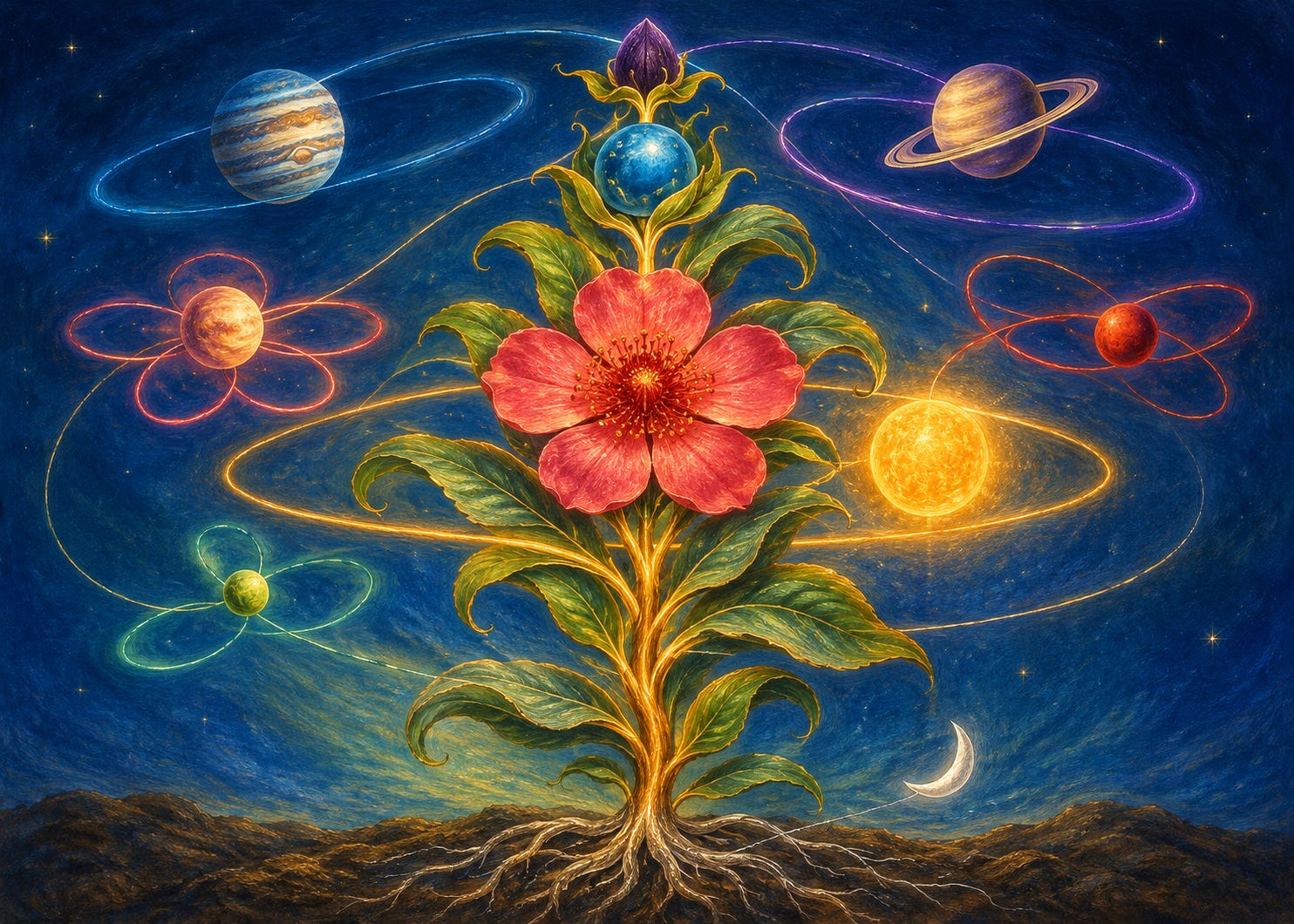
“Tycho Brahe’s view of the universe provides the key to understanding the plant kingdom.”
—Ernst Michael Kranich, Planetary Influences upon Plants
Goethe’s Search for the Archetypal Plant
In April 1787 Goethe walked through the public gardens of Palermo with a question he had carried from Weimar across the Alps. Plants he had known only in pots and hothouses were growing there in the open air, under a southern Sun, and the question came back to him with new force. He wondered “whether I might not chance upon my archetypal plant,” and as he compared the many forms around him, “always I found them more like than unlike” (Goethe, Botanical Writings). He later described the challenge that occupied him at the time as “the sensuous form of a supersensuous plant archetype.” He gave it a name, the Urpflanze (Figure 1).
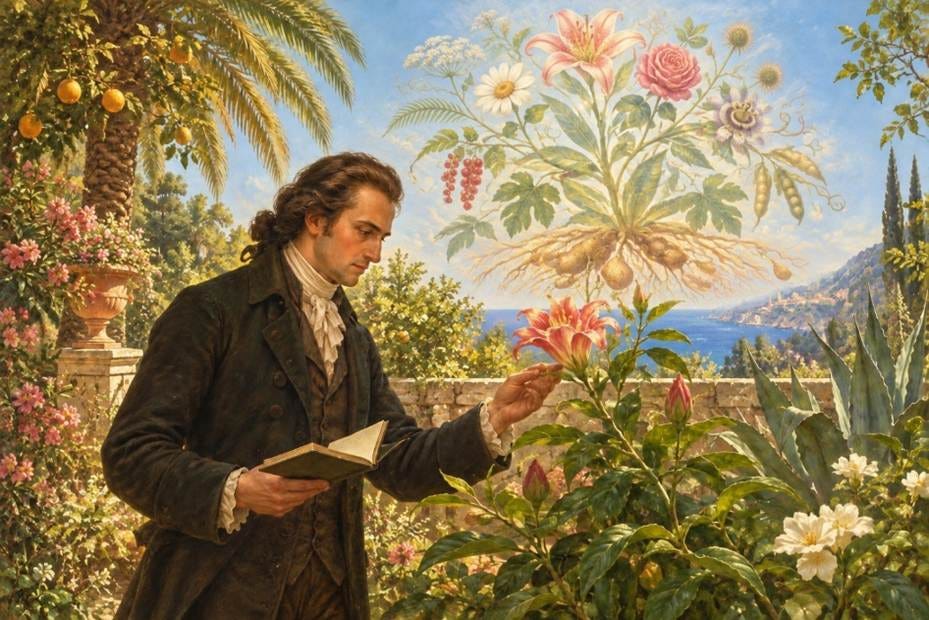
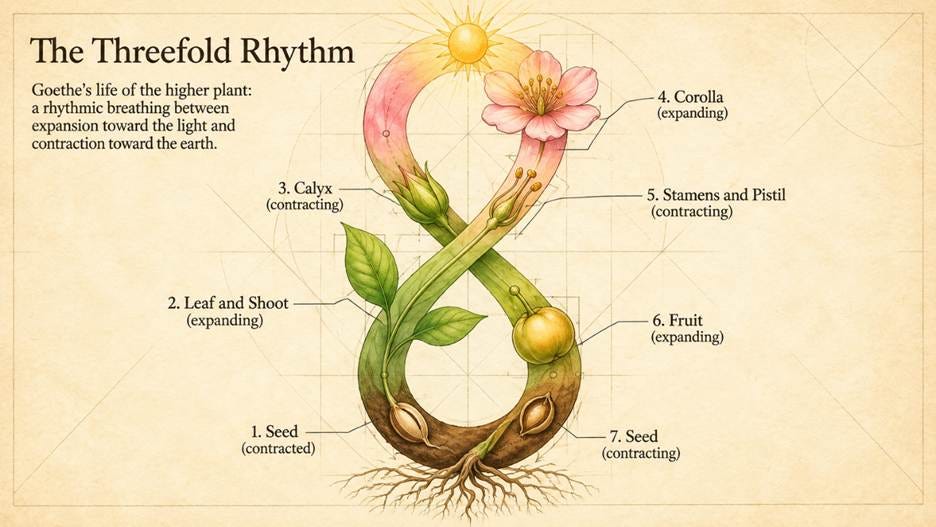
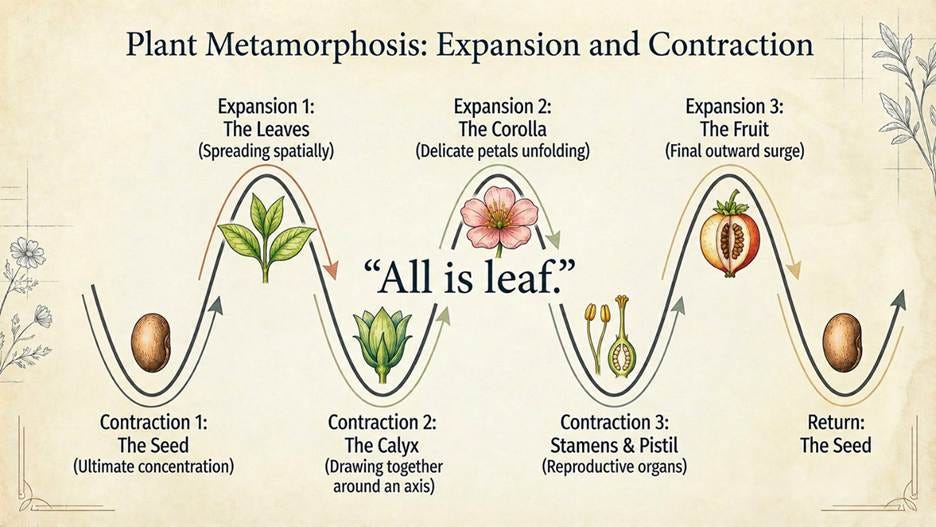
Three years later he published The Metamorphosis of Plants (1790). The essay follows one organ, the leaf, through a sequence of transformations from seed to seed: cotyledons, stem leaves, calyx, corolla, stamens and pistil, fruit, and seed again. The sequence moves through three alternations of expansion and contraction. From the cotyledons upward the leaf enlarges and elaborates its periphery; it contracts into the calyx; it expands again into the corolla; it contracts into stamens and styles; the fruit is “the last and greatest expansion which the plant undertakes”; and in the seed “the most extreme degree of contraction and interior elaboration occurs” (Figures 2 and 3).
In 1794 Goethe explained his theory to Schiller, drawing “a symbolic plant” with a few quick strokes of the pen. Schiller listened closely, then shook his head and said, “That is not an empiric experience, it is an idea.” Goethe answered, “How splendid that I have ideas without knowing it, and can see them before my very eyes.” The exchange set the terms for two centuries of argument. Goethe saw the archetype as a living reality he could observe in the plants. Schiller placed it in the mind of the observer. Academic botany followed Schiller, and the Urpflanze became a figure of speech.
“Goethe does not flee from reality in order to create an abstract world of thoughts which has nothing in common with reality; no, he goes deeper into reality, into its constant changes, its becoming and moving, in order to find the immutable laws; he confronts the individual [phenomenon] in order to see the archetype in that individual. Thus there arose in his mind the archetypal plant and the archetypal animal which are nothing other than the Idea of the animal, the Idea of the plant. These are no empty, general concepts which belong to some grey theory; they are the essential bases of organisms, with a rich, concrete content, full of life and clarity.”
—Rudolf Steiner, “Goethe as the Founder of a New Science of Aesthetics,” Vienna, 1888
Developmental genetics has since returned to Goethe by name. Plants lacking the genes that give the flower organs their identity form leaf-like organs in place of sepals, petals, stamens and carpels, and in 2001 Soraya Pelaz and her colleagues turned leaves into petals by switching on the missing genes. Their paper opens with Goethe’s proposal that each flower organ is a modified leaf (Pelaz et al., 2001). The laboratory has confirmed the metamorphosis. The question it leaves open is where the archetype resides.

In Seeing the Whole of the Plant (2023) I followed Goethe’s method of seeing and closed on the question of where the Idea resides. This piece takes up the answer given by the German biologist and Waldorf teacher-educator Ernst Michael Kranich in Die Formensprache der Pflanze, published in English as Planetary Influences upon Plants: A Cosmological Botany (1984). Kranich found the archetypal plant in a definite place: the planetary world as it appears from the Earth. The Sun, Moon and planets, moving as we see them move from where we stand, compose the formative order that each flowering plant follows from seed to seed. Kranich himself wrote that this planetary relationship “is the archetypal plant itself,” and that Tycho Brahe’s view of the universe is the key to the plant kingdom. I take this further. The Urpflanze is the Tychonic system, the apparent solar system of Earth, written into living form. Two consequences of that reading close this piece: the screening of the relationship by artificial fields, and its dependence on the Earth’s station among the planets.
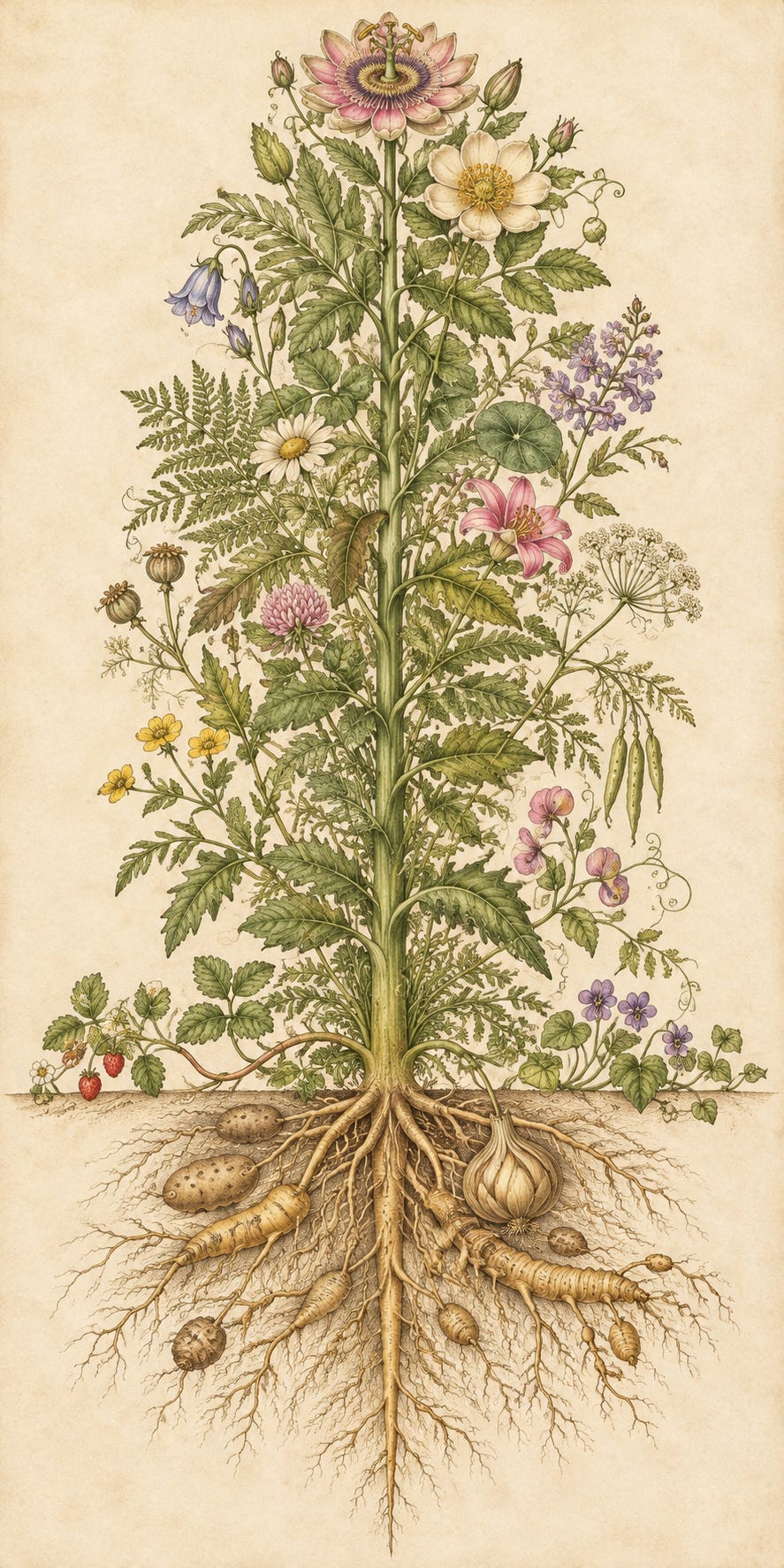
Kranich held that the archetype works within the plant. For Goethe, he wrote, the archetypal plant is “a reality present in the plants” (Kranich). It “exists outside of sense perception yet works in the rose as the most common law of formation.” A diagram of it “should not mislead you into thinking that the archetypal plant exists above or next to the individual plant”, because the archetype “activates the formative forces in the individual plant with varying intensity.” Pierre Turpin’s plate of 1837 draws the archetype in that spirit, every form of the plant kingdom growing from one axis (Figure 4). I read the archetype as a tendency: a set of formative relationships that each species meets within its own limits. György Doczi called this principle the power of limits. In the plant, the limits are cosmic relationships. A species expresses the whole planetary order, with one or two of its members sounding more strongly than the rest.
Goethe himself came close to this reading near the end of his life. In the 1831 essay On the Spiral Tendency of Vegetation he described two tendencies working through every plant. “We had to assume in vegetation a general spiral tendency, by means of which, in combination with a vertical force, all plant structures, all plant formations, are completed according to the law of metamorphosis.” The vertical tendency, the “virile sustaining principle of growth,” is “manifest from the very beginning of germination” and lifts the plant from root toward sky. The spiral tendency is “the actual reproductive life principle,” which “at the end, during blossoming and fruiting, predominates.” Kranich built his study on these two tendencies and states that his chapter on the center shoot describes Goethe’s vertical tendency, while the chapters on leaf, flower and fruit follow the spiral (Kranich).
The Heavens as Seen from Earth
Kranich’s method rests on what he called the correspondence of images. He set out to describe plant and planet side by side, each in its own terms, without claiming a mechanical cause running from one to the other. When both worlds are studied with enough thoroughness, he wrote, “the images perceived in one area correspond to those of the other area in gesture, dynamics and conformities.” Botanists use the same principle every time they recognize two plants as members of one genus or family. Kranich extended it from plant to heaven.
The second foundation is the point of view. Kranich insisted that the planetary movements be taken as they appear from the Earth, because the plant lives on the Earth and receives the heavens from there:
“For life on earth, happenings in the universe are to be taken into consideration only to the extent that they are mirrored on earth, i.e., how they appear when seen from earth. Therefore one must proceed strictly from the phenomena. For this reason the heliocentric view of the world, for our purposes, is not applicable. It is not a phenomenon; it is instead constructed from phenomena, with the support of certain assumptions. Seen from earth, nothing points to the sun as the center of the planetary system and to elliptic orbits of planets. For the earthly plant kingdom, the universe as seen from earth is of importance, not the thought-concept man has of it. Insofar as there are connections between the plant kingdom and the motions in the planetary system, they can be decoded through a geocentric approach alone and not by using the heliocentric system.”
Rudolf Steiner had stated the same principle in 1920, in the sixth lecture of the medical course Spiritual Science and Medicine. Speaking of the spiral sequence of leaves and flower parts, he said that its origin “is to be sought in the influence that works from the extra-telluric sphere, and chiefly in the influence of the sun’s apparent path through the heavens. (Let us say ‘apparent,’ for the respective motions of earth and sun can only be taken relatively.)” He continued: “There are indeed points of view better than the mathematics of Galileo, from which to study the paths of the heavenly bodies; they trace themselves in the sequence of formative processes in the plant. For what the stars do is faithfully copied by the plant” (GA 312, Lecture 6, 26 March 1920). In the same lecture he added that “it is time today that the whole Copernican system was re-examined and superseded by another.” He described the Sun drawing the plant upward, the outer planets Mars, Jupiter and Saturn deflecting that upward tendency to “bank up the formative forces which cause the formation of flower and seed,” and the Moon, Mercury and Venus drawing the plant downward into root. “So I would say that the plant expresses and bears the imprint of our whole planetary system.”
Four years later, in the Pastoral Medicine course, Steiner gave the briefest form of the picture, which Kranich prints in full: “We must see the presence of the sun’s forces on earth in the pressing upward. In the rounding-out of the root, we see the presence of the moon’s forces on earth.” The forces of Venus and Mercury aid the Sun, and “the forces of Venus and Mercury are everywhere opposed by those from Mars, Saturn, and Jupiter” (GA 318, quoted in Kranich). Steiner offered these statements as indications. Kranich notes that his remarks on leaf spirals and the planets “must be taken more as an indication of a new direction for research than as a detailed single statement.” Planetary Influences upon Plants is that research carried through. Steiner and Kranich share the standpoint, the heavens as seen from the Earth, and they describe two aspects of what it shows. Steiner describes the direction in which each group of planets works on the plant, earthward or skyward. Kranich describes which sphere’s gesture each organ images, so that Mercury appears in the leaf, Venus in the corolla and the Moon in root, ovary and seed.
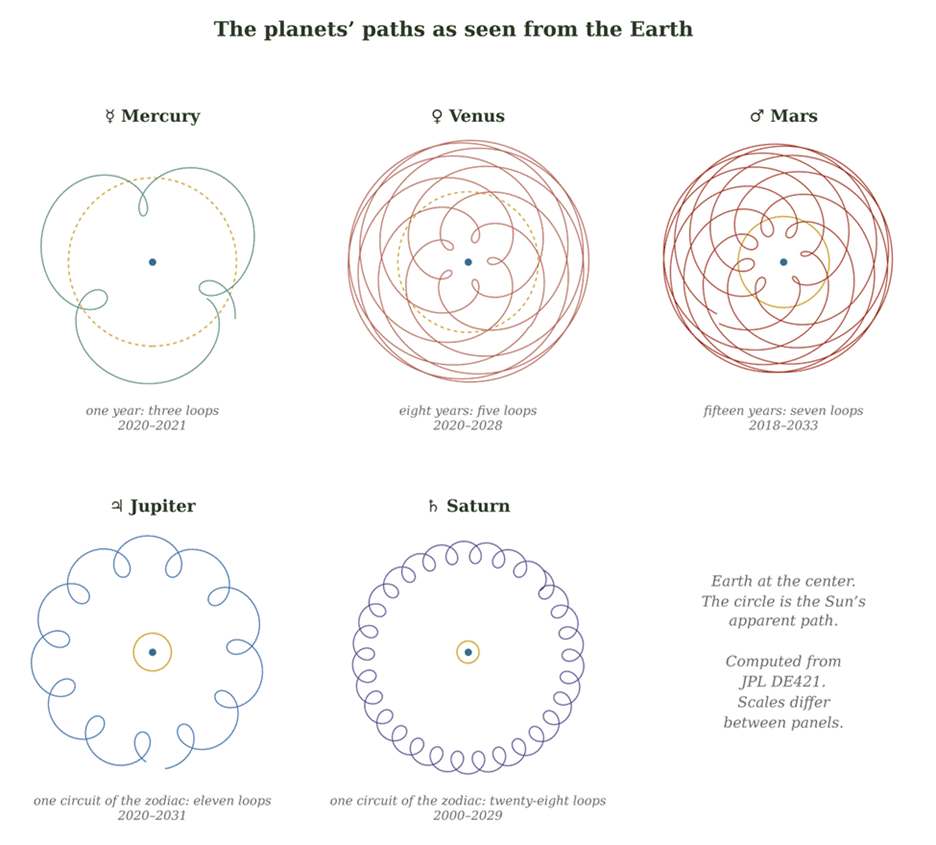
The order Kranich arrived at answers to one historical picture of the cosmos. Seen from the Earth, the Sun and Moon circle the Earth. Mercury and Venus circle the Sun and never stray far from it; they appear as morning and evening stars. Mars, Jupiter and Saturn move in great loops that enclose both Earth and Sun. Kranich drew the conclusion directly: the view that results from the phenomena “corresponds neither to the geocentric view of Ptolemy nor to the heliocentric view of Copernicus and Kepler. It does, however, correspond largely with Tycho Brahe’s view.” The planetary world has two centers, “the earth as center of the orbits of the sun and moon and the sun as center of the orbits of the planets.” Then comes the sentence that opens this piece: “Tycho Brahe’s view of the universe provides the key to understanding the plant kingdom.”
Kranich also drew attention to how the planetary rhythms interlock (Figure 5). Mercury completes three synodic cycles in a year, Venus five in eight years, Venus four while Mars completes three, Jupiter five sidereal circuits while Saturn completes two. None of these ratios is exact, and Kranich treated the small differences as part of the living order: “In the sphere of the planets, there are no two rhythms that correspond to each other exactly, not even when one of the two rhythms, or both, are multiplied with integral factors. Thus there are no identical constellations. The differences and novelties are an essential peculiarity of the planetary world.” He concluded that “reality in the planetary world does not lie in the manifest phenomena of the individual planets but in the harmony of their rhythms.” The plant takes up that harmony.
With this frame in place, we can follow Goethe’s sequence from seed to seed and see which member of the apparent heavens each stage of the plant answers to.
Seed and Germination: The Root and the Moon
The seed absorbs water, swells, and breaks its coat. The first organ to emerge is the radicle, which turns downward with gravity and penetrates the moist soil. Goethe traced the vertical tendency to this moment, “the very beginning of germination.” Kranich describes the root as the plant’s connection with the Earth: it develops in darkness, below the sphere of light and air, and with few exceptions it “primarily resembles an unraveling of fibers into the soil.” Above ground the plant is shaped by the Sun and the planets that move with it. For their rhythms to become living form on Earth, Kranich writes, they must be received in the moisture-sphere and earth-sphere, and “the organ that connects the influence of the sun, Mercury and Venus, etc., with the earthly region is the root.”
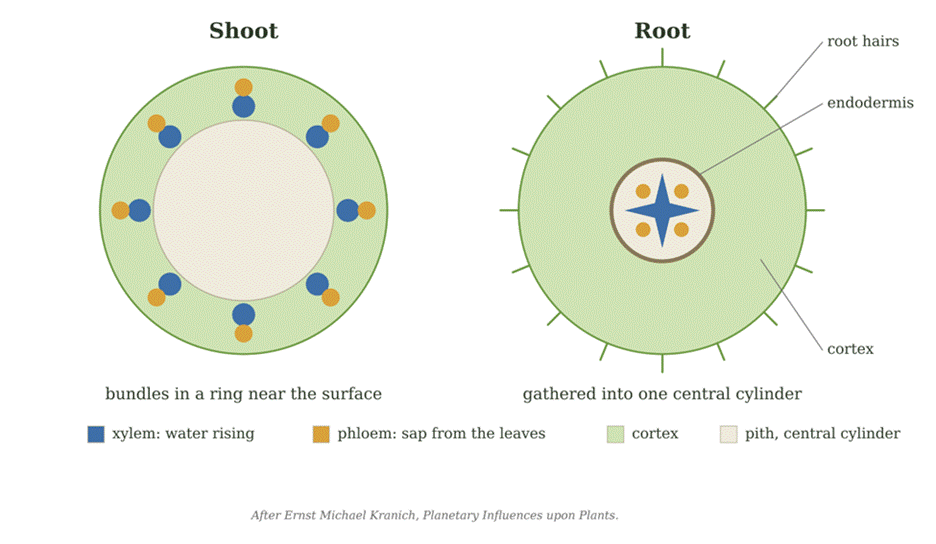
He identifies the root as “the direct manifestation of the moon within the plant.” The Moon stands closest to the Earth of all the heavenly bodies, and in Tycho’s picture it is centered on the Earth, as the root is. The Moon is fullest when it stands opposite the Sun, in the region the Earth’s shadow darkens most; the root grows most fully when it turns away from the Sun entirely, into dense matter and darkness. Kranich follows the image into the anatomy. In the shoot the vascular bundles, the strands that carry water up and sap down, lie in a ring near the surface, and the water rising through them is oriented toward the periphery. Where shoot passes into root the bundles undergo what Kranich calls a complicated transposition: they move to the center and gather into a single central cylinder, sealed by a thin layer of tissue, the endodermis, and enclosed by a thick cortex (Figure 6). In this “contracted isolation,” as he puts it, the Moon expresses itself particularly vividly. Even the side roots arise inside the central cylinder and push out through the endodermis and cortex to reach the soil, while side shoots grow from buds on the surface of the stem.
Lilly Kolisko tested the Moon’s relation to germination for more than a decade at the Biological Institute in Stuttgart, at Rudolf Steiner’s suggestion. In the laboratory she sowed wheat, oats and barley in glass dishes over successive phases of the Moon and measured the first leaf, second leaf, internode and roots. The maximum growth came during the waxing Moon, “year after year” (Kolisko, Agriculture of Tomorrow). In daily sowings across the year, the largest plants came “nearly always two days before full moon.” In the field, beginning with maize in 1926, she sowed two days before full Moon and again two days before new Moon. The full-Moon sowings sprouted quickly and grew strong; the new-Moon sowings sprouted slowly and grew poorly. To rule out the obvious objection that the second sowing was simply a fortnight younger, she sowed at three successive phases, full, new and full again. The first and third sowings, both before full Moon, consistently outgrew the second between them. The detailed results appeared in her monograph The Moon and the Growth of Plants (1936).
The modern literature has reached the same rhythm by other instruments. Ernst Zürcher and colleagues reported in Nature in 1998 that the diameters of tree stems swell and shrink in step with the lunisolar tide. Peter Barlow and his co-workers extended these measurements to many species and to roots, and Cristiano Gallep has recorded the faint light emitted by germinating wheat seedlings rising and falling with the local lunisolar tide. In each case the living plant keeps time with the Moon.
Rudolf Hauschka followed the same rhythm further, into the substance of the young plant itself, as the next section shows.
The Moon and the Coming and Going of Substance
Rudolf Hauschka carried the question of the Moon into matter. His starting point was the forgotten work of Baron von Herzeele of Hanover, who between 1876 and 1883 published some five hundred analyses of seeds sprouted in distilled water, in The Origin of Inorganic Substances and later works. By the law of the conservation of matter, the seedlings should have held exactly the minerals of the seeds they came from. Herzeele found an increase in the mineral ash and in every one of its components, potash, magnesium, phosphorus, calcium and sulfur, and he concluded that the living plant creates mineral substance (Hauschka, The Nature of Substance). Hauschka spent ten years checking these experiments. He confirmed the increases and found something Herzeele had missed: in other cases the mineral content fell. “His findings must therefore be extended to the statement that plants not only generate matter out of a non-material sphere, but under certain circumstances again etherealize it.”
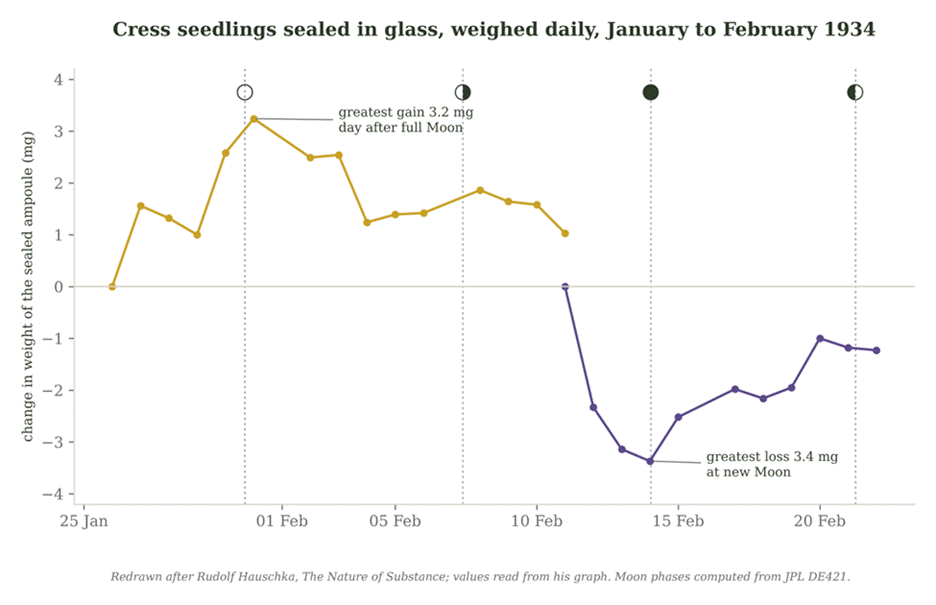
He then put the question to the balance. He sealed cress seeds and water in glass ampoules of 20 cubic centimeters and weighed them on a Kaiser and Sievers analytical balance reading to a hundredth of a milligram, against a counterweight vessel of equal volume, so that changes of air pressure, temperature and humidity cancelled out. The margin of error never exceeded a thousandth of a milligram, and each run lasted fourteen days. Nothing could enter or leave the ampoule, so its weight should have stayed constant. It rose and fell: “Increases and decreases in weight – or, to put it another way, the emergence and disappearance of matter – occurred in rhythmic sequences which proved the time factor to be the determining one.” His first pair of runs shows the pattern plainly (Figure 7). The run begun on January 26, 1934, spanned the full Moon of January 30 and reached its greatest gain, 3.2 milligrams or about half a percent of the weight of the seeds, on the 31st. The run begun on February 11 spanned the new Moon of February 14 and reached its greatest loss, 3.4 milligrams, on the 14th itself. Hauschka reports that from 1934 to 1940 every waxing Moon brought a gain and every waning Moon a loss, each test confirmed by two to four ampoules running side by side. He found the Moon’s rhythm “subservient to a stronger annual, or sun, rhythm,” with the swings coming to a standstill at midsummer, and the annual curves themselves governed by “a still greater rhythm” over the seven years.
Stephan Baumgartner re-examined the weighing experiments in 1992, working from Hauschka’s unpublished protocols, and repeated them himself. In his series a sealed glass of cress and water changed weight from day to day well beyond the spread of the measurements, while a control glass of silver nitrate and water beside it stayed constant (Baumgartner, 1992). Baumgartner made no claim beyond the reality of the effect, and the debate his study opened in Elemente der Naturwissenschaft continues.
In 1939 Hauschka turned from the weight of the seedlings to their minerals. Cress seeds from one batch, kept in a corked bottle, held a constant composition through repeated analyses: 24 milligrams of phosphoric acid per gram of seed, 18 of potash, 7 of calcium, 6 of magnesium, 6 of sulfuric acid and a tenth of a milligram of silicic acid. Seeds of the same batch were set to germinate in double-distilled water in bowls of rock crystal under bell jars, grown for fourteen days, then dried, burned and analyzed. No mineral came into contact with the seedlings and none was taken away. From June to December the phosphorus and potash rose and fell from fortnight to fortnight, phosphorus above the seed value at each full Moon and below it at each new Moon, potash in the opposite rhythm (Figure 8). “The emergence of these substances out of non-material states of being, as well as their disappearance from a material stage into an imponderable one, follows the rhythm of the moon phases.” Once in the half year each substance broke step, phosphorus in August and potash in September, and full Moon and new Moon exchanged their roles. Hauschka related this turning point to the Sun’s passage through the zodiac, so that the Moon’s rhythm carries the Sun’s yearly course within it.
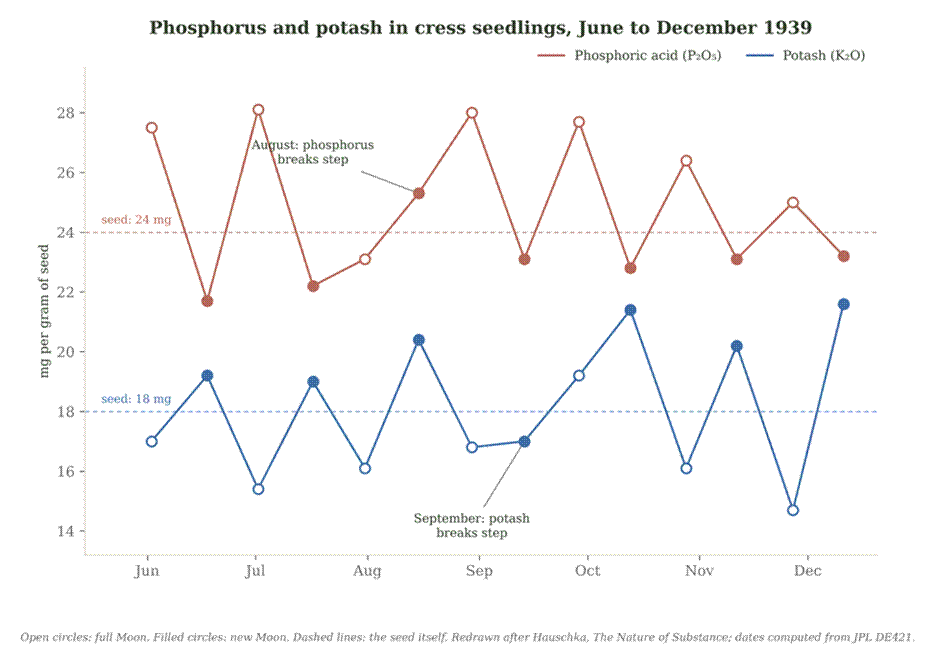
Hauschka called these results an interim report and promised a full account of the experiments later. He drew from them a conclusion that turns the usual picture of matter around: “Life overrides the law of the conservation of matter”, and “there is every reason to assume that matter is the precipitate of life.” In his chapter on silver, the metal of the Moon, he describes a tide in the plant to match the tide of the sea: “Plant growth is accompanied by a rhythmic increase and decrease of substances, a tidal emergence and disappearance of matter subject to a monthly rhythm.”
Here Hauschka’s balance meets Kranich’s root. Kranich places the root under the Moon, the body nearest the Earth. Hauschka found that the substance of the young plant waxes and wanes with the Moon, and that the Sun’s year and a still longer rhythm ride within the lunar one. Kolisko’s sowings grew largest when made two days before full Moon; Hauschka’s ampoules gained weight toward the full Moon and his seedlings gained phosphorus at the full. Two investigators, working with the measuring rod, the balance and the analysis of ash, record one lunar breathing in the germinating plant. In my reading the Moon is the gate through which the formative order of the heavens becomes earthly substance, and Hauschka’s figures show that gate opening and closing twice a month.
The Shoot: Earthly Image of the Sun
Above the root, the center shoot rises toward the light. Kranich calls it the earthly image of the Sun. In spring and early summer the growing tip of many herbaceous plants turns toward the Sun and follows its movement from morning to evening. The shoot grows most rapidly at night, when the Sun’s direct influence withdraws; the date palm grows only in darkness. Daylight restrains the stretching and brings form: the tissues differentiate, the stem strengthens, the leaves expand. In darkness a shoot keeps growing but loses form entirely, pale and elongated, “growth without form-expression.” The shoot is the product of day and night working in succession, the Sun’s formative light shaping what the night’s growth has stretched toward it.
The year shows the same relationship on a larger scale. In the northern hemisphere the earliest spring flowers have scarcely any shoot at all: the crocus keeps its shoot underground, the snowdrop and bluebell remain in the bud-like bulb, the coltsfoot and wood anemone push only short flower stalks up from a buried rhizome. As the Sun climbs toward midsummer the shoots lengthen, first in the buttercups and geraniums of May, then in the umbellifers and grasses of high summer. Among the buttercup family the species flower in a sequence from February to July, winter aconite to pasque flower and wood anemone, buttercup, larkspur and monkshood, the shoot growing taller with each step of the Sun’s ascent. The meadow saffron flowers as the Sun descends in autumn, with its shoot suppressed entirely, and forms shoot and leaves the following spring “along with the renewed ascent of the sun.” “There could hardly be a more impressive demonstration,” Kranich writes, “of the fact that the center shoot is the image of the sun’s movement and effects upon plant growth during the course of the year.”
This is the vertical tendency of Goethe and the upward-pressing force of Steiner’s 1924 description. Kranich adds that George Adams and Olive Whicher, working from projective geometry, arrived independently at a close connection between the growing point of the shoot and the Sun. We return to their work below.
The Leaf and Mercury
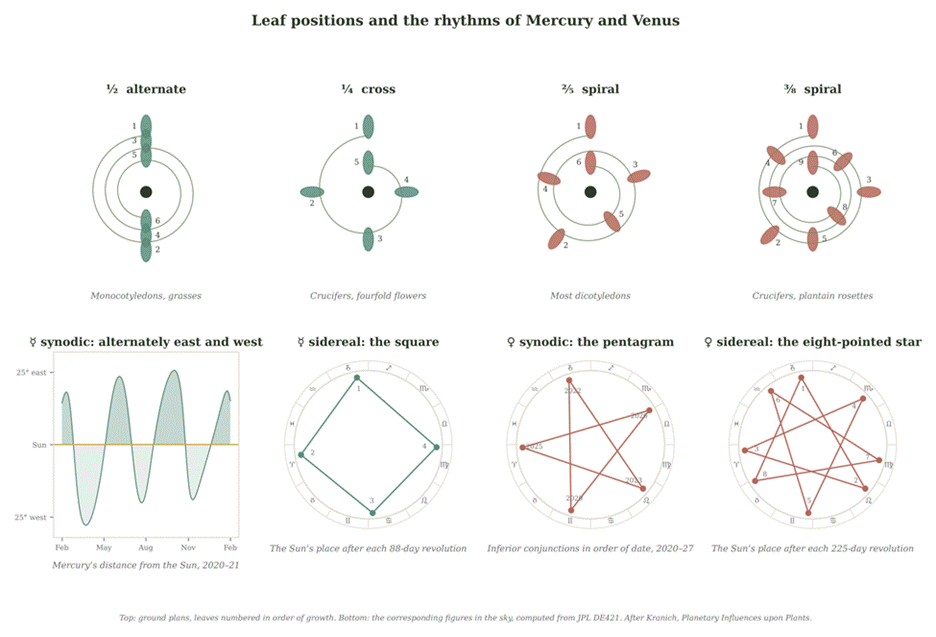
The leaves emerge from the shoot, and with them the spiral tendency begins. Kranich looks for the planet most intimately bound to the Sun, and finds Mercury. Seen from the Earth, Mercury never travels far from the Sun. After an upper conjunction, when it passes behind the Sun (astronomers call this the superior conjunction, and the passage in front the inferior), it moves eastward away from the Sun for about thirty-six days and appears briefly in the evening twilight, returns to pass between Earth and Sun in a lower conjunction, reappears in the morning sky, and returns again. One such synodic cycle lasts 116 days, so Mercury completes three in a year, with six conjunctions with the Sun, three in front of it and three behind. “These six conjunctions,” Kranich writes, “mark the corners of a hexagon formed by the sun and Mercury” (Figure 9).
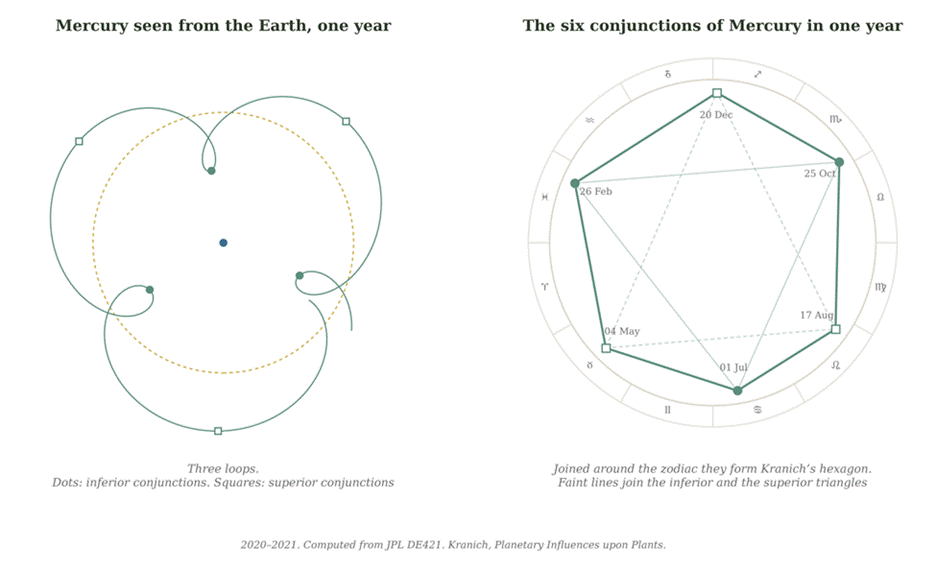
At the growing point the leaf primordia appear as small swellings at the side of the shoot tip, grow outward, and bend over the apex, much as Mercury emerges from the Sun’s path, moves away from it, and returns to cross it. In the monocotyledons, the parallel-veined leaves of tulips, lilies and orchids rise directly from the stem without a stalk and stand alternately on two opposite sides, a one-half arrangement. Mercury likewise appears alternately to the east and west of the Sun. Kranich derives the alternate (1/2) leaf position from Mercury’s synodic rhythm and the cross-wise, decussate (1/4) arrangement from its sidereal rhythm of 88 days.
The dicotyledons add an organ that most monocotyledons lack: the petiole, or leaf-stalk. In a dicotyledon the upper part of the young leaf divides into the blade and the petiole, and the petiole carries the blade out into the space around the shoot, where the blade spreads from its midrib through its pinnate veins. Kranich sees a second planet at work here. The leaf belongs by type to Mercury, and in many dicotyledons Venus carries it further: “the leaf-form of dicotyledons expresses Venus’ gesture: the movement farther away from the sun in the development of the petiole and the stronger relationship to the periphery of the sun’s sphere in the pinnately veined structure of the leaf blade.” His diagram of the two spheres sets the monocotyledon leaf directly on the shoot, as Mercury keeps close to the Sun, and the dicotyledon leaf in a sphere separated from the shoot by an intermediary region, as Venus circles farther out. The Norway maple shows the same gesture in a whole tree. Its long petioles carry the leaves out to the tips of the branches, where the palmately lobed blades fill the surrounding space, and Kranich concludes that “the length of the petiole (carrying the leaf to the periphery) and the leaf shape (connecting with the surrounding space) belong together.”
Mercury also mediates between the Sun and the Moon. During one synodic cycle of Mercury the Moon completes almost exactly four of its own (4 × 29.5 = 118 days), and the difference between Mercury’s sidereal and synodic periods corresponds to about one sidereal month. The leaf performs the same mediation in living substance. It lives in the light-filled atmosphere, drawing in carbon dioxide and receiving the Sun’s light, while water rising from the root, the Moon’s organ, flows into it through the veins. “As Mercury unites within itself the rhythms of the sun and moon, so the leaf unites the gaseous carbon dioxide and sunlight with water into the most original source of living substance.” Kranich calls this life process, “like the leaf itself, the manifestation of Mercury.” The Moon’s own rhythm shows through as well: the leaves of the sweet flag appear at intervals of seven days, a quarter of the lunar month.
Olive Whicher and George Adams studied the same region of the plant through projective geometry. In The Plant Between Sun and Earth they describe the hollow space at the tip of the growing shoot, hidden among the young enfolding leaves. “Within the hollow space enveloped by the young leaves, there is the all-relating point, the inner infinitude of a sun-space” (Adams and Whicher). The plant forms its own small Sun-space at the growing point, related to the great Sun-space of the heavens. The leaves that unfold from it are the plant’s planes, turned out toward the periphery from which light comes.
Buds That Keep Time: Lawrence Edwards
The leaf in its most contracted state is the bud, and here a second line of research joins Kranich’s. Lawrence Edwards was a teacher of mathematics who took up the projective geometry of George Adams and spent decades applying it to living forms. He found that the outlines of eggs, of many leaf and flower buds, of pine cones and of the human heart follow a family of curves known in projective geometry as path curves, the curves traced by points under a repeated transformation of space. Each such form can be described with great accuracy by a single number, which Edwards called lambda (λ). Lambda is the ratio of the logarithms of the two “multipliers” that govern the movement along two sides of the invariant figure of the transformation (Edwards, The Vortex of Life). A bud with a high lambda is sharp at the tip and broad at the base; a lambda of 1 gives a form equal at both ends. Measured carefully from a photograph, a good bud matches its path curve to within one or two percent of its radius, and the best, like the wild roses Edwards first measured, to little more than half a percent.
In the autumn of 1982, working in the Scottish Highlands, Edwards set out to see whether the shape of a single bud changed over time. He strapped individual leaf buds to small strips of Perspex left hanging on the tree, built a wooden frame that held his camera at exactly the same point of view each day, and photographed the same bud every morning through the winter. In choosing his trees he took a hint from Rudolf Steiner, who had given a set of correspondences between trees and planets: Sun with ash, Moon with cherry, Mercury with elm, Venus with birch, Mars with oak, Jupiter with maple and sycamore, Saturn with hornbeam, beech and the conifers. Edwards wrote that at the time he “had no knowledge of what the detailed connection could be, or that any connection would be found at all,” and that Steiner’s suggestions “certainly heightened the interest of the search.” He chose ash, cherry, elm, oak and beech.
The oak gave the clearest result. Its lambda value dropped below 2.1 at two-weekly intervals and, with one exception, at no other time. “On consulting an ephemeris one finds that these were the times, to the day, when the Moon and Mars had drawn into straight line with the Earth.” The bud showed no preference between conjunction and opposition, so Edwards called both by one name, alignment (Figure 10). Every fortnight, as the Moon passed the line between Earth and Mars on one side of the sky or the other, the oak bud made “a subtle gesture which takes it a little way towards opening and almost immediately closing again.” The cherry, Steiner’s Moon tree, showed a fourteen-day rhythm of its own, with its lambda rising to a peak at every new and full Moon, the alignments of Moon and Sun. The beech and elm results that first winter were consistent with Saturn and Mercury, but Edwards judged them too uncertain to count. He re-measured all his negatives in random order, blind to their dates, and accepted only the oak and cherry as firm.
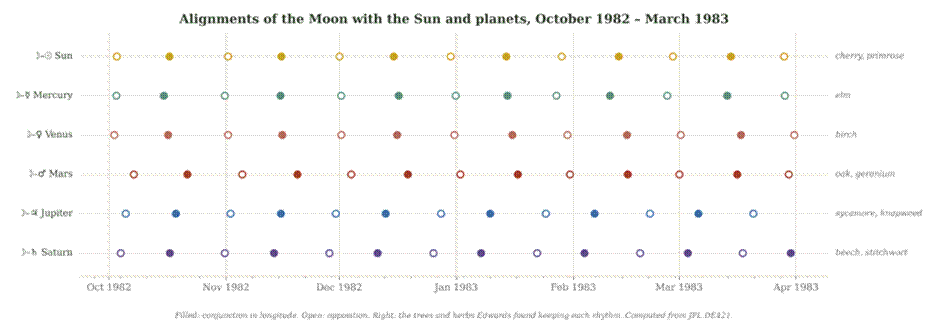
Over the following years he widened the work to flower buds, picking ten buds a day at the exact moment the colored petals begin to push through the green sepals, and plotting the daily mean. The primrose dipped at the alignments of Sun and Moon, new Moon and full Moon. In the winter of 1983 to 1984 he reduced the question to its simplest form for the beech: is its lambda lower when the Moon stands in line with Saturn than when it stands at right angles to it? He measured ten buds from the same branch each week at both positions. Every one of the weekly differences that winter came out in favor of the alignment; a second beech fifty yards away gave nineteen positive differences out of twenty, and an oak tested against Moon and Mars gave sixteen out of seventeen. That same winter he ran shorter series on three more of Steiner’s trees: the ash against the Sun, eight differences, all positive; the elm against Mercury, five positive out of six; and the birch against Venus, seven positive out of eight. He called this “definite, if preliminary, evidence.” Over the following seasons the birch followed the Moon and Venus, the sycamore and the knapweed the Moon and Jupiter, the geranium the Moon and Mars, and the stitchwort, like the beech, the Moon and Saturn. With the cherry and the Moon, the oak and Mars, the sycamore and Jupiter and the beech and Saturn, every one of Steiner’s seven pairings of tree and planet has a result in Edwards’ record. Each species keeps its own appointment with one planet, and the Moon carries the message to all of them.
“The plant-life, covering a given region of the Earth, is a kind of sense-organ, sensitive to all that is revealed towards the Earth out of the Cosmos. At seasons when the interplay is more intense between a portion of the Earth’s surface and the Universe, it is as though a human being were opening his eyes to the outer world to receive sense-impressions.”
—Rudolf Steiner, Interdisciplinary Astronomy, lecture of 3 January 1921
Edwards’ results run as a thread through the rest of Goethe’s sequence. They give a measured, day-by-day confirmation of what Kranich read from form: the plant responds to the planetary world as it appears from the Earth, and the Moon, standing nearest, mediates between the planets and the living plant. The alignment rhythm still awaits replication in other species by other hands. Edwards’ method has meanwhile entered peer-reviewed botany: Renatus Derbidge, Stephan Baumgartner and Peter Heusser fitted the outlines of mistletoe berries with his path-curve function and used lambda to record a rhythmic change of shape in the living berry (Derbidge et al., 2016).
Calyx and Corolla: Venus
After the stem leaves, Goethe’s sequence contracts into the calyx and expands again into the corolla. Here the plant rises above vegetative life. The upper leaves shrink, the green gives way to color, and the flower turns toward the Sun. Kranich notes that flowering is tied to the length of day far more closely than growth is: plants from the tropics will form shoots and leaves in a temperate garden for years and never flower, because flowering waits on the Sun’s rhythm proper to their latitude. The perianth in its whole gesture, he writes, “shows that the plant is elevated above the sun’s influence on the earthly shoot.”
Kranich first reads the simpler flowers of the monocotyledons, the tulip, lily, iris and gladiolus, with six perianth members in two circles of three. These answer to Mercury, which completes three synodic cycles in a year and moves out from the Sun six times. After its three upper conjunctions Mercury moves slowly toward the Earth, and after its three lower conjunctions it pulls swiftly away toward the Sun’s sphere; correspondingly the three outer members sit lower and keep the character of green leaves, while the three inner ones stand higher and open more strongly into space. The iris shows the contrast most clearly, its three outer falls turning down toward the Earth and its three standards rising upward.
The flower of the dicotyledons answers to Venus. Like Mercury it circles the Sun and returns to it, but it travels much farther out into the periphery of the Sun’s sphere and shines far more brightly, as evening star and morning star. Its synodic cycle of 584 days extends beyond the year, equal to about one and three-fifths years. Five synodic cycles take eight years almost exactly (5 × 584 = 2,920 days; 8 × 365.25 = 2,922). After those eight years Venus returns to nearly the same place in the zodiac, and its five conjunctions with the Sun have traced a pentagram around the sky. “This pentagram,” Kranich writes, “appears briefly in the blossom of the dicotyledons” (Figure 11).
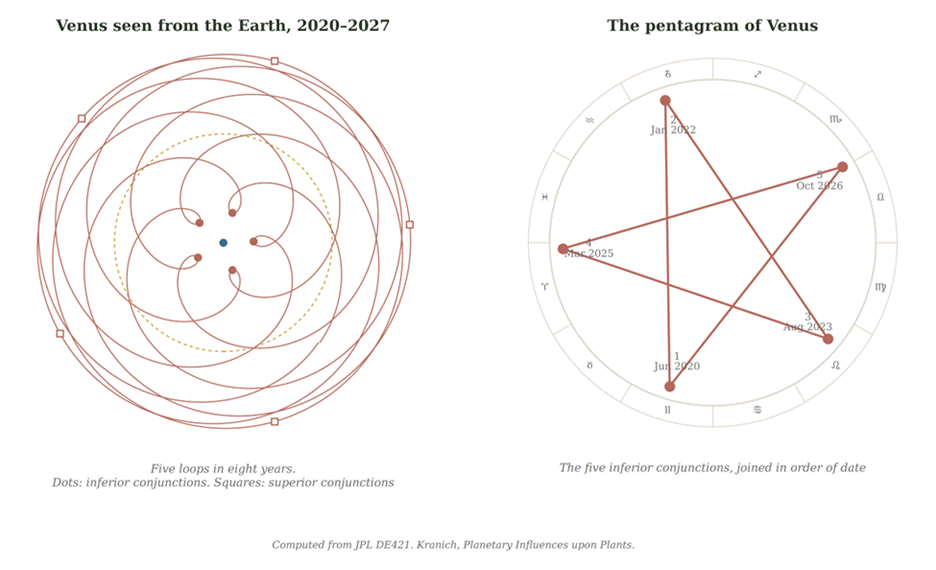
The flowers of the dicotyledons are built on five: five sepals, five petals, and often five or ten stamens and a five-chambered ovary, as anyone sees who cuts an apple across its core. Kranich reads the details closely. After each upper conjunction Venus moves slowly eastward into the evening sky for more than seven months; after each lower conjunction it moves swiftly westward as morning star and reaches its greatest brilliance within a few weeks. In eight years it moves out from the Sun ten times, five slowly and five swiftly. He sees the five sepals as the image of the slow movements and the five petals as the image of the swift ones: “The calyx of the double perianth in dicotyledons appears as the image of the slow movement of Venus away from the sun’s sphere after the upper conjunctions. In the five petals, the image of the much swifter movement of Venus away from the sun after the lower conjunctions is revealed.” The green, narrow sepals still carry the leaf character of Mercury; the petals, broad, colored, opening wide from the receptacle, express Venus fully. “Only in the corollas of the dicotyledons is perfect flowering achieved. Here Venus manifests itself perfectly in the plant.”
The spiral arrangement of leaves on the dicotyledon stem follows the same planet. Kranich derives the common two-fifths arrangement, in which five leaves complete two turns of the spiral, from the synodic Venus rhythm, and the three-eighths arrangement from its sidereal rhythm of 225 days (Figure 12). The first terms of the series botanists record in leaf positions, 1/2, 1/3, 2/5 and 3/8, appear here as signatures of Mercury and Venus. Venus holds three numbers of the series in a single rhythm: its five synodic cycles and its thirteen sidereal revolutions (13 × 224.7 = 2,921 days) fill the same eight years. The higher terms Kranich leaves open. Joachim Schultz tried to connect 5/13 with Jupiter and 8/21 with Saturn, and Kranich reports Schultz’s own judgment that the connection “can hardly be illustrated.”
“Some day men will study the connection of the spiral growth of the plants with the movements of the planets and then they will feel the kinship of the kingdoms of the Earth with the kingdoms of Heaven. Everything in the external world is a parable, a symbol; the laws of the growth of plants symbolize the movements of the planets, and these in turn are symbols of something even more sublime — deeds of spiritual Beings in the Cosmos.”
—Rudolf Steiner, lecture of 7 May 1912, Cologne
Steiner described the colors of flowers in planetary terms in the second lecture of the Agriculture Course: “Thus we can recognise Mars in the red flower, Jupiter in the yellow or white, Saturn in the blue, while in the green leaf we see essentially the Sun itself” (GA 327, Lecture 2, 10 June 1924). Lilly Kolisko took that indication into the laboratory, as we will see under Jupiter.
Among Edwards’ trees, the birch kept time with the alignments of Moon and Venus. Venus moves far enough from the Sun at times to separate the two rhythms, and on those occasions the birch dips always followed Venus. Edwards wrote that this, “combined with Rudolf Steiner’s intuition on the matter, gives me fair confidence that the birch and Venus are truly linked.”
Stamens, Pistil and Pollination: Mars and the Moon
Goethe’s next contraction draws the corolla into the stamens and the pistil, which he recognized as standing at the same stage of development. Kranich treats them as polar organs. The stamens carry their anthers outward on fine filaments and release pollen into the surrounding space. The pistil gathers several leaves together into a closed ovary, isolating a space of its own in which the ovules can form, and opens to the surrounding world only through the stigma.
In the ovary Kranich sees the Moon working on the forces of the Sun and Mercury. The Moon reflects the Sun’s light from every region of the zodiac back to the Earth, and so encloses the Earth in a sphere of reflected sunlight. The leaves that close together into the ovary turn away from their normal connection with the Sun and form an enclosed space, as the Moon forms one around the Earth. “The ovary appears as the influence of the sun and Mercury, isolated by the moon into a space of its own.”
The stamens answer to Mars. Of all the planets Mars has the longest synodic cycle, two years and fifty days on average. After its conjunction with the Sun it moves slowly out into the periphery of the Sun’s sphere, and a little over a year later it stands opposite the Sun, deep inside the Sun’s sphere, at its nearest approach to the Earth. Kranich draws the correspondence precisely: “Between the sun and Mars lies the moon’s sphere, as the ovary lies between the receptacle and the anthers in the open blossom. The filaments during their development are the image of Mars’ movement away from the sun after the conjunction.” After opposition, Mars moves back out into space, far beyond the Sun’s sphere, and Kranich sees that great expansion in the pollen carried away beyond shoot, leaf and flower. At the next conjunction the Sun stands between the Moon’s sphere and Mars, as the stigma stands above the ovary, and the meeting of Sun and Mars corresponds to pollination. Mars, which dips into the Sun’s sphere at opposition and then encloses it, mediates between the near planets and the far planets, as pollination mediates between the flower and the fruit.
Steiner gave the oak to Mars, and in the first lecture of the Agriculture Course he spoke of the oak in the same terms: “for an oak, rightly planted in the proper Mars-period, will thrive differently from one that is planted in the Earth thoughtlessly, just when it happens to suit” (GA 327, Lecture 1, 7 June 1924). Edwards’ oak buds followed the alignments of Moon and Mars from his first winter onward. Over many seasons he measured the mean period between dips in the oak at 14.29 days. The mean period between Moon–Mars alignments is 14.23 days, and 14.15 days once the phase-shift described below is taken into account. On either reckoning the oak stands nearer the Mars period than any other. The geranium, a herb with deep red-violet petals, followed Mars as well, with a period of 14.38 days (Edwards).
The Far Planets and the Five Spheres
With pollination the plant passes out of the Sun’s immediate sphere, and Kranich pauses at this point in his sequence to look at the planetary system as a whole. Mercury and Venus belong to the Sun; they circle it and never move to the opposite side of the sky. Mars, Jupiter and Saturn move outside the Sun’s sphere, enclose both Sun and Earth, and stand in opposition to the Sun. Mars only partly encloses the Sun’s sphere, dipping into it for a few months around opposition. Jupiter, with a sidereal period of 11.86 years, moves through about one sign of the zodiac each year and so links the Sun’s annual course with the zodiac. Saturn, with a sidereal period of 29.46 years, remains about two and a half years in each sign. Five circuits of Jupiter take almost exactly as long as two of Saturn.
From these phenomena Kranich builds out the two-centered order introduced earlier. He counts five spheres: the Earth as center of Moon and Sun; the Moon’s sphere, mediating between Sun and Earth; the Sun and its sphere as center of the planetary orbits; Mercury and Venus revolving around the Sun; and Mars, Jupiter and Saturn enclosing them all. This is the system Tycho Brahe published in 1588, set aside in the century that followed in favor of Kepler’s ellipses around a central Sun.
The Tychonic system and the Copernican system describe the same relative motions. They differ in their point of reference, and the point of reference is exactly what matters to a living plant. A plant on the Earth receives the Sun rising and setting over the Earth’s horizon, the Moon waxing and waning in the Earth’s sky, Mercury and Venus swinging out from the Sun and returning, Mars, Jupiter and Saturn tracing their retrograde loops against the stars. Those loops are the planets’ actual paths as the Earth experiences them. The geocentric path of Venus over eight years forms a five-petaled rosette; Mercury draws three loops a year; Jupiter forms about eleven loops in its twelve-year circuit and Saturn about twenty-eight in its twenty-nine and a half. The plant takes its form from these appearances. Here my own synthesis goes one step beyond Kranich’s wording. The archetypal plant Goethe sought is the Tychonic system, the apparent solar system of Earth, translated into the sequence of a living organism; the loops, rosettes and stations of the planets as seen from the ground are the forms the plant transposes into stem, leaf, flower, fruit and seed. The Urpflanze is the heavens as they appear from where the plant stands.
Fruit and Jupiter
After fertilization the plant makes what Goethe called its last and greatest expansion. The ovary swells into fruit, often to many times its size, and Kranich points to the manner of this growth. Most organs grow by forming new cells. The fruit grows mainly by the expansion of cells already present, and in many fruits it expands evenly in all directions into the surrounding space: berries, apples and peaches, poppy capsules, the dandelion clock, the spherical heads of the plane tree. The ovary was a contraction into isolation; the fruit is an expansion into space.
The planet that corresponds is Jupiter, outside the Sun’s sphere and linked to the Sun’s course by its twelve-year circuit. Kranich calls Jupiter the counter-image of the Moon with respect to the Sun. The Moon, inside the Sun’s sphere, completes twelve synodic months in a year and reflects the Sun’s light successively from all twelve regions of the zodiac. Jupiter, outside it, moves through one-twelfth of the zodiac in a year and “during one sidereal revolution reflects the light of twelve sun-cycles successively through the twelve regions of the zodiac.” The Moon leads the Sun’s influences into isolation in the ovary; Jupiter carries them out into space through the fruit. “Jupiter imprints its character upon the ovary, and during the formation of the fruit expands it greatly in all directions into the surrounding space.” Kranich adds that the maturing fruit takes in more oxygen than any other organ and develops warmth from within, which carries it beyond the green life of the plant into a state of rest and independence.
Steiner gave the same relationship in the plainest possible form: “In the apple you are eating Jupiter, in the plum you are actually eating Saturn” (GA 327, Lecture 2). He also assigned yellow and white flowers to Jupiter and remarked that the sunflower would be better called a Jupiter flower. Lilly Kolisko tested this. Tin has been the metal of Jupiter throughout the alchemical tradition, and she had already published her experiments on Jupiter’s influence on tin solutions in Jupiter and Tin (1932). In 1928 she began germinating sunflower seeds in dishes of the seven metals. The seeds on tin germinated first, within twenty-four hours. In the following years she grew sunflowers from seeds soaked in potencies of the seven metal salts from the first to the sixtieth, five plants to each potency and three hundred to each series. Tin chloride gave the tallest plants, 3.97 meters against 2.75 meters for the water controls; quicksilver came second in height, but its plants had thin, brittle stems that snapped like glass, while the tin plants stood sturdy and flexible. Gold chloride, the metal of the Sun, gave the weakest growth of all the metals. “Gold, as the earthly representative of the Sun, has the worst effect on this plant, and Tin, the representative of Jupiter, has the best.” In a further test, sunflower seeds germinated at a conjunction of Jupiter and the Moon outgrew those germinated at the opposition, 2.50 meters against 1.50 meters, and 3.60 against 2.70 among the tin-treated plants. Maple seedlings, Steiner’s Jupiter tree, likewise favored tin, which gave the young trees a well-formed crown and healthy growth (Kolisko).
Joachim Schultz, whose planetary diagrams Kranich used throughout his book, found a Jupiter rhythm in the forest: the years of heavy seed production in the red beech coincided with particular positions of Jupiter in the zodiac (Kranich). Among Edwards’ species, the knapweed, a composite whose flower heads open into a radiating disk, followed the alignments of Moon and Jupiter with a period of 13.87 days (Edwards).
Seed and Saturn
Within the fruit the seed forms, and Goethe’s sequence reaches its greatest contraction. The seed dries, often to a water content of about a tenth of its weight, and hardens its coat. Inside lies a complete plant in miniature: radicle, hypocotyl and cotyledons, enclosed in endosperm and seed coat. Kranich sees in the embryo the image of the Sun and Mercury isolated by the Moon, held in nested layers as the Earth is held within the spheres of Moon, Mercury and Sun. With the seed, the plant becomes a self-contained organism, able to wait through the winter independent of the moisture and growth that bound it to the soil.
This leads to the outermost planet of the visible system. Saturn takes 29.46 years to circle the zodiac and forms, as Kranich puts it, the boundary of the region directly ruled by the Sun. He draws a proportion: Saturn takes as many years for its circuit as the Moon takes days for its own, and its relation to the Sun’s year matches the Moon’s relation to the Earth’s day. Kranich sets Saturn’s years beside the Moon’s sidereal revolution of 27.32 days; I find the match closer with the synodic month of 29.53 days, the interval from new Moon to new Moon. As the Moon creates a sphere of isolation around the Earth within the Sun’s sphere, Saturn encloses the whole planetary world of the Sun against the universe beyond: “Saturn encloses in its own cosmic sphere the planetary world of the sun’s sphere, as opposed to the universe beyond that sphere, just as the plant through the development of the seed becomes a unified organism as opposed to the sphere of life outside it.” The seed forms under warmth that drives out moisture, and Saturn has been associated with warmth in Steiner’s cosmology from the first stage of the Earth’s evolution.
Steiner connected Saturn with the perennial plants: “We see what Saturn does with the help of the warmth-forces of our Earth, whenever the perennial plants arise” (GA 327, Lecture 1). In his tree list he gave Saturn the hornbeam, the beech and the conifers. Kranich found Saturn in the form of the conifers. Edwards’ longest and best series of measurements came from the beech. From many thousands of observations he found the mean period between dips in the beech curve to be 13.60 days. The mean period between alignments of Moon and Saturn is 13.70 days, and 13.61 days once the seven-year phase-shift described below is taken into account. The stitchwort, a small white-flowered herb of the hedgerows, followed Saturn too.
The seed falls, rests, absorbs water, and the radicle turns downward into the Earth. The sequence has returned to its beginning, and the Moon receives it again.
The Archetypal Plant Itself
Kranich summarizes the whole sequence in a table, which reads from the bottom upward as the plant grows. Figure 13 draws his table on the plant.
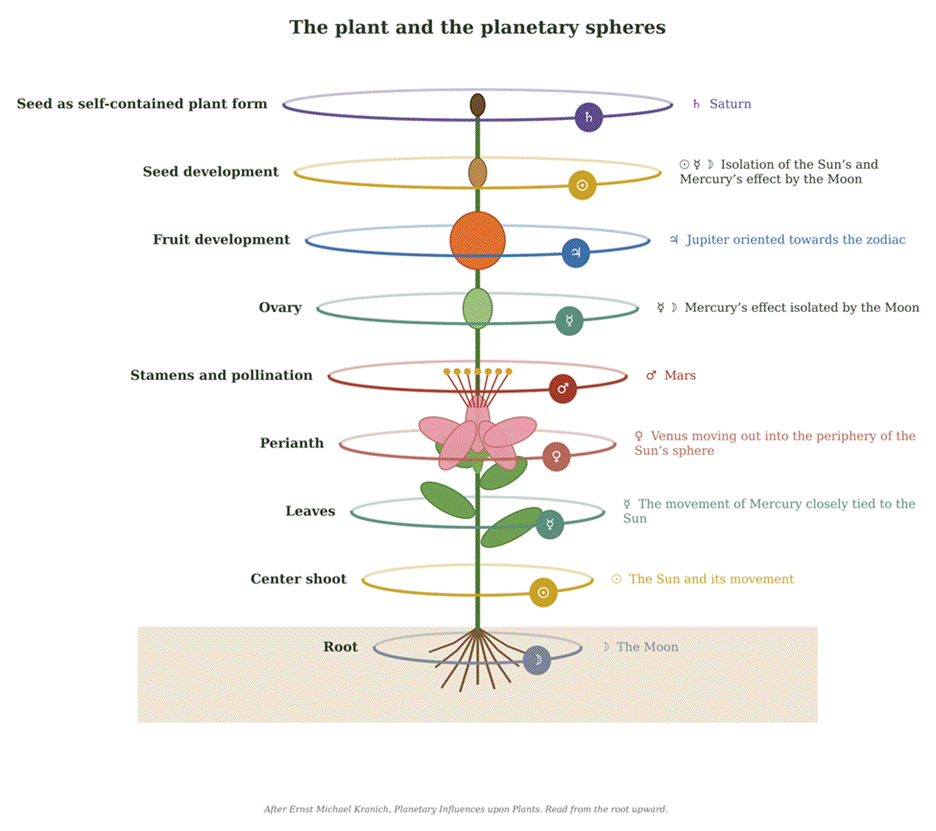
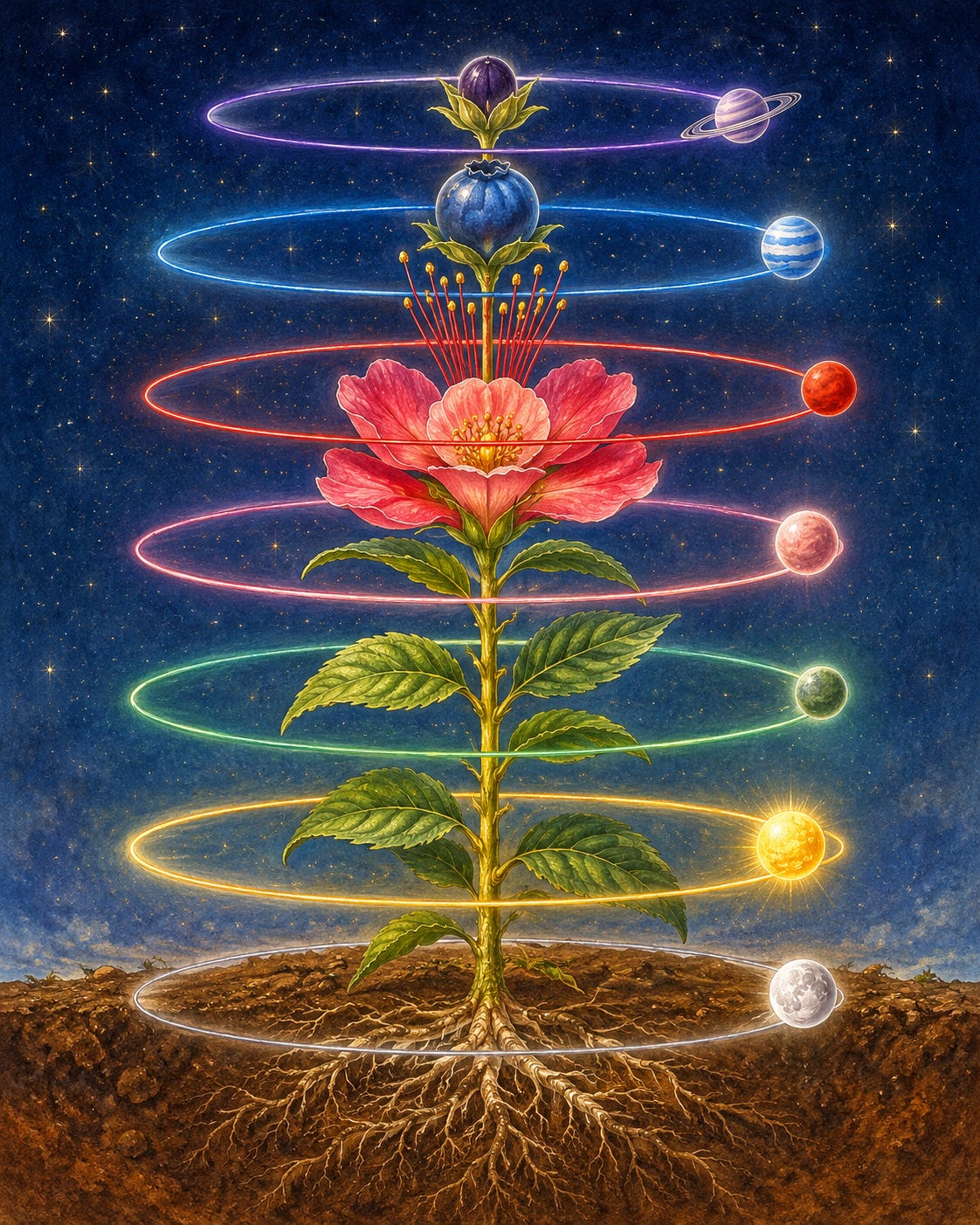
He then states his conclusion: “The sun and moon together with the so-called near planets (Mercury and Venus) and the far planets (Mars, Jupiter and Saturn) compose that factual relationship which is the source of the archetypal plant, or which is the archetypal plant itself. The plant patterns the stages of its metamorphosis on the sequence in which the planetary spheres arrange themselves around the earth.” First the Moon with its swift rhythm, then Mercury and the Sun, then Venus, Mars, Jupiter and Saturn with their ever longer periods, each organ taking its gesture from the sphere that corresponds to it (Figure 14).
Goethe placed the archetype before his own eyes and Schiller called it an idea. Kranich’s answer reconciles them. The archetypal plant is an idea in the full Goethean sense, a law that can be seen, and its visible counterpart stands overhead every night. Each plant is a particular expression of it, with the planetary voices sounding in different strengths. Kranich closes his book on that image: “We experience the individual plant as a mighty musical chord in which the individual notes resound in changing rhythms and intensities.”
Mercury, Venus and the Two Classes of Flowering Plants
The archetype never appears whole in a single species. “The archetypal plant does not appear completely in any plant species; however, it appears in specific, one-sided form expressions,” and the first division of those expressions is into the two classes of the monocotyledons and the dicotyledons (Kranich). Kranich reads the division from the two planets that circle the Sun inside the Earth’s orbit: “The dominant cosmic principle in the monocotyledons is Mercury; in the dicotyledons, it is Venus.”
The monocotyledons keep everything close to the shoot. Their parallel-veined leaves usually rise straight from the stem, their flowers sit close to the central axis in spikes, racemes and simple umbels, and their perianth parts stay narrow even in the lilies and gladioli. Kranich sees in this Mercury’s close attachment to the Sun. The monocotyledons also lean toward the Moon. Their primary root dies soon after germination and roots grow instead from the base of the shoot, and the same tendency produces the bulbs and underground stems of the tulip, the snowdrop, the iris and Solomon’s seal. The dicotyledons carry their leaves out on stalks, spread their flowers in branching inflorescences, and open broad petals into the surrounding space, as Venus moves out to the periphery of the Sun’s sphere. “The dicotyledons are oriented towards the outer regions of the universe by the forces from Venus, as the monocotyledons are oriented towards the earth through the moon.” The synodic cycle of Venus runs longer than the year, and Kranich relates this to the many dicotyledons that live as perennials, shrubs and trees. The monocotyledons remain, with few exceptions such as the palms, herbaceous plants bound to the yearly course of the Sun.
Kranich also traces four levels in the development of the corolla. At the first, as in the water lily or the magnolia, numerous petals crowd in spirals around the receptacle. At the second, the simple sixfold perianth of the monocotyledons takes a strict, ordered form. At the third, the dicotyledons separate a calyx from the corolla and open five free petals. At the fourth, in the bindweeds, gentians and bellflowers, the petals join into one corolla, and Kranich sees in this enclosing form the influence of the far planets, which surround the Sun’s sphere and Venus with it.
Botanical classification has moved since Kranich wrote, and the newer picture sharpens his correspondences. Molecular phylogenetics confirms the monocotyledons as one natural lineage. Kranich’s dicotyledons divide into the eudicots, about three quarters of all flowering plants, and a few older lineages that branched off earlier, the water lilies and the magnolias among them. Within the eudicots, the clade named Pentapetalae holds about seventy percent of living flowering plants, and its flowers follow a conserved plan of five-parted whorls; the early-branching eudicots, the buttercup and poppy lineage among them, show a more variable perianth in twos and threes (Soltis et al., 2003). In current terms the fivefold Venus flower belongs above all to the Pentapetalae, and the fused corolla of Kranich’s fourth level characterizes the asterids, the clade that culminates in the composites. One much-debated reconstruction of the first flower points the same way. Hervé Sauquet and thirty-five colleagues, working from the largest data set of floral traits yet assembled, reconstructed the ancestral flower of the flowering plants with more than two whorls of three undifferentiated tepals and more than two whorls of three stamens (Sauquet et al., 2017). Dmitry Sokoloff and colleagues have questioned its combination of whorled perianth and spiral carpels, and the debate continues (Sokoloff et al., 2018). The reconstruction places whorls of three at that origin, where Kranich’s first level describes spirals. Read in Kranich’s terms, the threefold signature of Mercury stands at the origin of the flowering plants, and the fivefold signature of Venus arises later in their history.
Growth Forms and Plant Families
The archetype sounds through every flowering plant, and each growth form lets one or two of its members sound loudest. Kranich devotes the second half of his book to this, and his summary can be given briefly.
The annual herb lives within a single course of the Sun. It germinates, grows, flowers and seeds as the Sun rises and falls through the year, and its form falls predominantly under the influence of the Sun and Mercury. Annuals thrive in deserts and steppes, where the Sun works most strongly on earthly life. The biennials stretch their development across two years. In the first year the Sun’s upward force is held back: the plant forms a ground-hugging rosette and a thick root, as cabbage, carrot and mullein do. In the second year the shoot rises with tremendous force and flowers. Kranich finds in this rhythm the two-year synodic cycle of Mars, which moves against the Sun toward opposition in one year and then rejoins it, so that the biennials are “form expressions of the Sun-Mercury-Venus-sphere modified by Mars.” The perennial herbs form renewal buds and carry their life through the winter under bud scales, which enclose an isolated space of moderated sunlight as the Moon’s sphere encloses the Earth. At the winter solstice the full Moon stands as high in the sky as the midsummer Sun, and the buds then lie in their deepest rest. “The moon parallels the perennials, as it carries the life from one year through the winter dormancy into the following year.”
In the trees the far planets take over. The deciduous tree spreads its crown in all directions from the trunk, as Jupiter directs the forces radiating from the Sun, and it builds its characteristic form over roughly one Jupiter circuit. “The deciduous tree stands as a powerful expression of Jupiter in the plant. During the development and maturation of the fruit in herbaceous plants, Jupiter manifests itself in one particular plant organ; in trees, it takes over the entire development.” The umbellifers carry the same gesture among the herbs, with their branching shoots, finely divided leaves and radiating umbels. The conifers stand apart from the Sun’s yearly rhythm, green through the winter, their growth inhibited and their substance dried by warmth into resin and wood. Free-standing firs and spruces usually grow vegetatively for about thirty years, one Saturn period, before they form cones, and the scale leaves of the araucarias live for thirty years. “Thus the image of Saturn in the plant kingdom is seen in the entire conifer.” The shrubs, with their arching first-year canes that rise from the center and bend back to root in the ground, as in blackberry, rose and elder, carry the full dynamic of Mars.
Plant Families as Expressions of the Planets
In the last part of his book Kranich reads seven plant families of Central Europe as particular expressions of the archetype, each with one planetary influence predominant, and he draws the result as a single diagram. Figure 15 redraws it, and Figures 15a to 15g show a member of each family. The grasses stand alone on the monocotyledon side. The six dicotyledon families run from the Moon through Mercury and Venus to the comprehensive rose family, and on to Jupiter and the far planets.
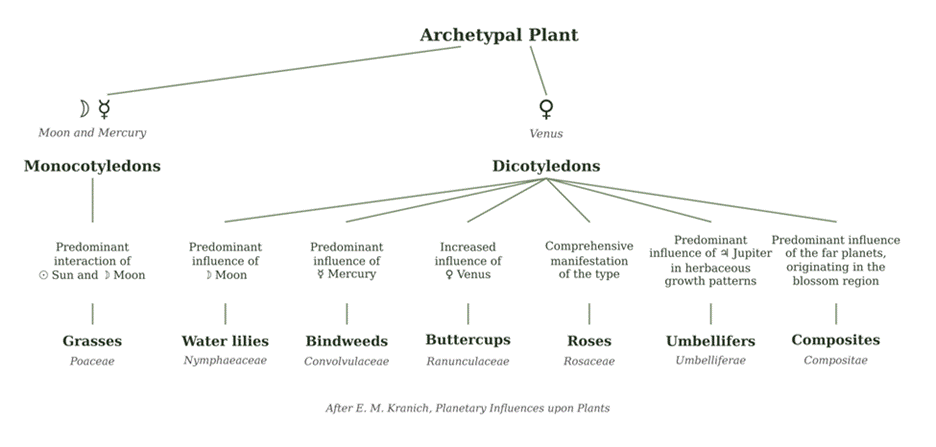
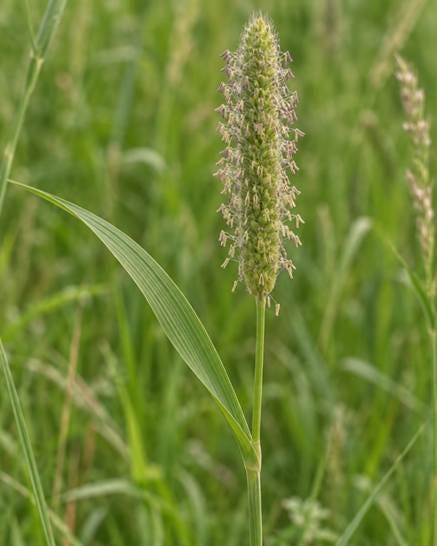
Grasses (Poaceae). Predominant interaction of Sun and Moon. The grass blade wraps the stem as the scales of a bulb wrap the bud, a lunar form imprinted with the Sun’s upward growth. “The grass blade is the reflection of a peculiar interaction of the moon and the sun in the region of the green plant.” “The grasses are a reflection of the moon, the sun and Mercury, even into their flowering sections. Venus is not represented at all here.”
Water lilies (Nymphaeaceae). Predominant influence of the Moon. Leaves and flowers rise from the water, the earthly reflection of the Moon’s sphere, and the fruit ripens back under water. “The water lilies, then, do not flower from the region of the sun in the plant, but from the region of the moon.” They are “a plant type that is dominated by the moon down to the minutest detail.”

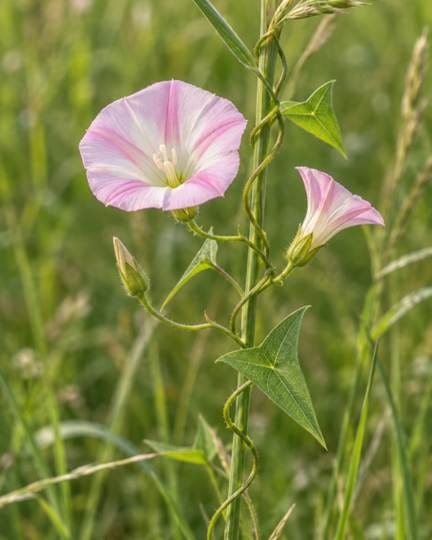
Bindweeds (Convolvulaceae). Predominant influence of Mercury. The weak, winding stems carry leaves and flowers from the leaf axils and end in no inflorescence, because Mercury governs the stem in place of the Sun. “The entire plant at first develops under the moon’s influence and only from there expands into the higher region of Mercury-related development.”
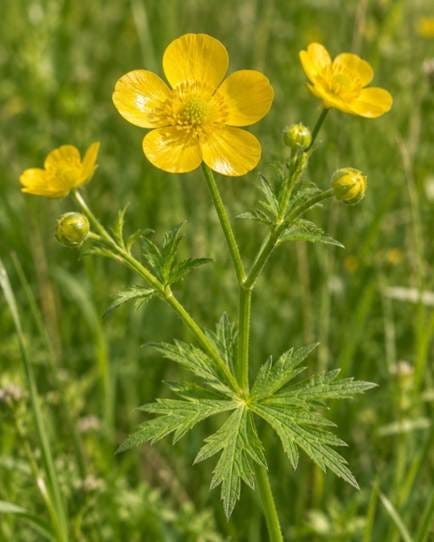
Buttercups (Ranunculaceae). Increased influence of Venus. A family of great variability, moving through the year from the Moon-bound Christmas rose to the open buttercup and pheasant’s eye. “Venus transforms a blossom, which according to its type has only a simple perianth, in such a way that from its organs a calyx and corolla develop.” The family is “a manysided expression of Venus and its relationship with Mercury.”
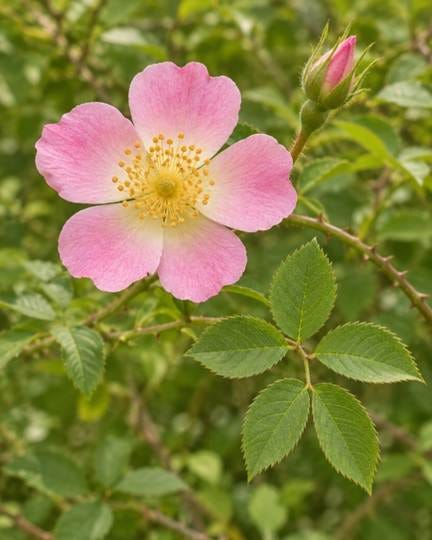
Roses (Rosaceae). Comprehensive manifestation of the type. The family “does not limit itself to one particular area of development or pattern of growth, but instead it develops comprehensively. It is a universal plant type.” Its herbs develop “in a nearly archetypal way, according to planetary images”; its shrubs carry Mars, and its pome fruits Jupiter.
Umbellifers (Umbelliferae). Predominant influence of Jupiter in the herbaceous growth patterns. Branching shoots, finely divided leaves and umbels spread into the surrounding space above the shoot. The umbellifers are “the image of Jupiter among the herbaceous dicotyledons.” Botany now usually names the family Apiaceae, after the genus Apium, celery. The Code keeps Umbelliferae as an accepted alternative, and the older name describes the umbrella-shaped flower clusters.
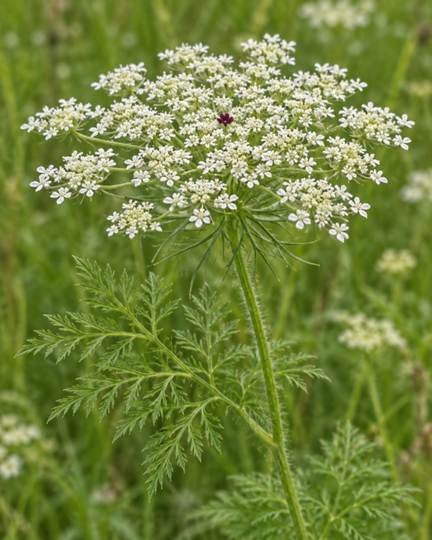
Composites (Compositae). Predominant influence of the far planets, originating in the blossom region. The flower head gathers many flowers into one, and the forces of Venus reach over into the region of the far planets: “Here the universe influences plant development more profoundly than usual.” Mars shows in the thistles, Jupiter in the open heads, Saturn in the globe thistle. Botany now usually names the family Asteraceae, after the genus Aster. The International Code of Nomenclature keeps Compositae as an accepted alternative, and the older name describes the type: each flower head is composed of many small flowers.
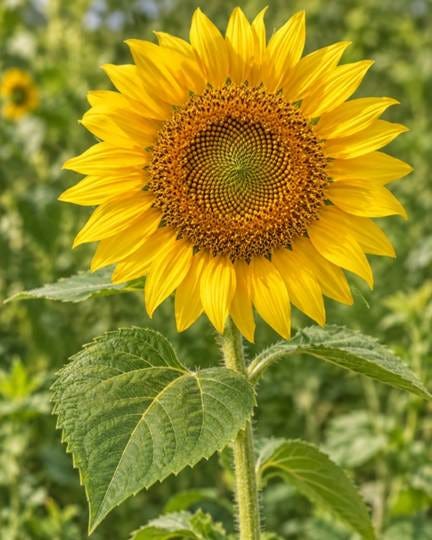
In current classification the families fall as follows. The grasses are monocots. The water lilies belong to the Nymphaeales, one of the earliest-branching lineages of flowering plants, outside both the monocots and the eudicots. Kranich groups the sacred lotus with the water lilies; molecular data place the lotus among the early eudicots, beside the plane tree, so the resemblance between the two is an instance of what Kranich himself calls convergence, the same gesture of form appearing in separate plant groups. The buttercups belong to the earliest-branching eudicot lineage, and the bindweeds, roses, umbellifers and composites to the Pentapetalae.
What Edwards Found Over Seven Years
In the autumn of 1984 Edwards noticed that the beech dips were arriving early. That winter the old beech he followed reacted about two days before each Moon–Saturn alignment, and by February nearly three. The primroses the following spring showed the same displacement. Over the next years the lead grew steadily, and every species he followed shared it: beech, oak, primrose, stitchwort, geranium, birch, sycamore and knapweed all ran early by the same number of days in a given season. The fortnightly rhythm itself held firm, with its turning points displaced together by a slowly changing amount. Edwards called this the phase-shift. By the autumn of 1985 the beech was running four and a half to five days early and an oak five days early. The shift then moved through its extreme of seven days, where seven days early becomes indistinguishable from seven days late, and came back toward zero. It stood at zero about January 1983 and again about January 1990, a period of about seven years, unconnected with the nodes of the Moon. “I know of no other phenomenon in the world of nature quite like it.” Each point on his phase-shift chart rests on the measurement of several hundred to two thousand buds.
The phase-shift raises an obvious objection. With the turning points displaced by several days, a dip can be made to coincide with an alignment of the Moon with almost any planet. Edwards answered with periodicity. The mean interval between successive alignments of the Moon with a given planet is constant and differs from planet to planet, and the phase-shift adjusts it by a small, calculable amount. Against these periods he set the mean intervals between turning points in his bud curves, species by species. Figure 16 places the two side by side.
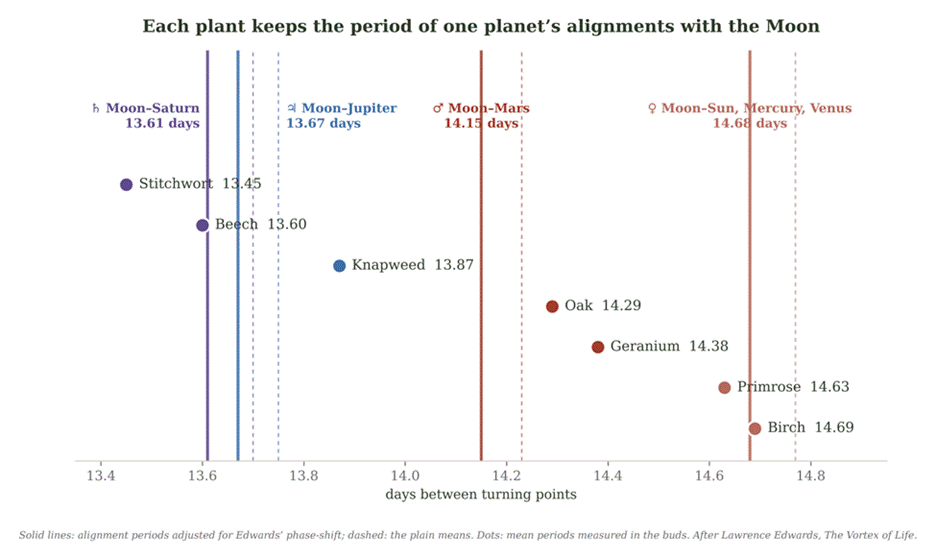
The beech figure comes from many thousands of observations and “matches the Saturn period almost exactly and it could not possibly apply to any of the others.” The oak figure “comes very close indeed to the figure for Mars, and again could not possibly apply to any of the other planets.” The primrose and the birch fall in the group of Sun, Mercury and Venus, which periodicity alone cannot separate; the birch was decided for Venus by its alignments, as described under Venus.
These are Edwards’ figures. The pattern in them follows the order of Kranich’s plant in Figure 13: the Saturn plants keep the shortest interval, the Jupiter plants a slightly longer one, the Mars plants longer again, and the plants of the near spheres the longest of all. The Moon overtakes a slow outer planet sooner than it overtakes the Sun, so the far planets give the quickest pulse. The Moon sets the pulse for every species, and each species chooses the planet whose alignment with the Moon it answers.
Space and Counterspace: The Geometry of the Bud
Edwards’ work rests on a geometry that George Adams developed from indications by Rudolf Steiner and that Olive Whicher carried into botany. Ordinary geometry builds every form outward from points and measures it from a center. Projective geometry gives the plane equal standing with the point, and so it opens a second kind of space, polar to the first, whose measures begin at the periphery and work inward. Adams wrote that to understand “the spatial working of the ethereal and sunlike forces, we must develop among other things the idea of a kind of counter-space or antispace, as against the one-sided physical space of normal consciousness” (Physical and Ethereal Spaces). Steiner called it counterspace, and also etheric space and Sun-space (Adams and Whicher).
Edwards found that a bud takes its form between the two. Every bud form belongs to a figure of four points and four planes that stays fixed while everything around it moves, which geometers call an invariant tetrahedron. In a bud two of the four points can be located: one at the tip, X, and one at the base, Y, each lying in a horizontal plane. The other two are imaginary points, and in ordinary space they appear only as a turning, a circling movement around the axis (Edwards). Figure 17 shows the result. In the upper plane, spirals wind inward toward X. In the lower plane, spirals wind outward from Y. Every point between the two planes travels along a path curve that rises out of Y and winds into X, and together the path curves make the surface of the bud. The single number lambda compares the rate of winding in the upper plane with the rate in the lower plane, and it fixes the whole outline of the bud.
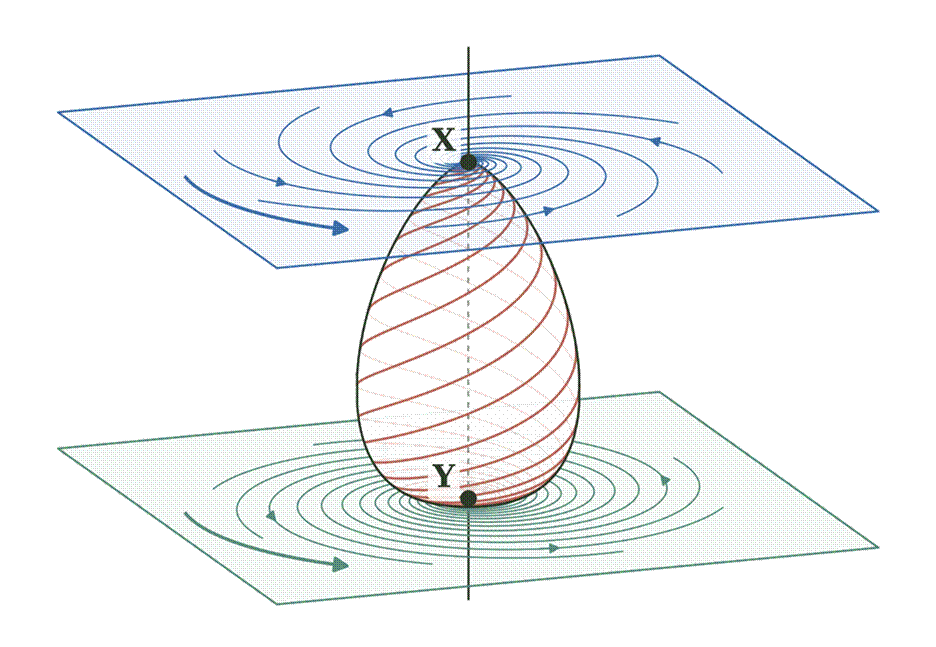
Edwards carried the picture one step further. He moved the upper point X out to infinity. The plane through it then became the outermost boundary of space, and the base point Y became the center of counterspace. “It spans all space. In one of my less prosaic moments I named it the cosmic tetrahedron.” With it he calculated how a vortex in counterspace, centered within the rose bud, gives the rose hip its form, and species after species matched his calculation. He named what he had found the field of form: “Here we are dealing with form only, just pure form.”
Here the geometry joins the cosmology. Kranich read the sequence of the plant from the apparent heavens. Adams and Whicher placed the growing point in a Sun-space that works from the periphery inward. Edwards measured buds that pulse with the alignments of the Moon and the planets, and generated their forms from a figure whose outer boundary is the whole periphery of the cosmos. Theodor Schwenk found the same order in the water vortex, slow at the outside and fast at the center, “closely akin to the great movements of the planetary system” (Sensitive Chaos). My reading draws these into one picture. The planetary heavens seen from the Earth form a periphery of rhythmic movement; the growing point of the plant opens toward that periphery; bud, flower and fruit take their forms from the field between them. The plane at infinity in Edwards’ geometry and the sphere of the fixed stars in Tycho’s answer to one another, each the outermost boundary of its own picture.
Screening the Heavens: Electricity and the Cosmic Connection
The evidence gathered so far comes in three grades. Kranich offers a correspondence of form: plant and planet described side by side, each in its own terms. Edwards offers a correlation in time, to the day, between the shape of a bud and the alignments of the Moon. The substation beech, Burr’s trees and Piccardi’s screened reactions offer a third grade: a relationship that a field can interrupt and modulate. Here I step from the first grade to the third and read the planetary influences as working through the Earth’s electrical environment.
In his second winter Edwards measured a beech that would not keep the Saturn rhythm. Its buds were curved like claws and had a dry, grey look, “as though they had been dusted with cement powder.” Then he noticed that the tree stood a few yards from an electricity substation behind a fence marked 33,000 volts, with the high-tension cable passing a few feet above its crown. “It was obviously growing in a powerful artificial magnetic and electric field; and the question naturally arose whether such conditions formed a shield which would cut a plant off from the cosmic connections in which it is otherwise enmeshed.” Through the winter of 1983 to 1984 he applied the same weekly test that had given an unbroken run of positive results in his other beeches. The substation beech gave fourteen differences, seven positive and seven negative, with a mean close to zero, which is the result to expect from a tree with no relation to the alignments. An oak sapling growing under a cable on the moor gave three positive and five negative. Edwards concluded that “the presence of an artificial electric field could act as a screen which isolates the plants from their cosmic connections; within this screen they continue to do all the ‘proper’ things, germinating, budding, blossoming, seeding, but now out of time with any heavenly context.” In 1985 he gathered knapweed buds from under the cables alongside buds from the open hillside and published the two curves together. He called each of these results preliminary and asked for more work.
The question is as old as electrical research. In the 1780s Francesco Gardini in Turin stretched a net of iron wires over the ground to detect atmospheric electricity. The wires ran over part of a monastery garden, and for the three years they stood there the gardeners reported harvests of fruit and seed fifty to seventy percent below the rest of the garden. When the wires were removed the yields returned to normal (Firstenberg, The Invisible Rainbow).
Harold Saxton Burr of Yale measured the living side of this relationship for thirty years. Beginning in 1938, and almost continuously from 1943 to 1968, he recorded the standing voltage between two electrodes set into the cambium of a maple in New Haven and an elm at Lyme, Connecticut, and later an oak (Blueprint for Immortality). The tree voltages varied with the Moon, with magnetic storms and with sunspots. When he added simultaneous records of the voltage in the air and in the earth beside the trees, he found that “no one of these four sets of measurements was independent of the other three. A change in one was accompanied by a change in all the others.” The tree records ran in a cycle close to the lunar month, and Burr was precise about what that meant: the evidence shows “that both the moon and living systems respond to some more primary characteristics of the Cosmos.” The seasonal correlations “gave credence to the notion that the living system is imbedded through its own electro-dynamic field in the field of its physical environment.” The tree potentials ran in step with the sunspot cycle recorded at Zurich.
Burr’s trees and Edwards’ buds describe the same condition from two sides. The tree is an antenna in a field that is itself modulated by the Sun, the Moon and the planets. Change the field around the tree, and the tree’s relation to the heavens changes with it.
Rudolf Steiner described the direction of that change in the Agriculture Course. Answering a question about electrified fodder, he said: “You must not forget that electricity always works on the higher organisation, the head-organisation both of man and animal; and correspondingly, on the root-organisation in the plant.” Electricity, he continued, “is at a lower level than that of living things. Whatever is alive, the higher it is, the more it will tend to ward off electricity” (GA 327, discussion of 16 June 1924). Throughout the course Steiner described the plant as standing inverted to the human being, its root answering to the human head. In Kranich’s reading the root is the organ of the Moon, and in Edwards’ measurements the Moon mediates every planetary rhythm. I read Steiner’s statement as placing the electrical influence on that lunar pole of the plant, the pole through which the planetary rhythms enter.
Lilly Kolisko recorded a parallel change in the metals. Through the 1920s and 1930s she studied each planet’s metal by capillary dynamolysis, the Steigbild or rising picture, in which a solution of the metal salt climbs filter paper and leaves a colored form. During the solar eclipse of 29 June 1927 she made gold pictures before, during and after the eclipse. The picture of 27 June was normal; by the 28th it had become cloudy, with specks and strokes; at the eclipse the colors turned dull brownish-red and dirty violet; by 5:19 p.m. on the 29th it was clean again, though its colors had yet to recover their full purity. She found the same disturbance at Greenwich during the eclipse of 20 May 1947, with the path of totality far away. From this she concluded: “we must look upon the sun not only as a heavenly body streaming down light and warmth to the earth from one particular spot, but surrounding, enveloping the whole globe with its sphere. When something spectacular happens, such as a total eclipse, certainly we see it happen at a definite place, observing the moon covering the sun, but the whole sunsphere is affected, and the whole earth participates in it” (Davidson, Metal Power).
At the Easter conference of the Anthroposophical Doctors’ Working Group at Comburg in 1964, Lilly Kolisko gave a lecture titled “Gold and the Signs of the Times.” The only record of it is Rudolf Hauschka’s account in his memoirs, which I reprinted in the Journal of Borderland Research in 1990:
“During an eclipse of the sun the gold Steigbild which normally glows with beautiful colors, shows a darkening and the emergence of grey formations. Frau Kolisko now showed a series of gold Steigbild produced in the last years almost hourly and at all times of the day and of the year. Without exception all of them showed the same sinister dark formations which had appeared earlier, in the first half of the century, only at the time of a sun eclipse. She closed her lecture with a question to the doctors, namely whether, considering the change now in gold, they could still be answerable for its use as a medicine. There was no doubt about it: since the middle of the century gold had become different, it was sick. Or, to express it differently, the connection between the spheres of the sun which stream down and the metal which they permeate is disturbed.” (Hauschka, At the Dawn of a New Age, quoted in Journal of Borderland Research, January–February 1990)
Gold is the metal of the Sun. From the middle of the century, by Kolisko’s record, it showed at every hour the signature it had previously shown only when the Moon stood between it and the Sun. In the same issue I set Hauschka’s account beside Trevor James Constable’s chart Cosmic Pulse of Life, which contrasts the planet before radar with the planet after it, its whole environment permeated by pulsed electromagnetic radiation, and wrote that “our present culture has cut off the cosmic forces, as is ominously evident in Lilly Kolisko’s 1964 report.”
The chronology of radar fits Kolisko’s dates. Radar is one candidate among the human alterations of the Earth’s electrical envelope in those years. Atmospheric nuclear testing is another: it peaked in 1961 and 1962, and the high-altitude explosions of 1958 and 1962 laid artificial radiation belts around the planet. Pulsed microwave radar spread through the Second World War and expanded rapidly after it. The Distant Early Warning Line, fifty-eight stations along the 69th parallel from Baffin Island across Alaska, operating between 1220 and 1350 megahertz, was dedicated on July 31, 1957, with lines of radar ships and aircraft extending it into both oceans (Firstenberg). The forest record kept time with later installations. At Skrunda in Latvia, a Soviet early-warning radar began operating in two units, in 1967 and 1971. When Scots pines at twenty-nine sites in front of the radar were sampled, the trees at every site had laid down much thinner growth rings “beginning precisely in 1971,” on average half as wide as before; seed from the most exposed trees germinated at a quarter to a half the rate of seed from less exposed trees. In West Germany white fir began to decline around 1970, spruce around 1979, Scots pine around 1980 and beech around 1981, and the physicist Wolfgang Volkrodt connected the decline with the powerful radar stations built and upgraded along the mountain ranges in those decades. Forest science attributes most of that decline to acid deposition and ozone, and Volkrodt’s radar reading remains a minority position.
The sensitivity of chemistry to the cosmic field has its own record. Giorgio Piccardi in Florence ran his standard chemical tests in pairs for years, one vessel under a thin metal screen and one exposed, and found that the screened and unscreened reactions diverged in step with solar activity. Before him the bacteriologist Hans Bortels had noticed that calcium phosphate precipitates in filaments under anticyclonic weather and in flakes under cyclonic, and that a thin sheet of aluminum covering half the vessel gave both forms of precipitate in the same solution (Piccardi, The Chemical Basis of Medical Climatology). In 2020 a Spanish, Swiss and Russian group reported that radioactive decay rates and capacitance measured inside a modified Faraday cage varied with geomagnetic and cosmic-ray activity under specific conditions (Milián-Sánchez et al., Scientific Reports 10, 2020). The Faraday cage, the instrument designed to exclude outside electrical influence, became in their work a detector of the cosmic field.
My synthesis of this evidence is as follows. Steiner placed electricity below the level of life, among the sub-natural forces, and in the picture I have worked with for many years it is fallen light, the subsensible pole of the light ether: real, engineerable and active below the threshold of the senses. The cosmic influences that Kranich reads in plant form, that Edwards measures in bud shape, and that Kolisko recorded in the metals, reach the Earth through a peripheral medium, the field Burr found the trees embedded in. Since the middle of the twentieth century humanity has filled that medium with its own pulsed and modulated fields, at power levels and frequencies the living world never met before. The substation beech and the cable oak continued to grow, bud, flower and seed. They lost their timing. Gold continued to be gold. It lost its relationship to the Sun. If the archetypal plant is the apparent heavens transposed into living form, then the electrical saturation of the Earth’s environment interposes a screen between the archetype and the plants that embody it. The archetype remains. The plants hear it more faintly.
Earth’s Station and Life on Other Worlds
What follows is the question the thesis raises when it is taken whole, one I have pondered for decades. If the plant takes its form from the heavens as they appear from the Earth, how would plants grow on Mars, let alone in a planetary system with entirely different rhythms?
If the plant takes its form from the planetary system as it appears from the Earth, then the plant is an Earth form in a precise sense. The sequence Kranich describes depends on the Earth’s station among the planets. The Earth stands third from the Sun, with two planets inside its orbit and three outside among the classical seven. From that station Mercury and Venus appear bound to the Sun, as morning and evening stars that never stray more than a limited angle from it, and Mars, Jupiter and Saturn appear free of the Sun, moving through the whole zodiac and standing in opposition to it. Steiner’s polarity, between the near planets working earthward and the far planets banking up the formative forces into flower, fruit and seed, and Kranich’s sequence, from Mercury in the leaf and Venus in the corolla to Mars, Jupiter and Saturn in stamen, fruit and seed, both rest on the division between the inferior and superior planets as seen from this one place. From Venus there would be one inferior planet; from Mars, three, with the Earth and its Moon among them; from a moon of Jupiter, the Sun’s whole inner system would appear as a cluster of near planets around it.
The two inner planets carry particular weight in this picture. Kranich divides the flowering plants into two great expressions of the archetype, each led by one of the planets that circle the Sun inside the Earth’s orbit: Mercury for the monocotyledons and Venus for the dicotyledons. The two-planet structure of the inner system appears in the two great bodies of flowering plants, the monocots and the five-parted eudicots. A system with one inner planet, or three, or inner planets in other proportions of period and distance from their sun, would offer its plants another polarity, and its flora would divide along other lines. The cosmological botany of any other world begins with the architecture of its inner system.
The Moon is a second condition. “The full moon, in opposition to the sun, is the cosmic mirror image of the sun, since it appears equal in size to the sun” (Kranich). That equality makes total eclipses possible, and in Kranich’s picture it expresses the Moon’s role as the boundary of the Earth’s own sphere and the mediator of the Sun’s influence into isolation, in the root, the ovary and the seed. Edwards found the Moon in every one of his rhythms. Without a Moon of that size at that distance the fortnightly pulse of the buds would have no messenger. Steiner treated Uranus and Neptune as later arrivals, guests in the planetary system whose influence on the plant can be set aside (GA 312, Lecture 6). The archetype, on this view, is built from the seven classical bodies as they appear from here.
The search for life elsewhere looks for the right chemistry under the right temperatures. The picture that emerges from Goethe, Kranich and Edwards adds a condition of form. A flowering plant requires the apparent heavens of the Earth, with its two near planets, its three far planets, its year of Sun, its month of Moon, and the interlocking ratios among them. A world at another station would receive another set of appearances, and life there, if it formed, would answer to a different archetype or to none we would recognize. On this reading the flowering plant, with its seed, leaf, flower and fruit, is a signature of the Earth’s place in the solar system, and its archetype is as particular to the Earth as the Earth’s view of the sky.
The Perceiver of the Archetype
Goethe stood in the garden at Palermo looking for a plant that would show him the law behind all plants. Kranich found that law overhead, in the order of the Sun, Moon and planets as they move across the Earth’s sky. Edwards measured the law at work in single buds, day by day, through seven winters, and found the plants keeping time with the Moon and the planets as precisely as an ephemeris. Adams and Whicher gave the geometry in which a form can be drawn from the periphery inward. Kolisko and Burr found the same cosmic order expressed in metals and in the electrical life of trees. Each of these investigators came to the plant from a different side, and each found it embedded in the heavens as the Earth sees them.
“There may be a difference between seeing and seeing, that the eyes of the spirit have to work in perpetual living connection with those of the body, for one otherwise risks seeing and yet seeing past a thing.”
—Goethe, writing on Caspar Friedrich Wolff, 1817
When Goethe told Schiller that he could see his ideas (Figure 18), he spoke of a perception in which attentive observation and living thought had become one activity. The plant and the planetary sky are both visible. What joins them is perceived by the observer who holds both in view and lets the correspondence of their images become clear.

“Goethe believed that the true Theory is contained in the Phenomenon. The phenomena our senses see do not deceive us; they are not unlike the ideal reality which brings them forth. As the Greek origin of the word implies, the ‘Theory’ is the true seeing of the thing—the insight that should come with healthy sight. Yet man is so constituted that he does not really see unless he meets what he sees with spiritual activity on his own part.”
—Olive Whicher, The Living Plant and the Science of Physical and Ethereal Spaces, 1952
Kranich chose as the frontispiece of his book a sentence of Steiner’s: “The comprehension of nature’s rhythms... will become true natural science.” That comprehension is an act of human perception, and it carries a responsibility. The human being now stands between the plants and the heavens as a third party, able to deepen the connection through understanding and able to screen it with technology. The archetypal plant is the apparent heavens of Earth, written into stem, leaf, flower, fruit and seed. Every gardener who sows by the Moon, every forester who watches the seed years of the beech, and every engineer who chooses where to run a cable or aim a beam takes part in that relationship. The plants continue to keep time with the sky. The task is to keep the sky open to them.
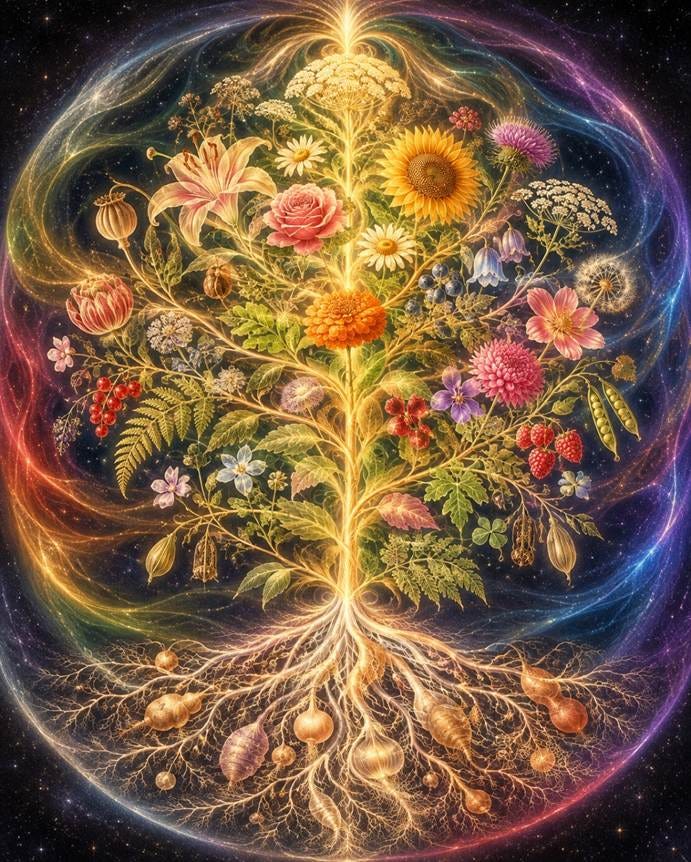
References
Adams, George, Physical and Ethereal Spaces, Rudolf Steiner Press, 1965.
Adams, George, and Olive Whicher, The Plant Between Sun and Earth, Rudolf Steiner Press, 1980.
Balodis, Valdis, et al., “Does the Skrunda Radio Location Station diminish the radial growth of pine trees?” Science of the Total Environment 180, 1996, 57–64.
Barlow, Peter W., Miroslav Mikulecký and Jaroslav Střeštík, “Tree-stem diameter fluctuates with the lunar tides and perhaps with geomagnetic activity,” Protoplasma 247, 2010, 25–43.
Baumgartner, Stephan, study of Hauschka’s weighing experiments, Mathematisch-Astronomische Blätter, Neue Folge 16, Verlag am Goetheanum, 1992; with Johannes Wirz’s critique and Baumgartner’s reply in Elemente der Naturwissenschaft, 1992.
Brown, Thomas Joseph, Seeing the Whole of the Plant, Chronicles of Alkemix, 2023.
Burr, Harold Saxton, Blueprint for Immortality: The Electric Patterns of Life, Neville Spearman, 1972.
Constable, Trevor James, The Cosmic Pulse of Life, Merlin Press, 1976.
Davidson, Alison, Metal Power: The Soul Life of the Planets, ed. Tom Brown, Borderland Sciences Research Foundation, 1991.
Derbidge, Renatus, Stephan Baumgartner and Peter Heusser, “Mistletoe berry outline mapping with a path curve function and recording the circadian rhythm of their phenotypic shape change,” Frontiers in Plant Science 7, 2016, 1749.
Doczi, György, The Power of Limits: Proportional Harmonies in Nature, Art and Architecture, Shambhala, 1981.
Edwards, Lawrence, The Vortex of Life: Nature’s Patterns in Space and Time, 2nd ed., rev. Graham Calderwood, Floris Books, 2006.
Firstenberg, Arthur, The Invisible Rainbow: A History of Electricity and Life, Chelsea Green, 2020.
Gallep, Cristiano M., et al., “Lunisolar tidal synchronism with biophoton emission during intercontinental wheat-seedling germination tests,” Plant Signaling & Behavior 9, 2014, e28671.
Goethe, Johann Wolfgang von, Goethe’s Botanical Writings, trans. Bertha Mueller, University of Hawaii Press, 1952.
Hauschka, Rudolf, At the Dawn of a New Age: Memoirs of a Scientist, Steiner Book Centre, 1985.
Hauschka, Rudolf, The Nature of Substance, 2nd ed., Rudolf Steiner Press, 1983.
Journal of Borderland Research 46, no. 1, January–February 1990.
Kolisko, Lilly, and Eugen Kolisko, Agriculture of Tomorrow, Kolisko Archive, 1939.
Kolisko, Lilly, Jupiter and Tin, Anthroposophical Publishing Company, 1932.
Kolisko, Lilly, The Moon and the Growth of Plants, Anthroposophical Agricultural Foundation, 1936.
Kranich, Ernst Michael, Planetary Influences upon Plants: A Cosmological Botany, trans. Ulla and Austin Chadwick, Bio-Dynamic Literature, 1984.
Milián-Sánchez, V., F. Scholkmann, et al., “Fluctuations in measured radioactive decay rates inside a modified Faraday cage: Correlations with space weather,” Scientific Reports 10, 2020, 8525.
Pelaz, Soraya, et al., “Conversion of leaves into petals in Arabidopsis,” Current Biology 11, 2001, 182–184.
Piccardi, Giorgio, The Chemical Basis of Medical Climatology, Charles C. Thomas, 1962.
Sauquet, Hervé, et al., “The ancestral flower of angiosperms and its early diversification,” Nature Communications 8, 2017, 16047.
Schwenk, Theodor, Sensitive Chaos: The Creation of Flowing Forms in Water and Air, Rudolf Steiner Press, 1965.
Sokoloff, Dmitry D., et al., “Was the ancestral angiosperm flower whorled throughout?” American Journal of Botany 105, 2018, 5–15.
Soltis, Douglas E., et al., “Gunnerales are sister to other core eudicots: implications for the evolution of pentamery,” American Journal of Botany 90, 2003, 461–470.
Steiner, Rudolf, Agriculture (GA 327), trans. George Adams, Rudolf Steiner Press, 2012.
Steiner, Rudolf, “Goethe as the Founder of a New Science of Aesthetics,” lecture, Vienna, 1888 (GA 271).
Steiner, Rudolf, Interdisciplinary Astronomy (GA 323), lecture of 3 January 1921.
Steiner, Rudolf, lecture of 7 May 1912, Cologne (GA 143).
Steiner, Rudolf, Pastoral Medicine (GA 318), quoted in Kranich.
Steiner, Rudolf, Spiritual Science and Medicine (GA 312), Lecture 6, 26 March 1920.
Whicher, Olive, The Living Plant and the Science of Physical and Ethereal Spaces, Goethean Science Foundation, 1952.
Zürcher, Ernst, Maria-Giulia Cantiani, Francesco Sorbetti-Guerri and Denis Michel, “Tree stem diameters fluctuate with tide,” Nature 392, 1998, 665–666.

Support Independent Research into Hidden Knowledge & Unexplored Dimensions
Thank you for reading! These writings are open to everyone.
If they have been of real value to you and you feel moved to reciprocate, there are a few ways to do that:
Workshops: Lux.Alkemix.Art — Take the ideas into practice and direct experience!
Sacred threads: AlkemixArts.etsy.com — geometries and symbols for expression in life.
Donations: PayPal.Me/alkemix33
Paid subscriptions: helps keep this work independent and allows more time for deep research and long-form essays such as this one.