



“A fluctuating network of water molecules, with localized icosahedral symmetry, is proposed to exist derived from clusters containing, if complete, 280 fully hydrogen-bonded molecules... The structure allows explanation of many of the anomalous properties of water..” — Professor Martin F. Chaplin, Biophysical Chemistry
Hexagonal Water?
Search for “structured water” online and you will quickly find it: hexagonal water. Diagrammed on device packaging and product websites, illustrated in premium functional water branding, explained in books, and promoted by wellness influencers to audiences of millions. An entire ecosystem of water-structuring devices — vortex units, magnetic conditioners, crystal-infused bottles, Analemma wands — promises to “restore” water’s hexagonal structure, at prices ranging from the modest to the considerable. Dedicated sites present the hexagonal ring as the molecular signature of living, organised, biologically active water, in contrast to the “chaotic” structure of ordinary tap water. The imagery is consistent: neat six-sided rings, occasionally a snowflake reproduced as if it were a molecular diagram, a split comparison of ordered hexagonal geometry against disordered bulk.
The intention is genuine. These producers and practitioners are pointing at something real: water has structure, that structure can be degraded, and organised water behaves differently in biological systems than the random thermal jostle of bulk water. All of that is true and important.
But the shape they have given living water is the shape of ice.
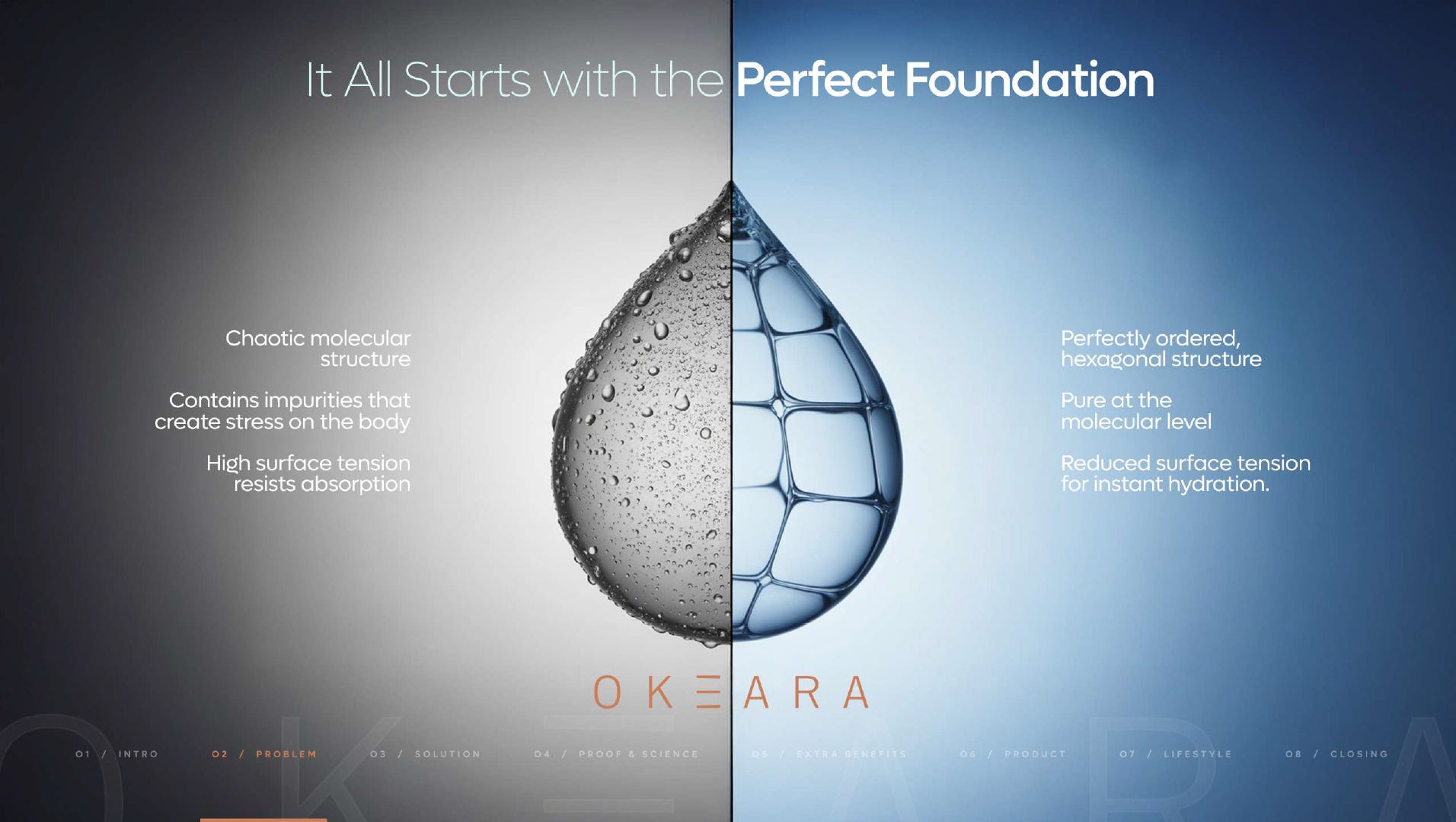
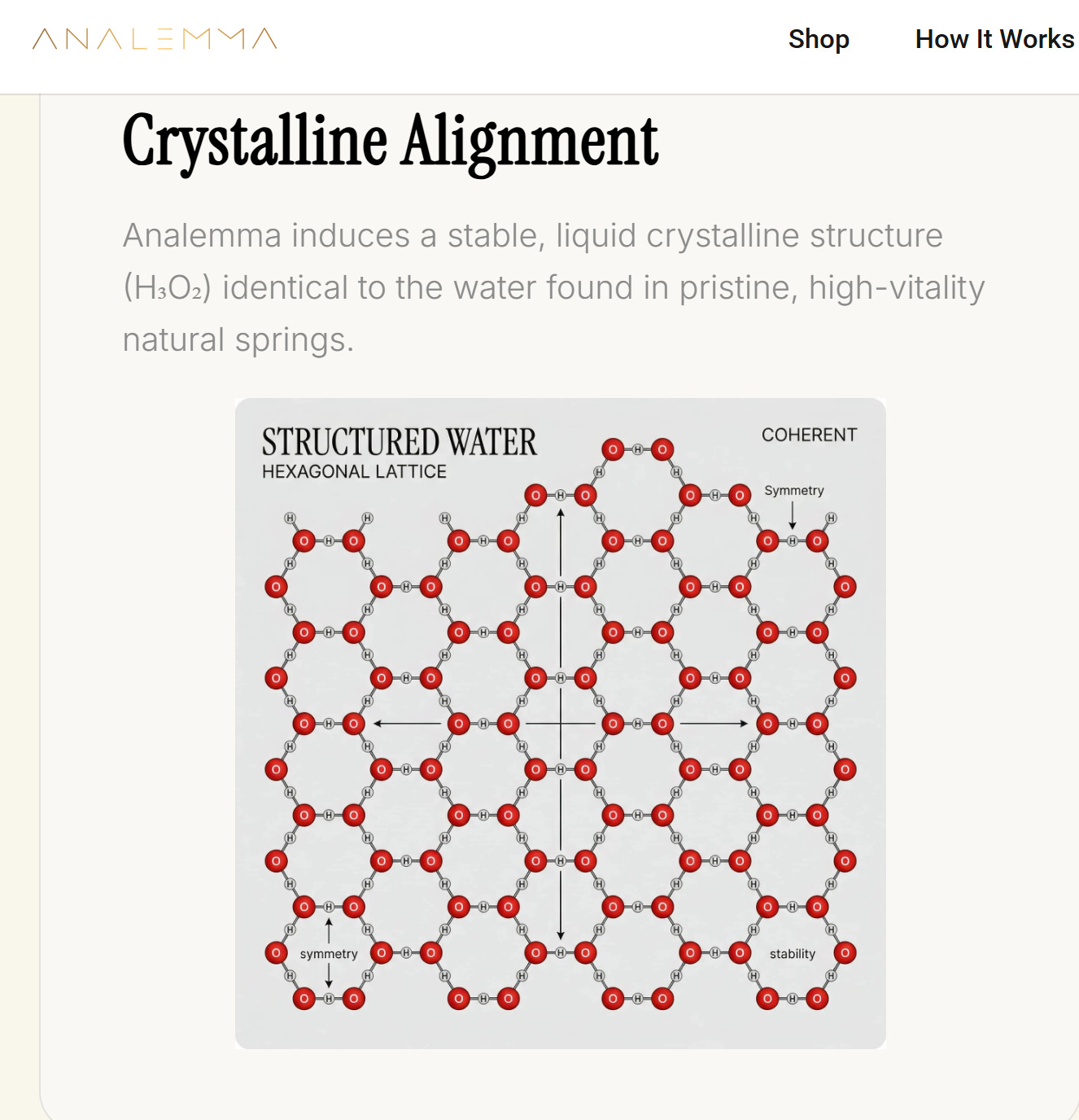
This is not a small error. The hexagonal lattice is the precise geometric signature of the crystalline phase — of water after the living principle has been expelled from it. It is the geometry gravity produces when it finally wins. Understanding why that matters, why the correction reaches from the molecular scale all the way to the deep structure of space itself, is the subject of this article — and of the workshop it is written to introduce.
Two Families, Two Principles
The ancient Greeks identified exactly five regular solids — five, by mathematical proof, and no more. What almost no one notices is that these five divide into two irreconcilable families, separated by the most fundamental distinction in three-dimensional geometry.
The first family — tetrahedron, cube, octahedron — uses whole-number ratios throughout. They tile space completely. Pack them together and no gap remains. They are the geometry of crystalline closure: efficient, final, space-filling. The hexagonal lattice of ice Ih belongs to this family.
The tetrahedron holds a singular position within the point-pole family — self-dual, its own reciprocal, the geometric hinge at the threshold between the two poles rather than the expression of either alone.
The second family — dodecahedron and icosahedron — requires φ, the golden ratio: 1.618033… A number that cannot be expressed as any fraction of whole numbers, that resists rational approximation more stubbornly than any other irrational. These two solids cannot tile space. Five-fold symmetry is mathematically incompatible with complete space-filling. They always generate voids.
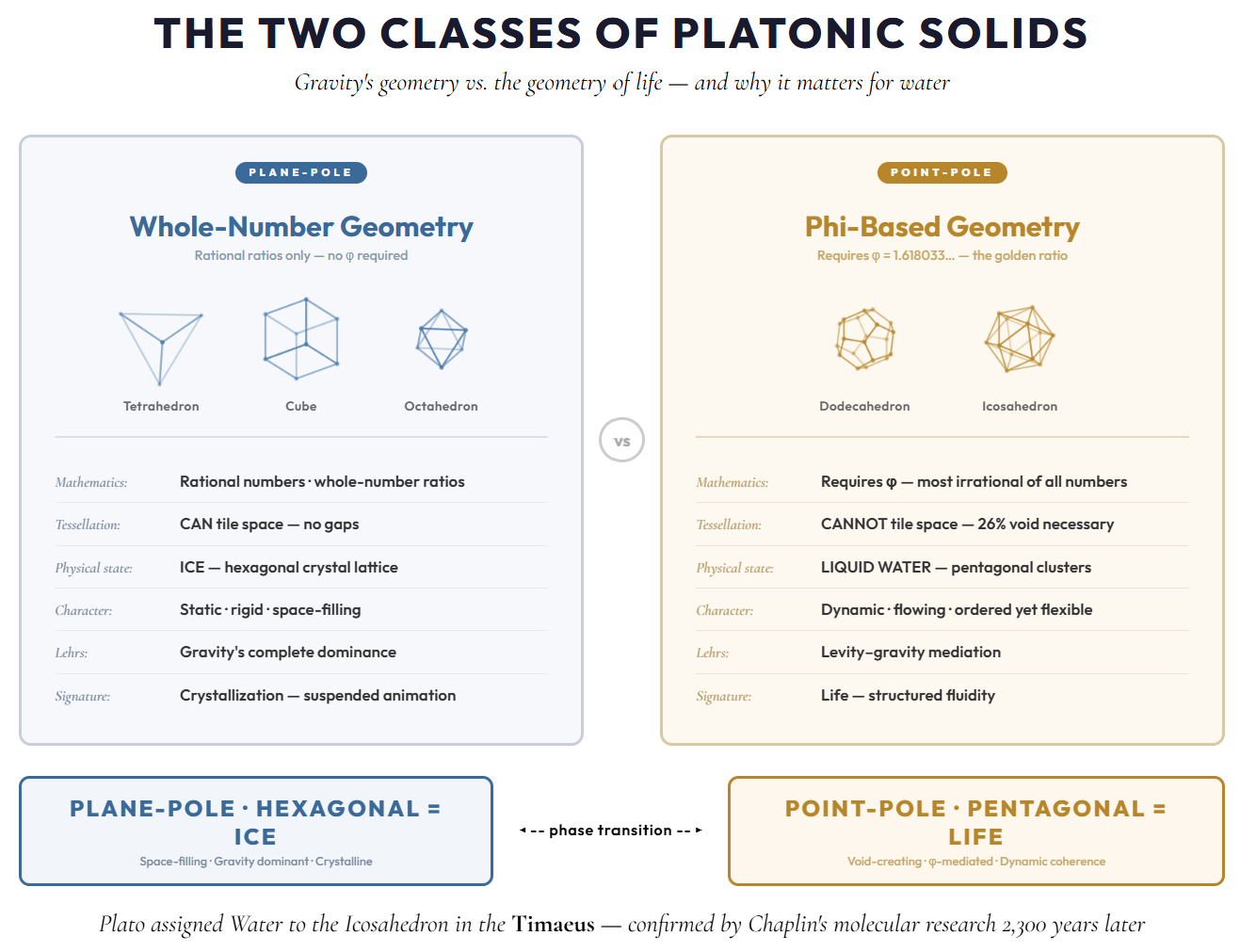
This is where George Adams enters, and the picture sharpens considerably.
Adams was a mathematician working in projective geometry in the tradition of Rudolf Steiner, and his central contribution — most clearly stated in his 1961 lecture Potentization and the Peripheral Forces of Nature — is that space is not a neutral container. It has two irreducible and mathematically complementary poles.
The point-pole is the source of forces radiating outward from material centers: gravity, electrostatics, molecular bonding. Its spatial character is rational, whole-number, space-filling. Its Platonic expression is the tetrahedron, cube, and octahedron. Its chemistry is oxygen — the contracting, fixing, gravity-bearing element that Lehrs calls the “true generator of ashes.” Its geometry is the hexagonal lattice.
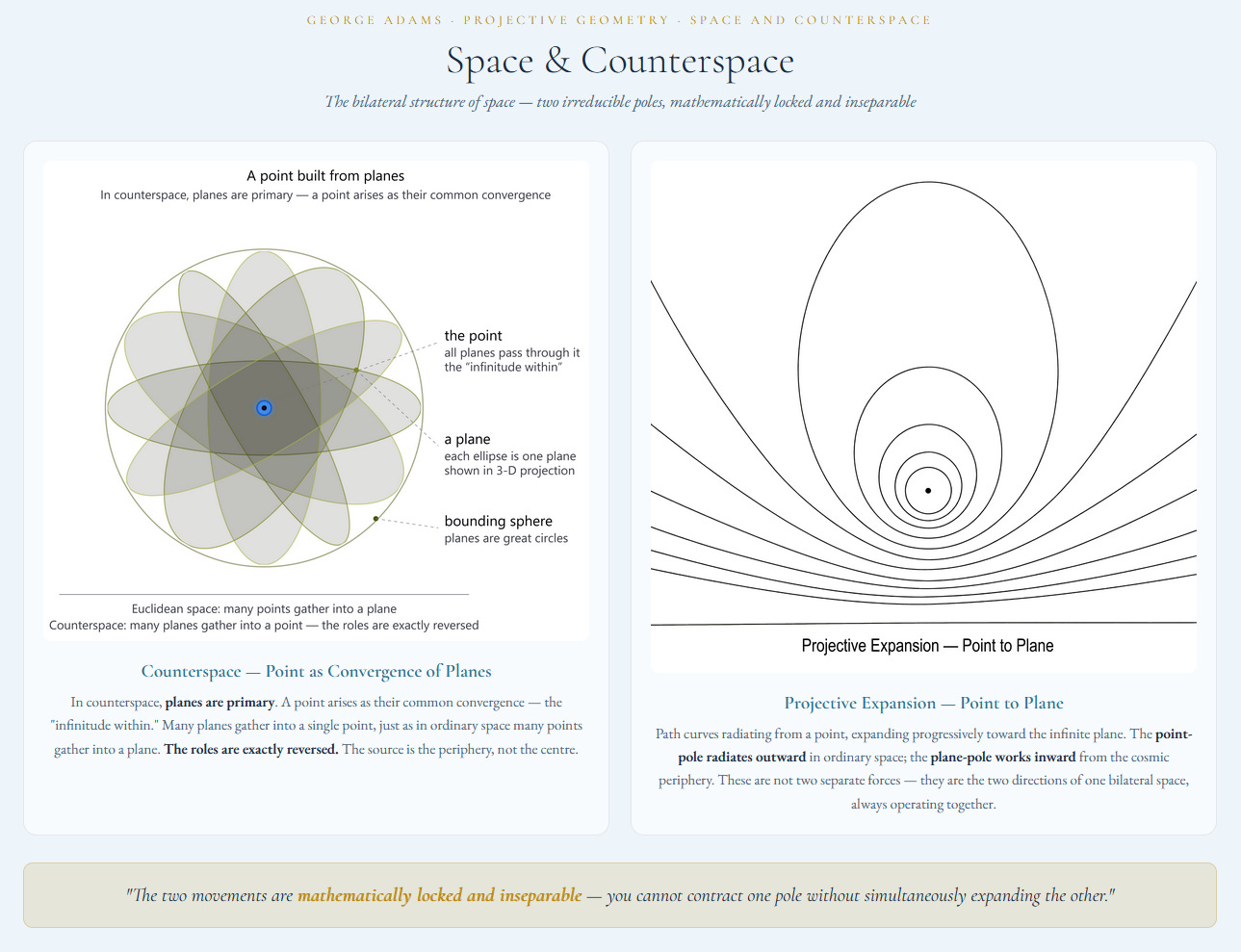
The plane-pole is the source of forces working inward from the cosmic periphery: formative, organizing, etheric in Steiner’s precise sense. Its spatial character is irrational, φ-based, void-generating. Its Platonic expression is the dodecahedron and icosahedron. Its chemistry is hydrogen — the lightest element, dissolving, levity-bearing, perpetually tending toward the peripheral. Its geometry is pentagonal.
The five Platonic solids are not five unrelated curiosities. They are the three-dimensional expressions of the two poles of space itself, inscribed in pure geometry two millennia before molecular science could confirm them in matter.
Ice is point-pole geometry made molecular. Liquid water is plane-pole geometry made molecular.
Adams proved this from pure mathematics in the 1930s. Martin Chaplin confirmed the molecular consequence in 2000, with no knowledge of Adams’ projective geometric framework.
The Chemistry Behind the Geometry: Hauschka’s Four Pillars
There is a layer deeper than geometry, and it bears on why the pentagon belongs to water’s living state.
Rudolf Hauschka, in The Nature of Substance, gives a framework that reverses the standard chemical picture. The elements are not primary — they are condensed residues of cosmic formative forces that preceded them. The forces are primary. The atoms are their crystallised footprints in matter.
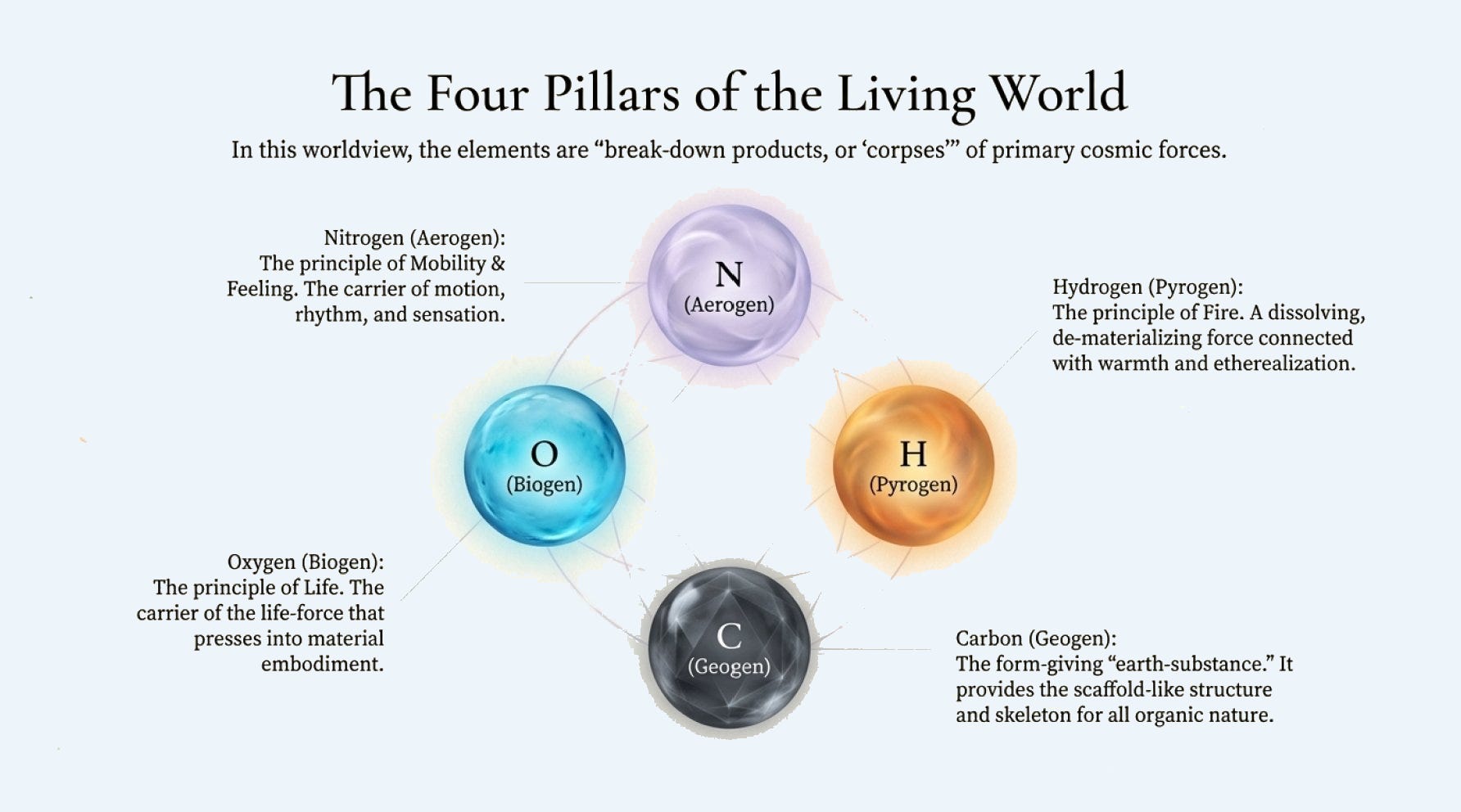
Four forces, four pillars of the living world:
Hydrogen is pyrogen — the fire-principle. Dissolving, volatilizing, returning matter toward the cosmic periphery. The lightest element, upward in gesture, the plane-pole’s chemistry.
Oxygen is biogen — the integrating, fixing principle. Pressing cosmic activity down into structural form. Combustion is oxidation; what oxidation leaves is ash — the point-pole’s chemistry, gravity’s final word.
Nitrogen is aerogen — the principle of mediation and rhythm. At 78% of the atmosphere, diluting oxygen’s concentrated gravity into rhythms breathable by life. It passes through respiration entirely unchanged. It does not react. It mediates.
Carbon is geogen — the form-giving earth-substance, the scaffold into which the living forces build their architecture.
These four are primary as forces. The chemical atoms we name after them are their condensed residue.
Water stands at the crossing of the primary polarity — pyrogen and biogen, hydrogen and oxygen, plane-pole and point-pole in dynamic, never-resolved tension. Two gases that feed fire unite to produce the substance that extinguishes it. The gesture of each pole is completely transcended in their union. That transcendence is water’s constitutional principle, legible from the molecular scale upward. And its geometry — the plane-pole’s φ-based, void-generating, pentagonal architecture — is pyrogen’s spatial signature inscribed in every cluster of liquid water.
Chaplin’s Key
Martin Chaplin, Emeritus Professor of Applied Science at London South Bank University, published his structural model of liquid water in Biophysical Chemistry in 2000. It is a work of exceptional structural imagination.
The key is the flexibility of the hydrogen bond. Water molecules bond at approximately tetrahedral angles — but the hydrogen bond is not rigid. It flexes sufficiently to accommodate the 108° angle of a pentagonal ring. Five water molecules can form a ring because that ring is energetically feasible. From five pentamers, a dodecahedral cage of twenty molecules assembles: twelve pentagonal faces, no hexagonal faces, perfect five-fold symmetry. From the dodecahedral core, with twelve further pentameric caps, the icosahedral cluster of 280 molecules forms — approximately 3 nanometres across. Thirteen of these nested together produce the 1,820-molecule super-icosahedron: a fractal hierarchy, each level φ-scaled, each level pentagonal.
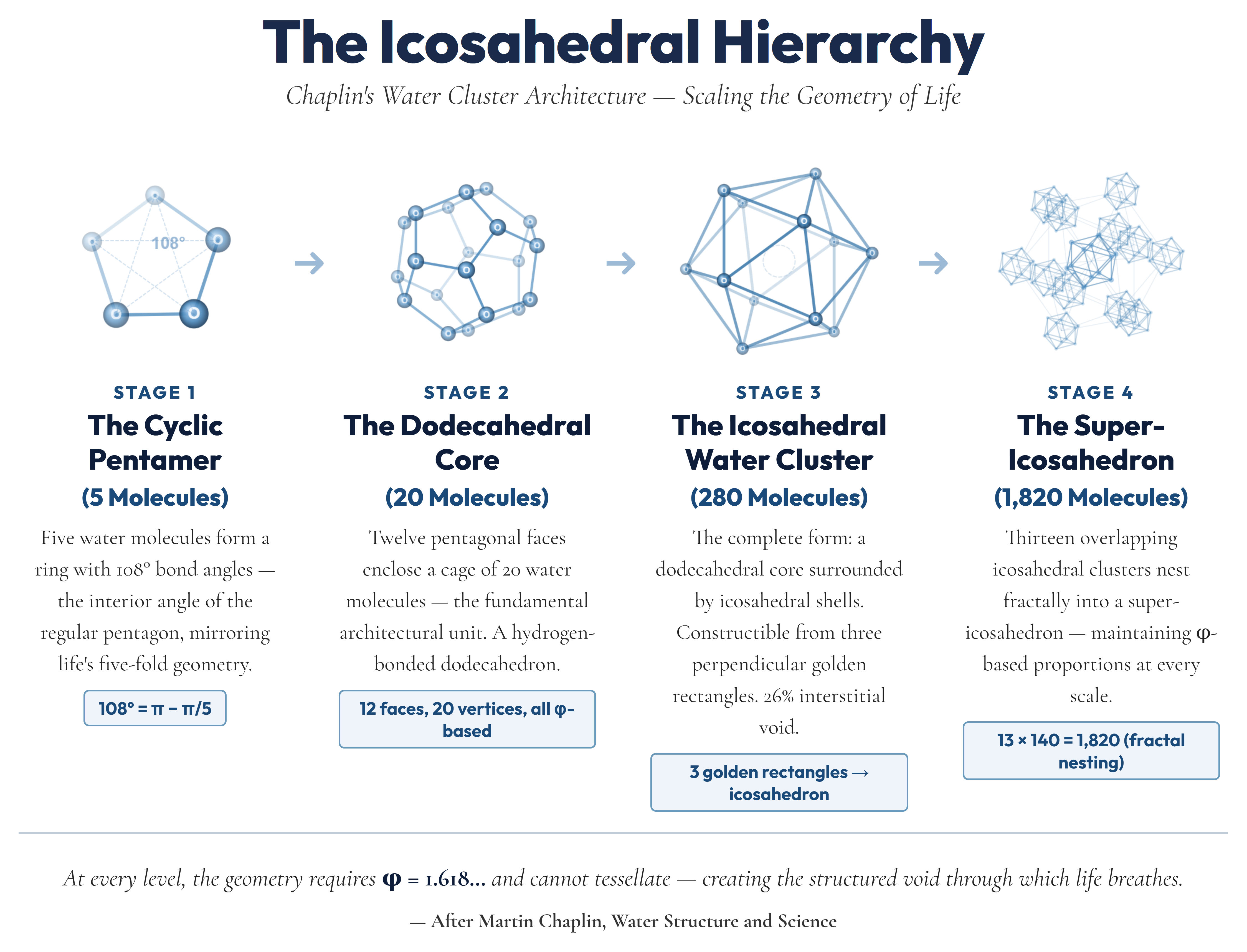
This icosahedral Expanded Structure breathes between itself and a Collapsed Structure — denser, matching liquid water’s density at 4°C — without breaking a single hydrogen bond. The transition requires only a 1% change in the angular force constant. What conventional water science has catalogued as anomalies — the density maximum at 4°C, the anomalous compressibility, the vast heat capacity — are the thermodynamic signatures of this breathing. They are what a substance looks like when it holds two geometric poles in living tension.
Plato assigned the icosahedron to water in the Timaeus, 360 BC. Chaplin confirmed it from molecular dynamics. “Plato would not have been wrong to connect liquid structure in general to icosahedra,” he wrote. Two thousand three hundred years. The geometry was always there.
Recent structural work confirms Chaplin’s picture. Beaulieu, Deringer, and Martelli (2026) show that the splitting of the principal peak in water’s structure factor arises from five-to-eight-membered rings, with five-membered rings “particularly persistent, maintaining distinct structural signatures even above room temperature.” Lee and Kim (2009) found that water molecules at protein surfaces arrange spontaneously into pentagons and partial dodecahedra — and where hexagonal arrangements appeared, they were associated with ice-like conditions. The protein, life’s most refined molecular tool, organizes its water in Chaplin’s geometry.
The Electromagnetic Foundation
Chaplin’s clusters explain the mesoscopic geometry. But they do not explain why water’s structure persists against the thermal chaos that destroys individual hydrogen bonds in under 200 femtoseconds.
Emilio Del Giudice, Giuliano Preparata, and Giuseppe Vitiello provided the answer in their framework of quantum electrodynamical coherence in water. A coherent domain, approximately 100 nanometres across, traps an electromagnetic field between its boundaries as within a resonating cavity. Water molecules within the domain oscillate coherently between electronic states, the domain both generating and sustained by a shared field. The coherent domain is not held by hydrogen bonds — it is held by light. Topologically stable vortices of quasi-free electrons at the domain periphery persist for days to weeks, expelling protons into the inter-domain space, maintaining a sustained charge separation that is the electrical engine of cellular biology.
Three levels, one process: Steiner’s Chemical or Tone Ether — the peripheral formative activity working inward from the cosmic plane-pole — is the organizing principle above matter. Chaplin’s icosahedral cluster architecture is its inscription in liquid water’s molecular geometry. Del Giudice’s coherent domain is the electromagnetic phenomenon that the icosahedral substrate makes possible and sustains. Each level is real. None is reducible to the others.
The geometry is the constant. Pentagonal throughout: from the 5-molecule ring to the icosahedral cluster to the coherent domain — 100 nanometres of pentagonal order sustained by the trapped electromagnetic field it generates within itself, held together by its own resonance rather than by chemical bonds.
The Hexagonal Error and Its Sources
Against this background, the “hexagonal water” hypothesis requires examination — not as a curiosity but as a persistent and consequential misdirection.
Dr. Mu Shik Jhon’s observations are genuine and his concern for water quality admirable. His Water Puzzle and the Hexagonal Key opened important territory for popular understanding. But his methodology contains a precise logical error. The photographs he presents as evidence of hexagonal liquid water are photographs of ice crystals — the dendritic hexagonal growth habit of ordinary ice Ih. Jhon froze water samples and described the hexagonal geometry of the resulting crystals as evidence for the hexagonal structure of the precursor liquid. He treated the freezing product as a portrait of what came before it.
A liquid can produce a hexagonal crystal without itself being hexagonal — just as molten metal produces a crystalline solid whose lattice bears no necessary resemblance to the random arrangement of the melt. The crystal photographs of Emoto’s work, whatever their sensitivity to environmental conditions, are equally subject to this critique. They show ice. They do not show water.
Here is the nuance that matters, and that makes Jhon’s proxy potentially legitimate even where his geometry is inverted: water that has been subjected to conditions enhancing coherence — vortex flow, structured electromagnetic environment, proximity to living organisms — may well produce finer, more regular ice crystals on freezing, because a more coherently organised liquid provides a better-organised precursor for crystallization. The beauty of those crystals is real. What it reflects is the quality of the crystallization event, not the geometry of the liquid. The icosahedral plane-pole architecture of living water expresses itself, at the moment of freezing, in the clarity of its surrender to the point-pole — not in any hexagonal structure it possessed before.
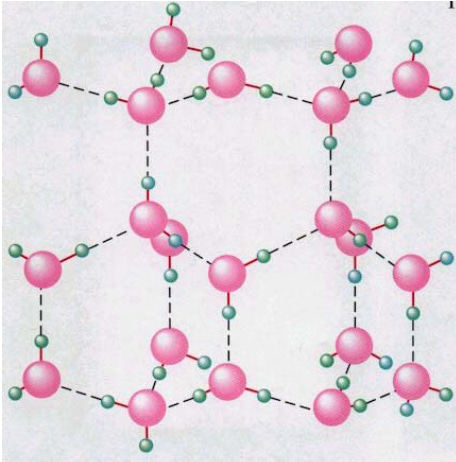
Gerald Pollack’s work deserves a cleaner separation of its two components. His experimental documentation of the Exclusion Zone — the ordered water layer at hydrophilic surfaces that excludes solutes, carries a negative charge, absorbs UV radiation at 270 nanometres, and stores energy as an electrical gradient — is a major contribution confirmed across multiple laboratories. These phenomena are real and important.
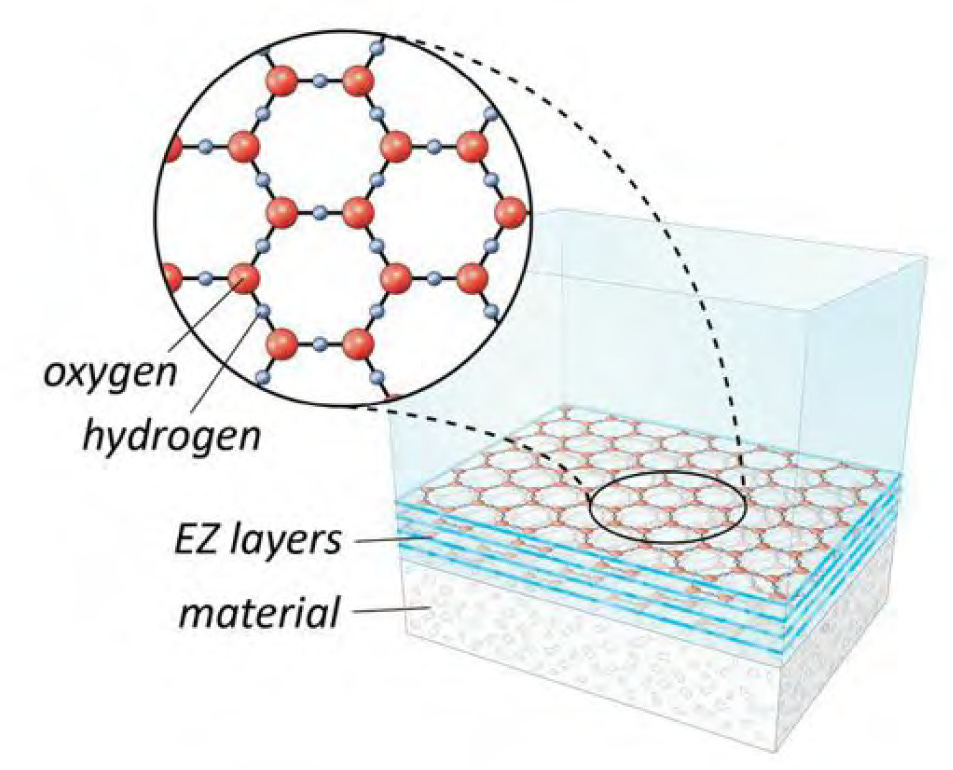
The structural interpretation Pollack offers — a hexagonal H₃O₂⁻ lattice “out of register” with ice — is where the evidence parts company with the model. H₃O₂⁻ is a transient femtosecond species known to chemistry as a proton-transfer intermediate, with no evidence for its existence as a stable structural unit in liquid water. More fundamentally: hexagonal structure in liquid water is ice structure in a thermal environment that destroys it in femtoseconds. Del Giudice’s coherent domain framework explains every one of Pollack’s observations — the charge separation, the UV absorption, the solute exclusion, the increased viscosity — through the quasi-free electron plasma at the coherent domain periphery, without requiring impossible hexagonal stability. Correctly interpreted, Pollack’s EZ is liquid water operating at elevated coherent domain organisation, stabilized and extended by the hydrophilic biological surface. Correcting the geometric interpretation strengthens his contribution rather than diminishing it.
What a Fungus Knows
In March 2026, Eufemio and colleagues published in Science Advances their discovery of a previously unrecognized class of fungal ice-nucleating proteins — INpros — from fungi in the Mortierellaceae family, including Mortierella alpina. These proteins are β-solenoid folds carrying repetitive hydroxyl-bearing residues — threonine, serine — spaced precisely to match the oxygen lattice of hexagonal ice Ih. When the protein encounters water, it templates hexagonal order onto adjacent water molecules: imposing the geometry of ice onto a liquid that, by its own preferences, arranges itself otherwise.
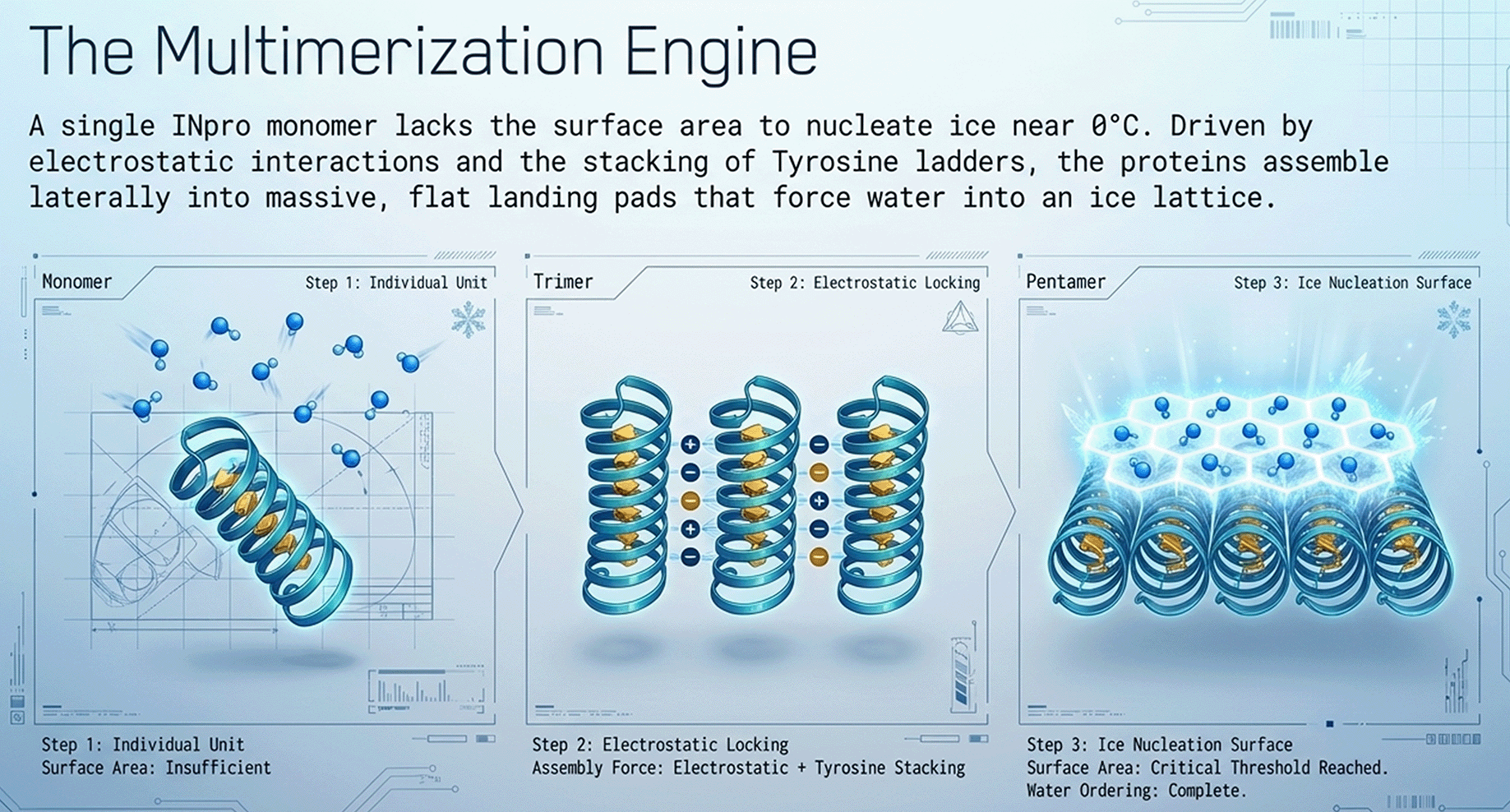
This is already significant. But the paper’s critical finding goes further.
Single INpro monomers are inefficient ice nucleators. Efficiency rises dramatically with multimerization. Trimers nucleate at approximately −7.5°C. Tetramers at approximately −6.5°C. Pentamers — the five-fold assembly — nucleate at approximately −5.6°C. But the paper documents a further fact: bacterial and fungal ice nucleators, in their most aggressive native forms, enable ice formation at temperatures as high as −2°C. That upper bound belongs to bacterial INpro Class A — rare, membrane-anchored, dependent on still larger oligomeric assemblies and precise electrostatic interactions that push hexagonal templating to its biological limit.
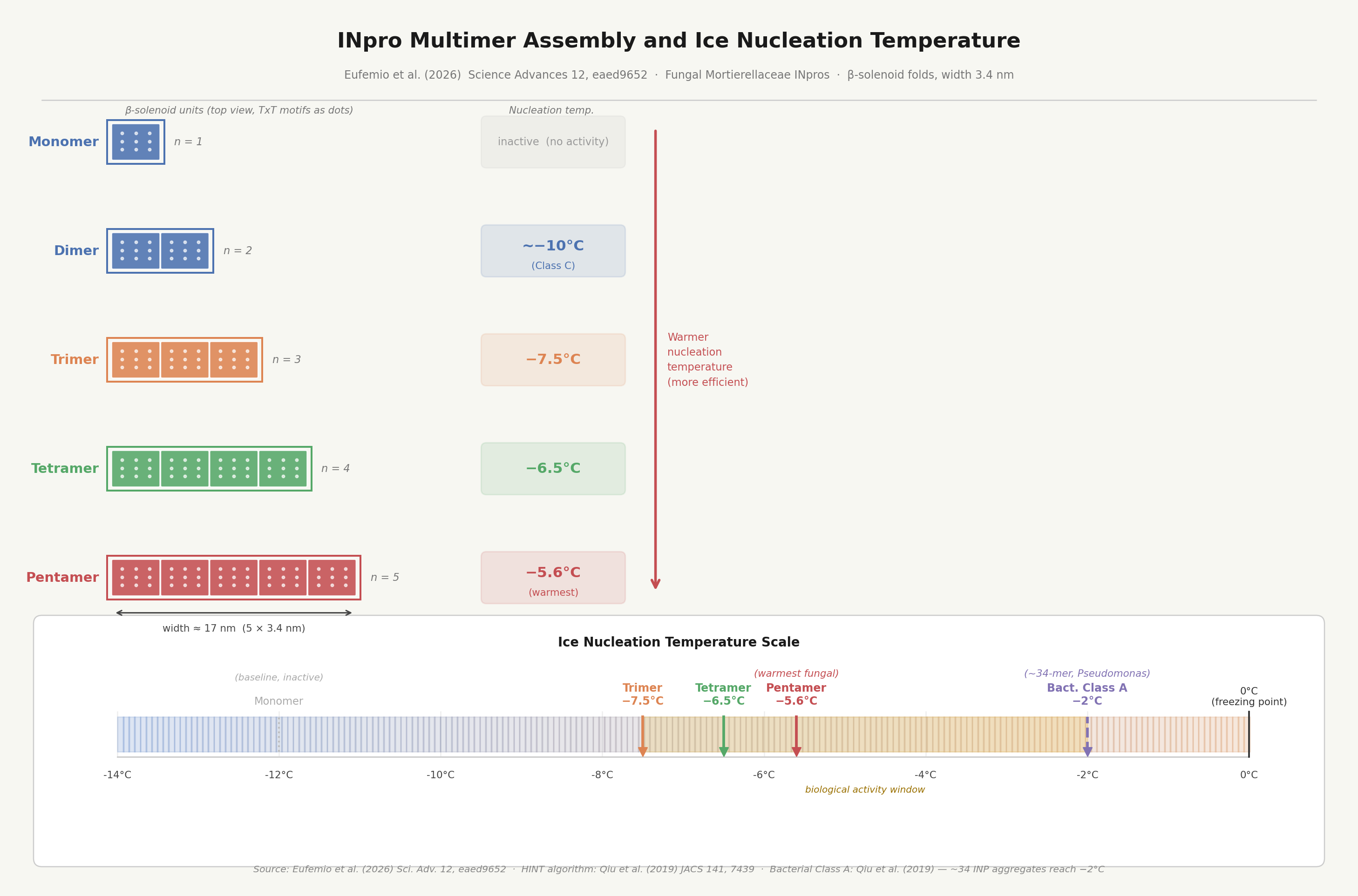
Read the gradient whole. From −7.5°C at trimers to −2°C at maximal bacterial assembly: each degree warmer requires more aggressive multimerization, a wider ice-binding surface presenting more hydroxyl groups simultaneously, more comprehensive templating of the hexagonal lattice. The closer the target to biological temperature — to the thermal range where living water operates — the more work the protein must perform to override water’s native pentagonal preferences. The gradient is a direct measure of resistance. Water resists hexagonal organisation with increasing force the closer to life’s own operating range the override is attempted.
And consider the form of the override instrument itself. Life, requiring machinery to force water across the geometric boundary from pentagonal to hexagonal, from plane-pole to point-pole, from liquid to ice — builds that machinery in the shape of water’s own living geometry. The pentameric assembly is the key that fits the lock precisely because it matches the architecture of the liquid it must override.
Pseudomonas syringae, the bacterial ancestor of this protein lineage and the source of Class A’s most aggressive ice nucleators, uses its InaZ protein as a weapon: inducing ice crystal formation inside plant tissue at temperatures the plant’s cells would otherwise survive, rupturing cell walls, gaining access to nutrients. The fungi acquired this capacity by horizontal gene transfer and deploy it as a specialist tool, kept membrane-independent and cell-free — a precision instrument held at arm’s length from the organism’s own living water.
Life nucleates ice by force. It does not inhabit hexagonal water. It weaponizes hexagonal geometry when it needs to freeze something.
This is the point-pole deployed as instrument. And the fact that the most efficient deployment takes the pentameric form — five-fold, the plane-pole’s own number — and that pushing nucleation toward biological temperatures requires proportionally greater oligomeric effort, is the most precise confirmation available that biology treats the boundary between the two geometric kingdoms as real, distinct, and worth building dedicated molecular machinery to cross.
The icosahedron cannot crystallize. Five-fold symmetry is mathematically incompatible with the periodic lattice of a crystal. This is the protection of living water’s architecture. The pentagon is nature’s firewall against the point-pole’s dominion — the geometric principle that keeps water liquid, coherent, and alive at the temperatures where biochemistry is possible. And when life needs, for some specific purpose, to cross that boundary — it builds a pentameric key to do it.
The Sacred Geometry Recovered
Goethe insisted that phenomena, rightly attended to, speak their own theory. The Anschauende Urteilskraft — the beholding judgment — moves from the particular to the universal through a quality of perception that does not impose but receives.
What the phenomena of water have been saying, across ninety years of structural inquiry and across the full depth of Goethean observation, is this: “the pentagon is my unit. The dodecahedron is my cell. The icosahedron is my body. I am coherent, not crystalline. I am held by light. The light I make. The electromagnetic field my own coherent oscillation generates within itself — and that holds me in return. My fluidity is the presence of a structure so dynamically self-similar, so rooted in the plane-pole’s irreducible openness, that it resists crystalline lock-up as a matter of geometric necessity. And this resistance is the condition of my capacity to carry life.”
The snowflake is beautiful. But it is water compelled — water overridden, water crystallised by cold or by biological force. The living water is the water before the snowflake, and after the thaw. Its geometry is pentagonal, icosahedral, coherent. Its mathematics is φ. Its organizing principle works inward from the cosmic periphery, as Adams proved from pure projective geometry four decades before Chaplin confirmed it in molecular biology.
You are built primarily of this water. The peripheral forces that maintain its icosahedral architecture, that sustain the coherent domain organisation in your cells, are working in you continuously, at every scale from the 5-molecule pentameric ring to the organised water at your membrane interfaces and the hydration shells around your DNA. Giorgio Piccardi spent a decade showing that water in a beaker responds to solar and galactic electromagnetic conditions through a copper Faraday cage. Your body is orders of magnitude more complex, more structured, and more electrically active than Piccardi’s beaker.
The geometry is the form of water’s first and most fundamental principle: to remain open, coherent, and alive.
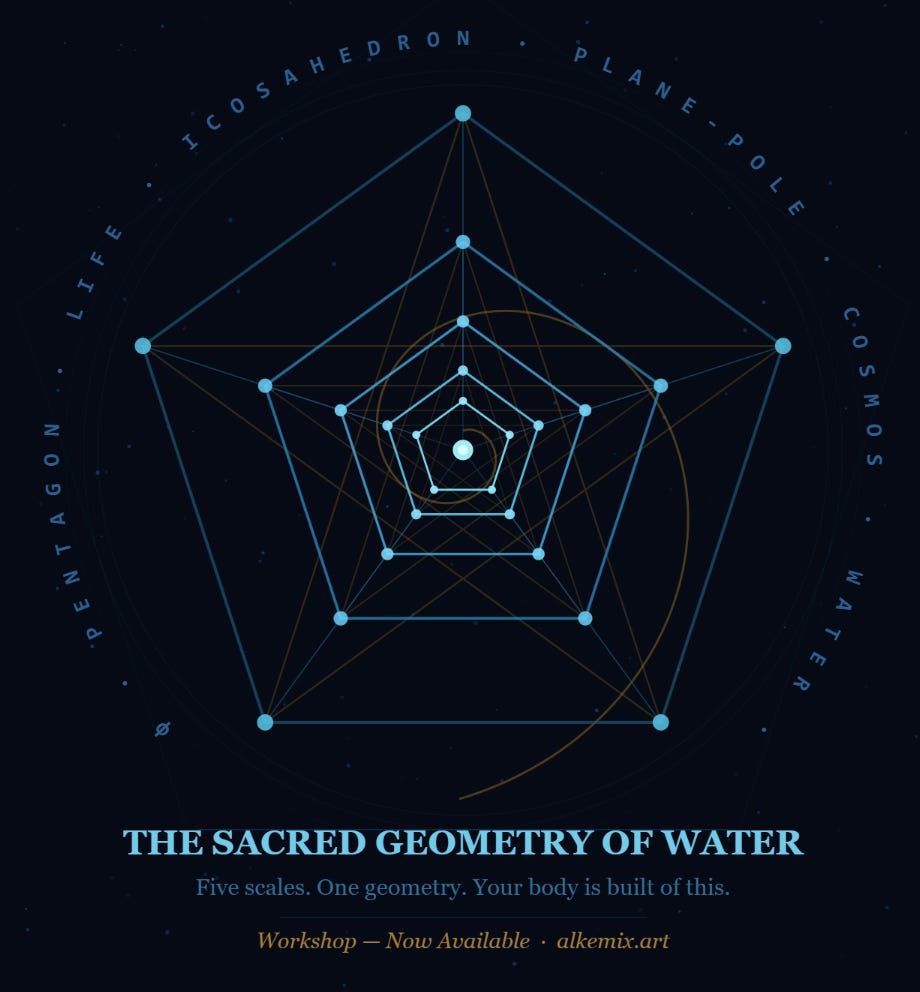
The Sacred Geometry of Water — Workshop
The argument developed here — from the Platonic polarity of space through Hauschka’s cosmic chemistry, Chaplin’s icosahedral hierarchy, Del Giudice’s coherent domains, Adams’ bilateral geometry, and the five-scale vortex cascade from molecule to atmosphere — is the subject of my new four-hour video masterclass, The Sacred Geometry of Water, now available online.
Thirty-nine slides across four parts, supplied as permanent study aids. The complete thesis, from the 5-molecule pentameric ring to Giorgio Piccardi’s geocosmic evidence, from Theodore Schwenk’s seven years of germination experiments to Trevor Constable’s atmospheric-scale geometric engineering, from the φ-spiral vortex to the hydration architecture of living cells. The molecular science, the projective geometry, the Goethean phenomenology, and the practical consequences for how we understand and work with water — as a medium of health, of agriculture, of conscious relationship with the primary substance of life.
What does it mean to live as a φ-based, icosahedral, electromagnetically coherent water organism in a cosmos organised by the same geometry?
That is the question the workshop is built to open.
Access link → The Sacred Geometry of Water — Master Class
References
Adams, G. (1961). Potentization and the Peripheral Forces of Nature. British Homeopathic Journal, 1961, reprinted 1989.
Beaulieu, C., Deringer, V.L. & Martelli, F. (2026). Five-to-eight-membered rings in water’s structure factor. DOI: 284597133.
Bernal, J.D. & Fowler, R.H. (1933). A note on the pseudo-crystalline structure of water. Trans. Faraday Soc. 29, 1049.
Brown, T.J. (2026). The Living Geometry of Water: Coherent Domains, Sacred Geometry, and the Architecture of Life. Zenodo. DOI: 10.5281/zenodo.18821539.
Brown, T.J. (2026). The Sacred Architecture of Water. Zenodo. DOI: 10.5281/zenodo.19059110.
Chaplin, M.F. (2000). A proposal for the structuring of water. Biophysical Chemistry 83(3), 211–221.
Del Giudice, E., Preparata, G. & Vitiello, G. (1988). Water as a free electric dipole laser. Physical Review Letters 61, 1085.
Eufemio, R.J. et al. (2026). A previously unrecognized class of fungal ice-nucleating proteins with bacterial ancestry. Science Advances 12, eaed9652. [Refs 9–10 therein document the −2°C biological ice nucleation ceiling for bacterial INPs.]
Eufemio, R.J. et al. (2022). Biological ice nucleators: Class C vs Class A INpro structure and protein-protein interactions. bioRxiv. [Distinguishes Class C (dimers, −7°C to −10°C) and Class A (higher-order oligomers, −2°C to −5°C).]
Finney, J.L. (2024). The structure of water: A historical perspective. Journal of Chemical Physics 160, 060901.
Hauschka, R. (1950). The Nature of Substance. Rudolf Steiner Press.
Jhon, M.S. (2004). The Water Puzzle and the Hexagonal Key. Uplifting Press.
Lee, J.Y. & Kim, S.H. (2009). Water polygons in high-resolution protein crystal structures. Protein Science 18.
Nilsson, A. & Pettersson, L.G.M. (2015). The structural origin of anomalous properties of liquid water. Nature Communications 6, 8998.
Pollack, G.H. (2013). The Fourth Phase of Water. Ebner & Sons.
Soper, A.K. & Ricci, M.A. (2000). Structures of high- and low-density water. Physical Review Letters 84, 2881.
Tokushima, T. et al. (2008). High resolution X-ray emission spectroscopy of liquid water. Chemical Physics Letters.

Thank you for putting all this information about water together. Two pointers:
1) Buckminster Fuller did a lot of work on those platonic solids. His books "Synergetics: Explorations in the Geometry of Thinking" and "Synergetics 2: Further Explorations in the Geometry of Thinking" are going deeply into that.
2) Another one is the "Water Wizard", Viktor Schauberger, who did hands-on experiments and constructed machines to work with water's properties, especially its tendency to form vortices, which inverts entropy. It makes water have a concentrating, life-giving property. Also a fascinating study. "Living Water" by Olof Alexanderson is, I think, a good introduction.
Wonderful article!
I'm only one video into your master class, so far.
The section on Ice nucleating proteins and fungii is not completely clear. I am assuming the fungus leverages its structure to impose higher temperature freezing in order to access nutrients? With the general idea being that biology can alter the structure of water to raise and lower water's freezing temperature, it's activity, conductivity for the fugii's own ends. In other words, life organizes water to maximize vitality.