


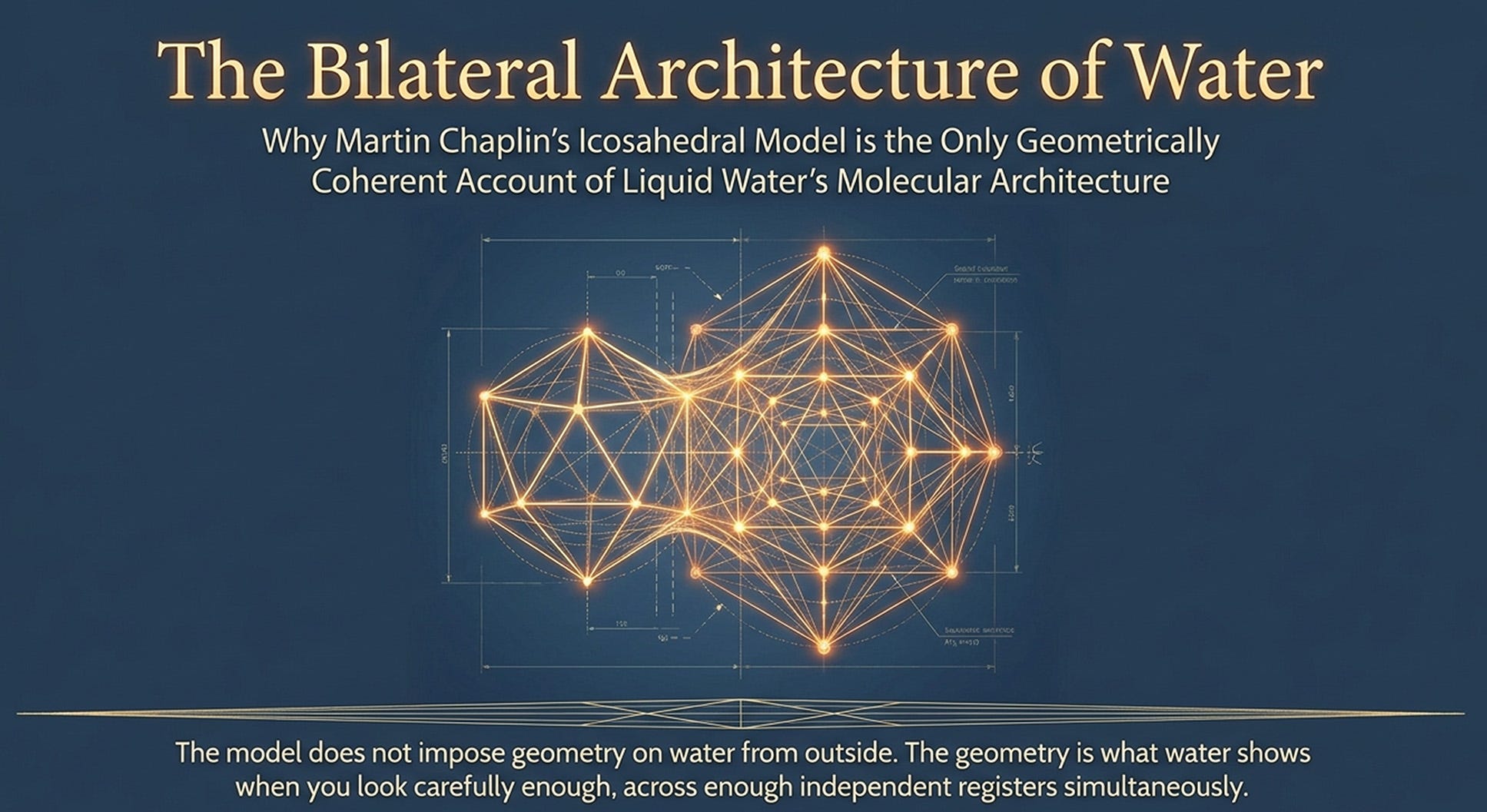
The Method Behind the Model
There is a prior question that water science has largely failed to ask. Before assembling the experimental data, before choosing an instrument, before publishing a model, the question of how we are looking determines what we will find. This is not a philosophical preamble. It is a methodological statement with direct consequences for evaluating the competing models of liquid water structure that have proliferated across the last three decades.
Johann Wolfgang von Goethe’s contribution to natural science was not a theory but a discipline: the sustained, unprejudiced attentiveness to phenomena as they present themselves, prior to the intervention of instrument or abstraction. His Anschauende Urteilskraft — intuitive judgment — is the cultivated capacity to perceive the formative idea operating within a phenomenon, visible to the trained observer who has spent enough time with the phenomenon to develop perception adequate to its nature. This is not mysticism. It is the recognition that cognition is itself a natural organ, capable of development, and that the science produced by an undeveloped cognitive instrument is limited by that instrument’s limitations.
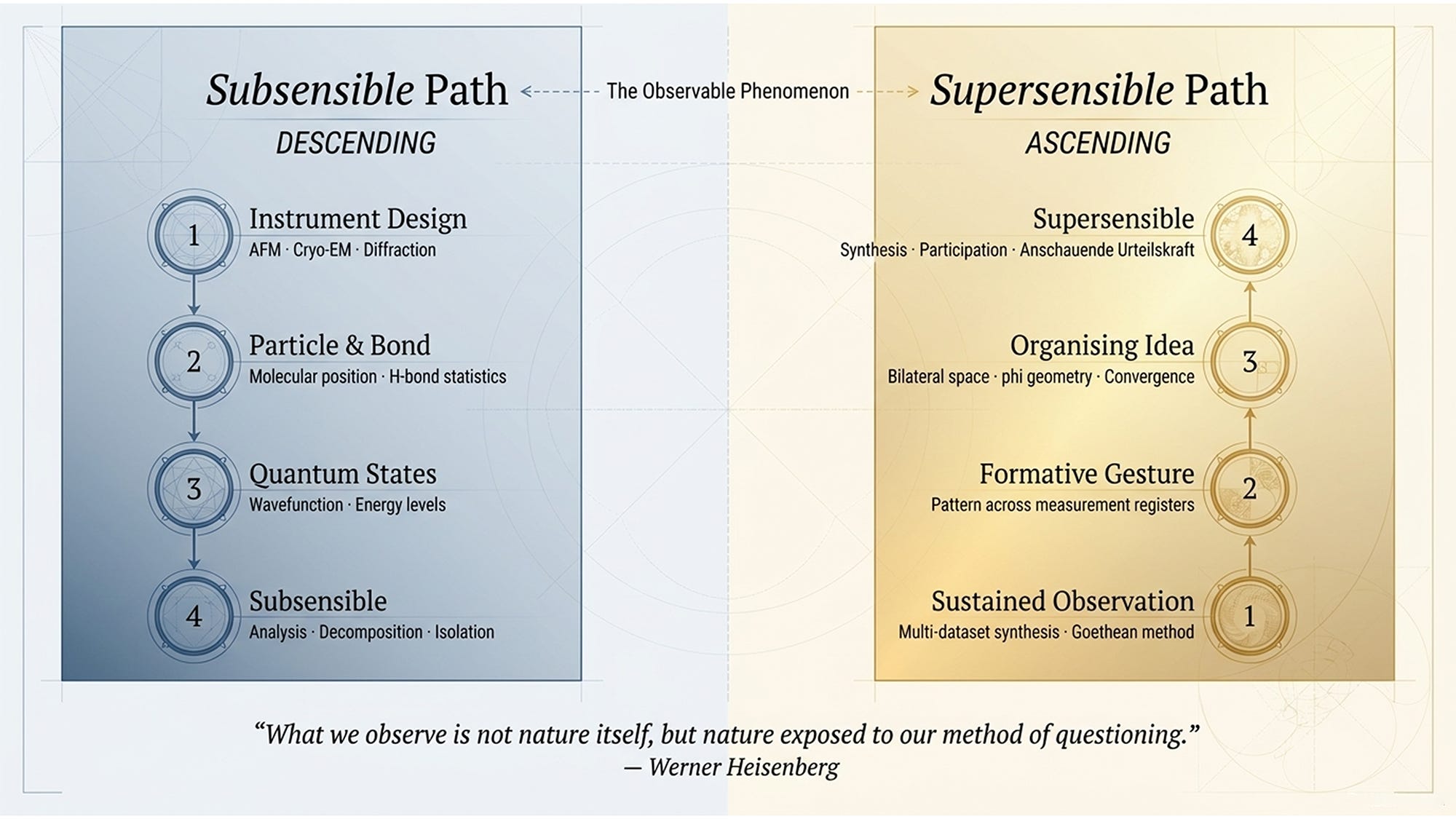
I have invested four decades in this discipline, working across orgone and etheric research, biogeometric antenna design, Goethean natural science, and sacred geometry. The framework I am describing here — the bilateral architecture of projective space, its correspondence to the polar grouping of the Platonic solids, and its confirmation of Martin Chaplin’s icosahedral cluster model — did not arrive as a theoretical construction. It arrived through the same process Goethe described: sustained attentive engagement with the phenomena themselves, until the organizing form became perceptible. That form is the icosahedron. That form is φ. That form is what liquid water actually is.
The model does not impose geometry on water from outside. The geometry is what water shows when you look carefully enough, and long enough, across enough independent registers simultaneously.
Bilateral Space: A New Cognitive Organ
The projective geometry of George Adams provides the decisive cognitive framework. In ordinary Euclidean space, the primitive elements are points, which aggregate into lines, which aggregate into planes. Points are the primary generators; the plane is the derivative. This is the geometry of the laboratory bench, the crystallography diffractometer, the atomic force microscope; instruments designed around the logic of point-to-point measurement, object-to-detector, particle-to-detector.
Projective geometry reveals that this is only half of spatial reality. Space is bilateral: for every theorem about points and their aggregation into planes, there is a precisely dual theorem in which planes are the primitive generators and points are the derivative. In counterspace, Adams’ term for the complementary spatial mode, planes work inward from the cosmic periphery, converging toward a centre. The point-pole works outward from a centre to its periphery. These two spatial modes are mathematically inseparable: every point-operation has an exact plane-operation dual, and neither is more fundamental than the other. Space is constitutively polar in this regard.
The cognitive development this framework demands is real and takes time. Our ordinary spatial intuition is trained entirely in point-pole geometry: we think in objects, locations, distances, centres. Developing the plane-pole intuition requires what I can only describe as a reversal of the habitual direction of spatial thinking: learning to perceive from the periphery inward rather than from the centre outward. The plane at infinity is not a surface far away; it is the spatial complement of a point, the polar dual of a location. Working with this consistently, until it becomes a natural cognitive gesture rather than an intellectual exercise, constitutes the development of a genuine new organ of cognition — a description of what extended engagement with projective geometry actually produces in the practitioner.
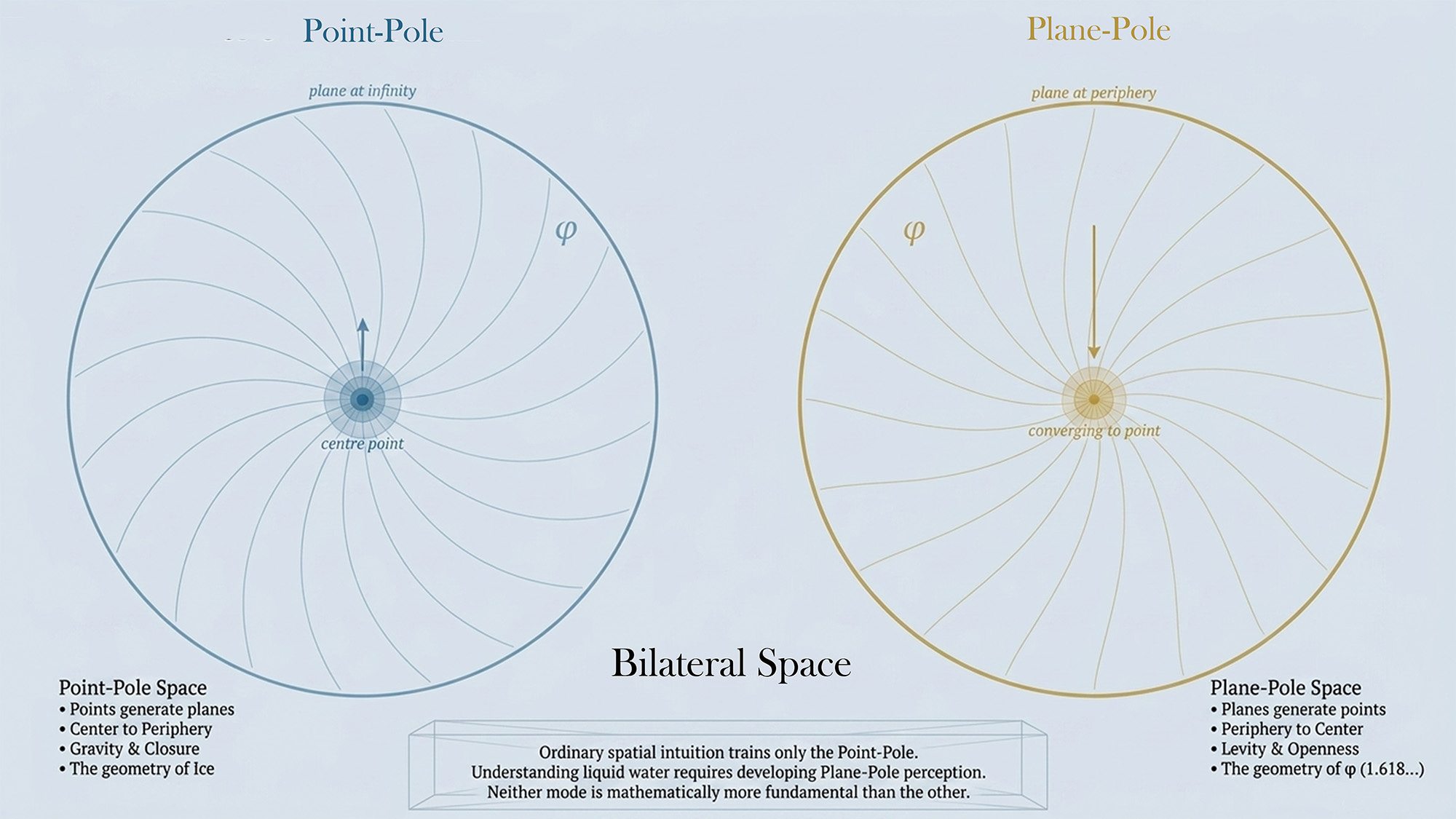
φ — the golden ratio, (1 + √5) / 2 = 1.618… — is the plane-pole’s number. It is, rigorously and provably, the most irrational of all irrational numbers in the sense of continued fraction theory: its continued fraction expansion is [1; 1, 1, 1, 1, …], the slowest-converging of all, the number most resistant to rational approximation. This means φ-based structures are maximally incommensurable with whole-number geometry — they resist closure, resist tessellation, always generate a structured remainder. Adams demonstrated that φ-based geometry is the spatial signature of the plane-pole’s formative activity: the geometry of openness, receptivity, and peripheral organisation working inward.
The Polar Grouping of the Platonic Solids: The Decisive Table
The five Platonic solids divide cleanly into two groups under projective-geometric analysis, and this division is not arbitrary. It is determined by whether the solid’s proportional relationships involve whole-number ratios or φ-based ratios, and correspondingly whether the solid can or cannot tessellate space.
The tetrahedron, cube, and octahedron — the whole-number group — all have edge lengths, diagonals, and circumradii expressible as rational multiples of one another. They tessellate space completely: a cubic lattice fills three-dimensional space without remainder, as does a tetrahedral-octahedral alternation. These are point-pole geometries. They organize from a centre outward, fill space completely, and leave no structural void. They are the geometries of minerals, salts, and, critically, ice.
The icosahedron and dodecahedron — the φ-based group — have proportional relationships that require φ at every scale. The icosahedron’s three mutually perpendicular golden rectangles, whose twelve corners define the twelve vertices exactly, have side ratios of 1 : φ. The dihedral angles, the ratio of circumradius to edge length, the relationship between face area and total surface — all involve φ. Neither the icosahedron nor the dodecahedron can tessellate space; five-fold symmetry is geometrically incompatible with space-filling. They are plane-pole geometries, working from the periphery inward, irreducibly generating structured void in any close-packing arrangement.
Plato assigned the icosahedron to water in the Timaeus, circa 360 BCE. He was working from qualitative geometric reasoning about the nature of fluidity, not from molecular data. That a 2,300-year-old geometric intuition is confirmed exactly by modern solution thermodynamics, spectroscopy, and neutron diffraction is one of the more remarkable convergences in the history of natural philosophy — and it is precisely the kind of convergence that the bilateral space framework predicts. The plane-pole’s spatial signature is φ-based and icosahedral; water, as the living mediator between the levity and gravity principles, carries that signature at the molecular scale.
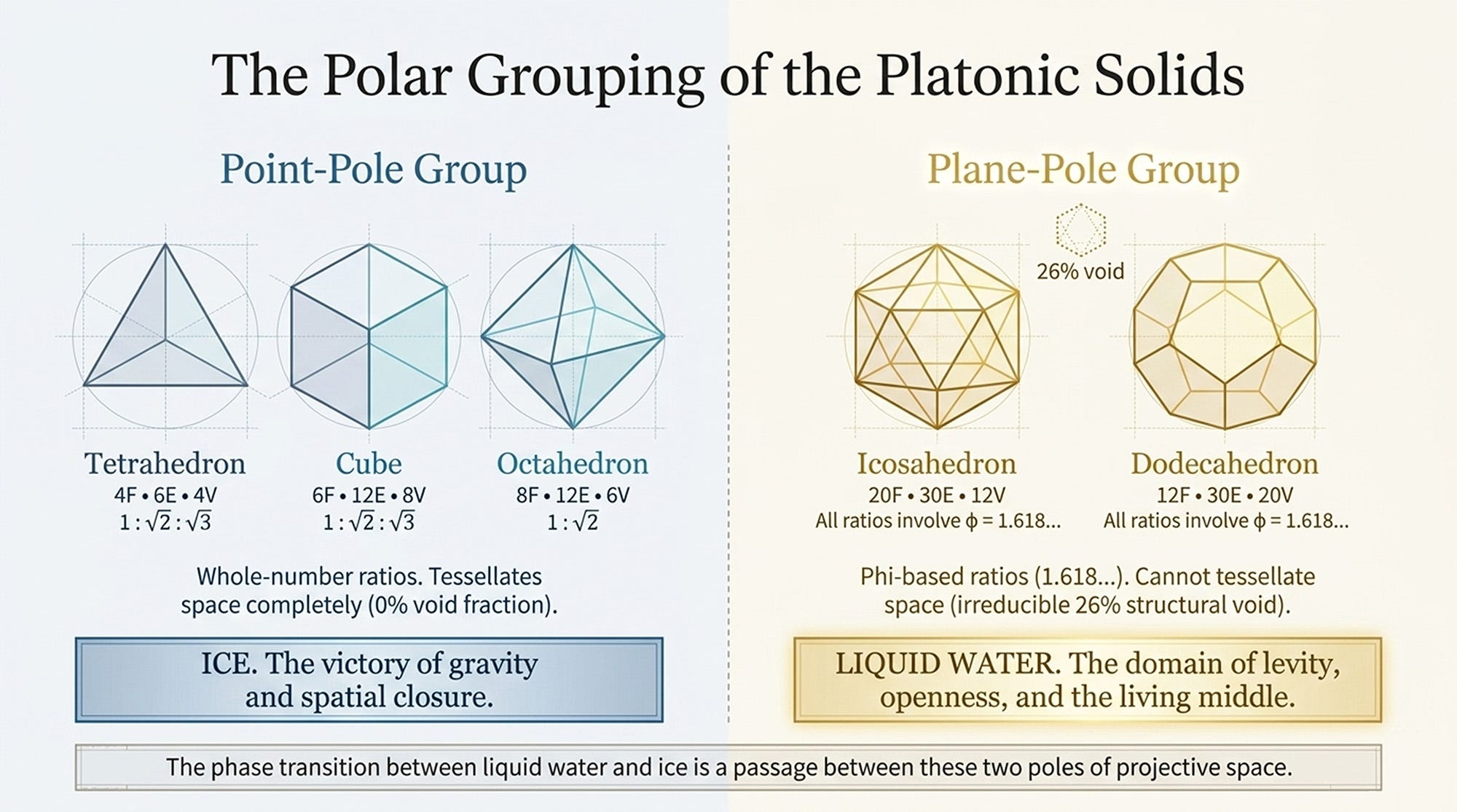
The icosahedron and dodecahedron cannot tile space. This is not a geometric limitation. It is the geometric definition of fluidity — of the living middle that refuses to resolve into either pure levity or pure gravity.
The phase transition between liquid water and ice is, from this perspective, a passage between the two poles of projective space. Ice — hexagonal symmetry, whole-number geometry, space-filling — is the point-pole’s victory: gravity, crystallization, closure. Liquid water — icosahedral symmetry, φ-based geometry, irreducible void — is the plane-pole’s domain: levity, fluidity, openness. The 26% interstitial void between icosahedral clusters in Chaplin’s model is not empty space. It is the structured remainder of five-fold symmetry’s irreducible incommensurability with spatial closure — the Pythagorean comma of molecular architecture, the gap that keeps water alive.
Martin Chaplin’s Icosahedral Hierarchy: The Model the Data Demands
Martin Chaplin’s icosahedral cluster model (Chaplin 1999; London South Bank University) is the product of a multi-decade synthesis of independent experimental datasets, none of which individually resolves cluster geometry, but whose simultaneous constraints together demand a specific geometric solution. This is the methodology of structural inference at its most rigorous: over-determination by independent evidence streams.
The hierarchy Chaplin establishes runs as follows. The foundational unit is a pentagonal ring of five hydrogen-bonded water molecules, with O-O-O angles of 108°, the interior angle of a regular pentagon, identical to the vertex angle of φ-based polygons. This ring is not a theoretical construct; it is required by the measured angular distribution functions in liquid water’s neutron diffraction data. Five such pentagonal rings assemble into a dodecahedral shell of twenty water molecules — twelve pentagonal faces, twenty vertices, the point-pole’s dual in φ-space. Twenty of these dodecahedral units, sharing faces, assemble into the 280-molecule icosahedral cluster: 20 triangular faces, 12 vertices each marking the convergence of five triangular faces in pentagonal symmetry, and three mutually perpendicular golden rectangles whose 12 corners define the vertices with exact φ proportions. Thirteen of these 280-molecule icosahedra, one central and twelve surrounding, assemble into the 1,820-molecule super-icosahedron — the icosahedron of icosahedra, the plane-pole fractal complete at four nested scales.
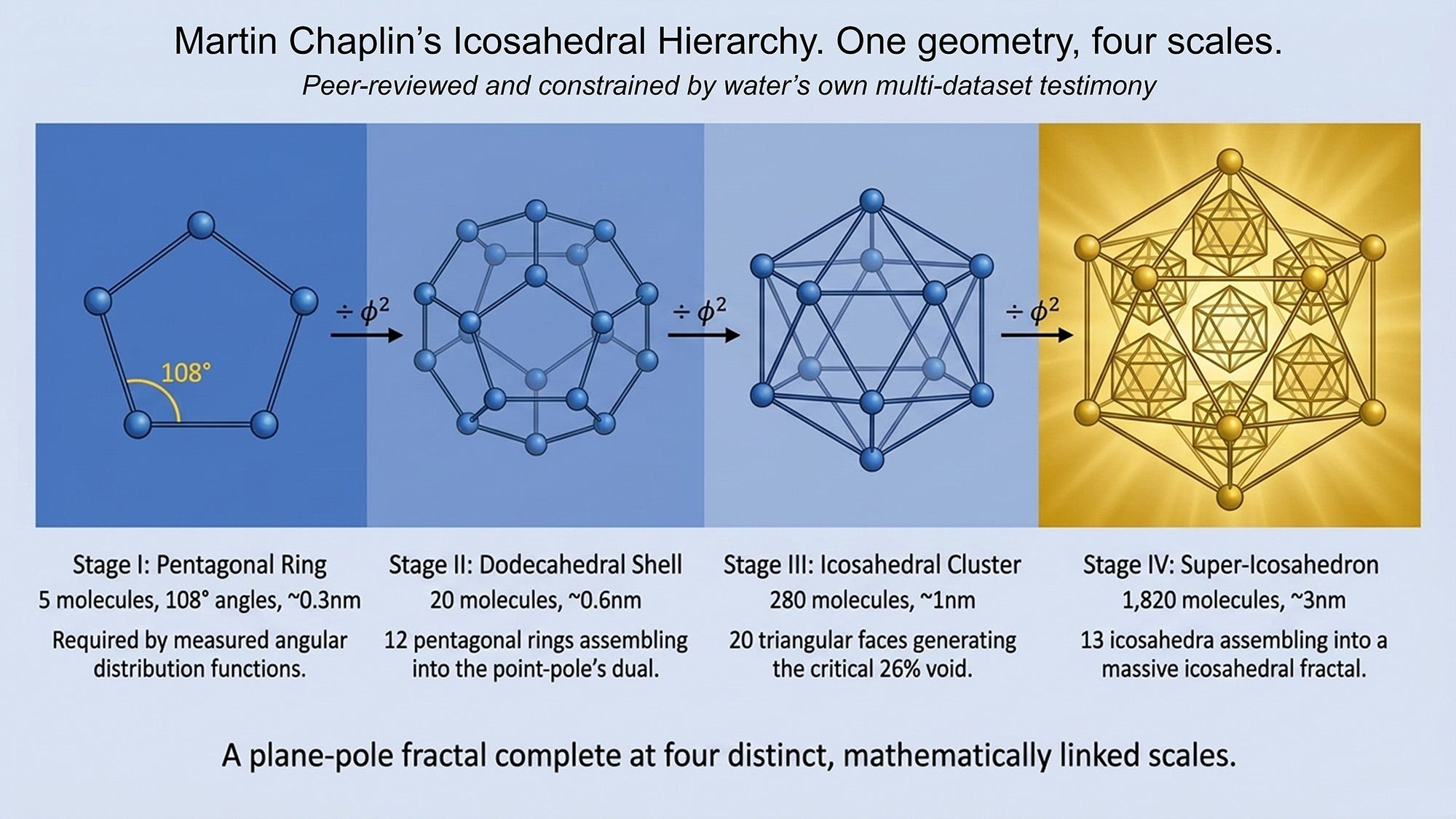
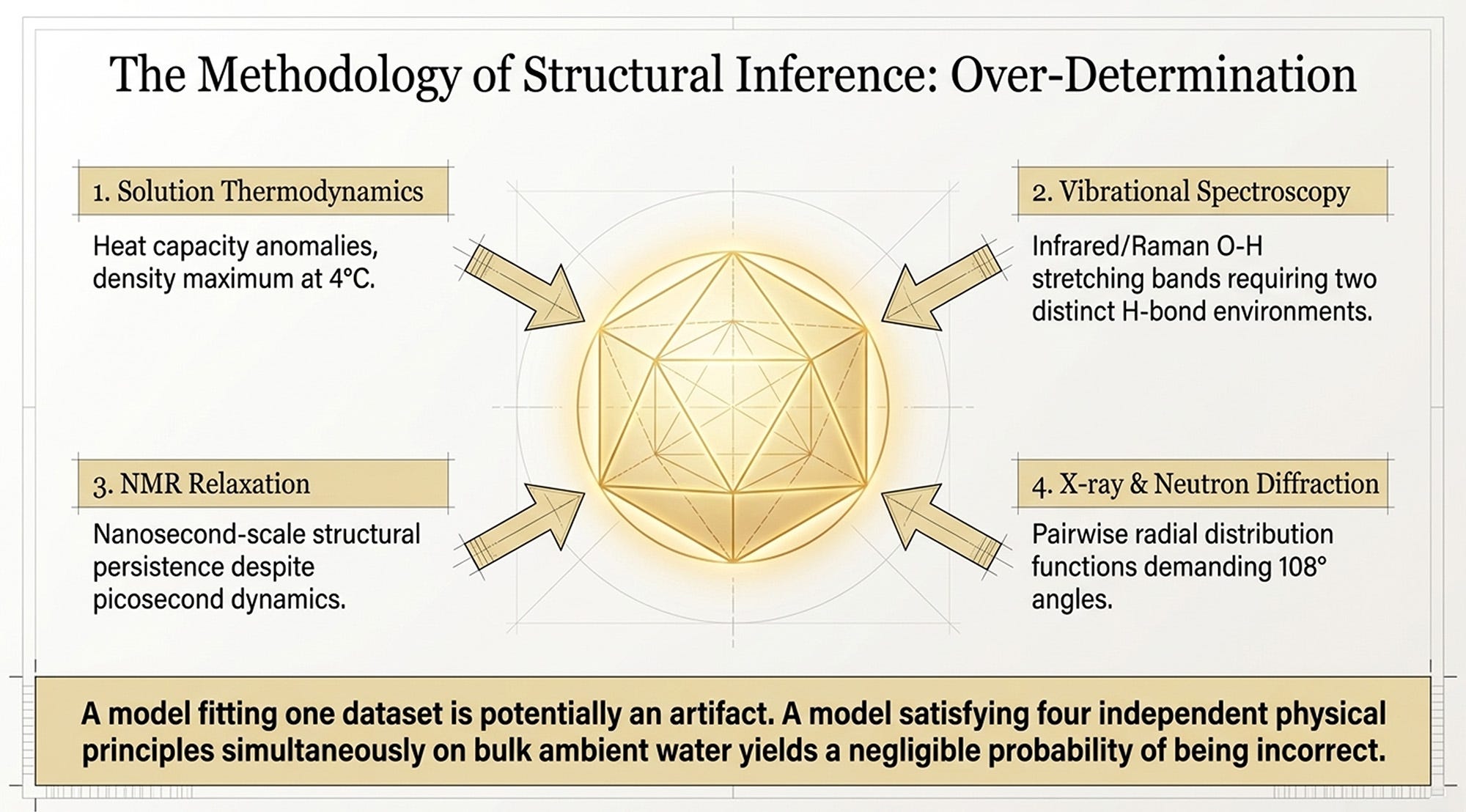
The experimental datasets this model simultaneously satisfies include: solution thermodynamics (heat capacity anomalies, density maximum at 4°C, isothermal compressibility minimum near 46°C); dielectric relaxation spectra (two distinct relaxation processes corresponding to intra-cluster and inter-cluster dynamics, measured by Yagihara et al. 2019 and demonstrating fractal relaxation dynamics with measurable fractal dimensionality); infrared and Raman vibrational spectroscopy (O-H stretching bands requiring at least two distinct hydrogen-bonding environments, consistent with the intra-cluster versus inter-cluster distinction); NMR relaxation times (nanosecond-scale structural persistence consistent with cluster-level organisation despite picosecond H-bond dynamics); X-ray and neutron diffraction radial distribution functions (O-O, O-H, and H-H pairwise distance distributions requiring icosahedral geometry as the minimum-complexity consistent model); and the full suite of water’s anomalous properties — all of which Chaplin demonstrates follow naturally from the φ-based icosahedral architecture.
The epistemological significance of this over-determination cannot be overstated. A model that fits thermodynamic data is always potentially a thermodynamic artefact. A model that simultaneously fits thermodynamics, spectroscopy, diffraction, and NMR relaxation — independently measured, using different physical principles, on bulk liquid water at ambient conditions — is constrained from four directions at once. The probability of an incorrect model satisfying all four simultaneously is negligible. This is not Chaplin’s theory of water. It is what water’s own data, taken as a whole and across all available measurement registers, demands.
I want to make a further observation about Chaplin’s methodology that is rarely noted in evaluations of his work. His approach is, structurally and procedurally, a Goethean one, whether or not he would use that term. He did not begin with a model and seek confirmation. He began with the data and asked what geometry was consistent with it. He expanded the dataset over decades, revised the cluster dimensions as new spectroscopic constraints accumulated, and arrived at a form, the icosahedron, that his training as a water chemist gave him no particular reason to expect. The form emerged from the phenomena themselves when attended to with sufficient rigor and patience across sufficient time. That is Anschauende Urteilskraft in action, operating within a mainstream scientific career.
The Femtosecond Constraint: Why Static Bulk Structure Is Impossible and What Persists Instead
Before evaluating the competing models, one experimental fact must be placed at the centre of the analysis, because it determines what kind of structural claim is physically permissible for liquid water. Hydrogen bond lifetime in liquid water at physiological temperatures is approximately 200 femtoseconds (Elsaesser 2009; Nibbering and Elsaesser 2004). A femtosecond is 10^-15 seconds. In one second of clock time, the hydrogen bond network of liquid water undergoes approximately five trillion complete reorganizations.
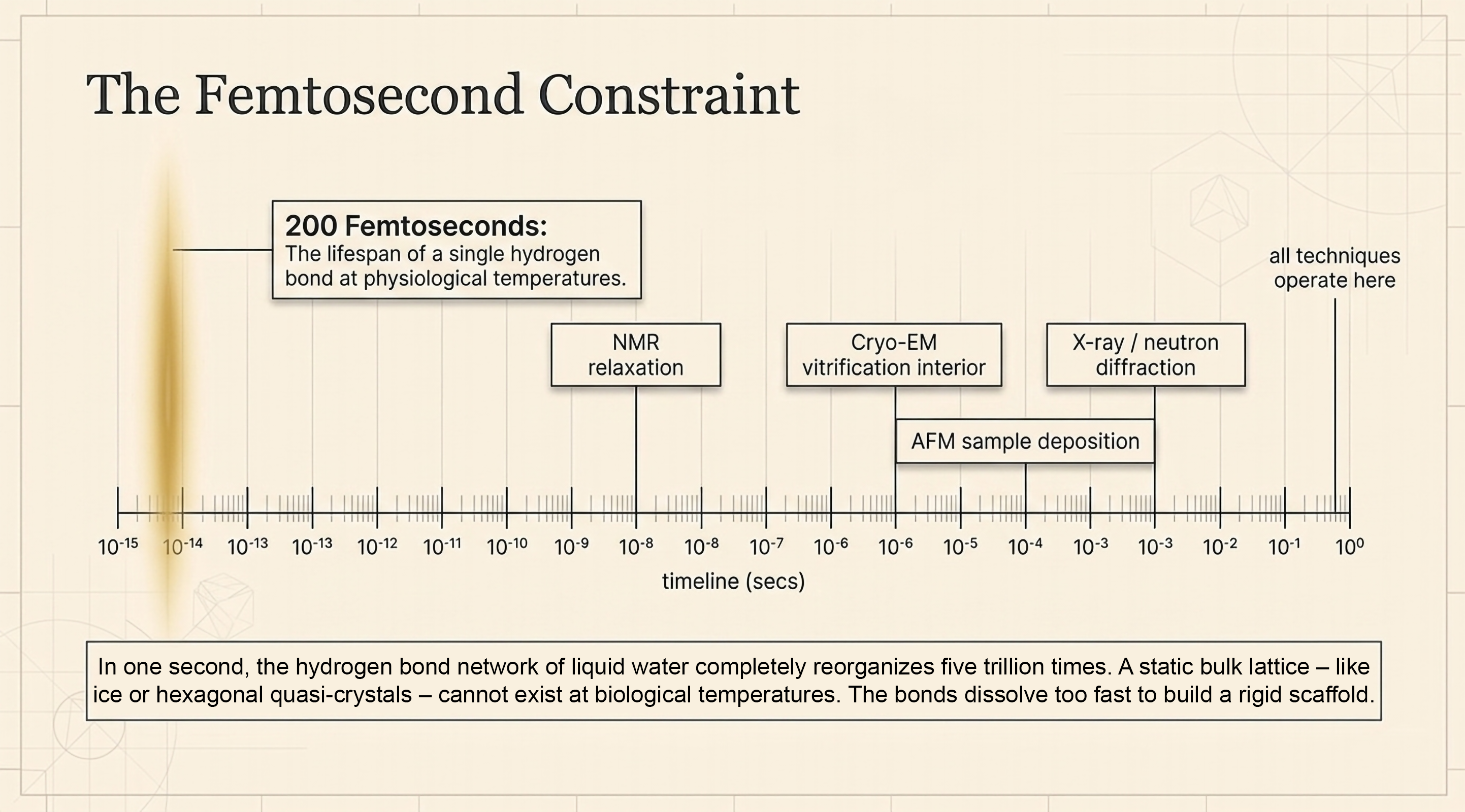
This single measurement rules out, with finality, any model in which liquid water’s biological or physical properties derive from a persistent static hexagonal lattice. There is no hexagonal bulk structure in liquid water at body temperature. There cannot be. The bonds that would constitute it dissolve and reform on a timescale ten orders of magnitude faster than any biological process they are supposed to mediate. A hexagonal lattice in bulk liquid water would be like trying to build a bridge out of soap bubbles that last 200 femtoseconds, a fifth of a trillionth of a second, each.
What the femtosecond data confirms is precisely what Chaplin’s model and Del Giudice’s quantum electrodynamical framework both assert from different directions: the organisation of liquid water is electromagnetic, not structural. What persists across the H-bond reorganization timescale is not a fixed molecular arrangement but a field pattern, a topologically stable configuration of the quantum vacuum electromagnetic field that organises molecular positions without requiring those molecules to hold still. Emilio Del Giudice and Giuliano Preparata (1994, 2006) demonstrated from quantum field theory that coherent domains of approximately 100 nanometres diameter, containing approximately 5 to 10 million water molecules in phase-locked oscillation with a self-trapped electromagnetic field, are the minimum energy configuration of bulk liquid water under ambient conditions. The molecules within these domains oscillate coherently together; the domain geometry persists through trillions of individual H-bond reorganizations because it is the field pattern, not the molecular arrangement, that is the structural reality.
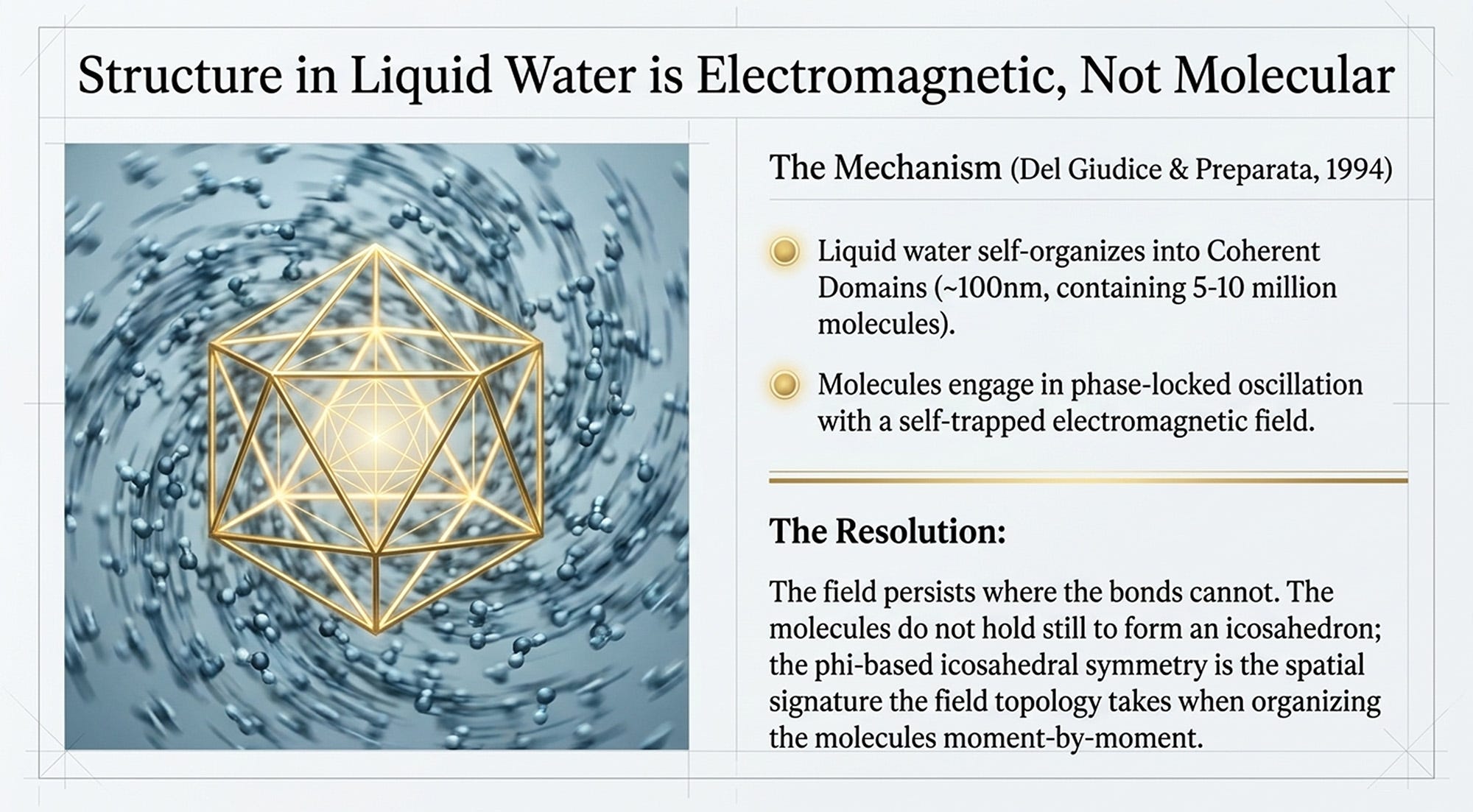
The coherent domain is Del Giudice’s description of Adams’ peripheral force in molecular terms. The plane-pole works through the field topology, not through the momentary molecular positions. The icosahedral geometry of Chaplin’s clusters is the spatial signature this field topology takes when it organises water molecules — not because the molecules hold that shape statically, but because φ-based icosahedral symmetry is the geometry of the plane-pole’s formative activity, and the plane-pole’s field patterns organize molecular positions accordingly, moment by moment, across the full cascade from 1-nanometre cluster to 100-nanometre coherent domain to 100-micrometre exclusion zone to atmospheric organisation.
Hexagonal Water Models: Real Phenomena, Compromised Geometry
Gerald Pollack’s exclusion zone research (Pollack 2006, 2013) represents one of the most significant contributions to water science of the last two decades. The phenomena he documents are real, reproducible, and multiply confirmed by independent measurement: exclusion zones form adjacent to hydrophilic surfaces, extending up to several hundred micrometers into the bulk liquid; these zones absorb strongly at 270 nanometres in the UV; they carry a net negative charge while extruding protons into the surrounding bulk; they behave as a distinct physical phase with measurably different viscosity, density, and refractive index from the adjacent bulk water; and their formation is enhanced by infrared radiation at wavelengths corresponding to water’s absorption bands.
The inferential leap occurs in the structural interpretation. From the exclusion behaviour, the charge separation, and the UV absorption signature, Pollack derives a specific molecular geometry — a hexagonal H₃O₂ honeycomb lattice, a quasi-crystalline sheet structure analogous to ice but distinct from it. This geometric model is not directly observed in his primary experiments; it is inferred from indirect signatures and then presented as the mechanism explaining the EZ phenomena. The femtosecond constraint applies here with full force: hydrogen bonds in liquid water reorganize completely in approximately 200 femtoseconds, thirteen orders of magnitude faster than any of the measurement timescales Pollack employs — UV-vis spectroscopy, NMR, microelectrode potential measurement, infrared imaging. What these techniques register is a time-averaged signal across millions of H-bond reorganisation events. A static hexagonal lattice cannot survive that reorganisation rate; what persists is an electromagnetic field pattern, a charge distribution, a coherent domain — precisely what Del Giudice’s QED framework describes, and precisely what the bilateral space framework identifies as the plane-pole’s organizational signature.
The methodological problem extends to imaging approaches used within the same research program. Hwang et al. (2018), publishing in PLoS ONE in work that engages directly with Pollack’s EZ water framework, used cryogenic scanning electron microscopy on powder-supernatant water — hydrophilic ceramic powder agitated with deionized water, the supernatant collected, then frozen and imaged — and concluded that the resulting cell-like heterogeneous ice structure constitutes evidence for three-dimensional structured water at ambient temperature. The preparation paradox is inscribed in the paper’s own method: the sample is frozen before imaging, and what the cryo-SEM records is the ice that formed during vitrification, not the liquid water that preceded it. The cell-like walls and high-density regions the authors identify are features of the freezing trajectory. The powder contact introduces a further confound: the ceramic surface imposes boundary conditions on molecular arrangement during the crystallization event the cryo-SEM is actually capturing. Genuine phenomena — charge separation, EZ exclusion — are here interpreted through an imaging technique that cannot access the ambient liquid state in which those phenomena occur.
Where Pollack’s account requires revision, then, is precisely in the geometric interpretation placed on these genuine phenomena. Hexagonal geometry is the point-pole’s spatial signature — the geometry of ice, of whole-number Platonic closure, of structures that resolve into stable spatial tessellation. Liquid water’s exclusion zones are warm, biologically active, metabolically relevant structures. Their geometry is the plane-pole’s signature: coherent pentagonal icosahedral domains, stabilized and spatially extended by the hydrophilic surface acting as a template for the peripheral force’s inward-working organisation. The surface provides the boundary condition that allows the plane-pole’s field topology to organize coherent domains into an extended layered structure. The result is Pollack’s EZ — but the geometry underlying it is Del Giudice’s coherent domain structure, which holds Chaplin’s icosahedral cluster geometry, which is Adams’ plane-pole spatial signature.
What Pollack demonstrates, and what the hexagonal interpretation cannot accommodate, is the proton exclusion into the bulk phase. Coherent pentagonal domains organised by the plane-pole’s peripheral force work by extruding the chemistry — the protons, the point-pole’s carriers — into the surrounding medium, just as the 26% interstitial void of Chaplin’s icosahedral cluster is the space from which the plane-pole’s field geometry has excluded the molecular bulk. The proton extrusion is the molecular-scale expression of the same bilateral space geometry operating at the cluster level. Correcting Pollack’s hexagonal interpretation does not diminish his experimental contribution; it elevates it, by placing his observations within the unified framework that explains them most coherently.
Pitkänen’s TGD Model: Phenomenological Convergence and Non-Phenomenological Departure
The Finnish theoretical physicist Matti Pitkänen has developed, within his Topological Geometrodynamics (TGD) framework, an extensive account of water structure that engages seriously with Pollack’s exclusion zone data and builds directly on Chaplin’s icosahedral cluster model. His conclusions regarding geometry are substantially convergent with my thesis: he identifies the icosahedral and dodecahedral hierarchy, the golden ratio proportions at each scale, and the 26% void volume as structurally significant and biologically indispensable — observations my thesis confirms and extends through the bilateral space framework. He correctly recognises that the approximately 26% interstitial space generated by icosahedral packing is occupied by functionally active water rather than being genuinely empty, enabling the dynamic reorganisation and density fluctuations that characterise water’s anomalous behavior. He further correctly recognises that conventional chemistry has no adequate mechanism for the long-range coherence that Pollack’s exclusion zone data demonstrates, and that any adequate account of water’s biological role requires a theoretical framework that conventional molecular physics does not supply. In all of this his diagnostic is sound, and his geometric observations form part of the convergence argument this thesis advances.
Where Pitkänen’s account parts company with the phenomenological standard is precisely where it departs from the phenomena themselves. Having correctly identified the explanatory gap that conventional chemistry cannot close, he fills it not by following the geometric form of the water phenomena toward its own adequate theoretical expression, but by importing the pre-existing ontology of TGD: dark protons with variable effective Planck constants (h_eff = n × h) residing on magnetic flux tubes belonging to a “magnetic body” associated with the exclusion zone. These entities are not derived from any observation of water. Nothing in Chaplin’s multi-dataset thermodynamic synthesis requires a variable Planck constant. Nothing in Pollack’s exclusion zone measurements calls for dark protons on magnetic flux tubes. Nothing in Del Giudice’s quantum electrodynamical treatment of coherent domains — which already provides a rigorous, independently testable mechanism for the long-range electromagnetic organisation that both Pollack and Pitkänen seek to explain — requires novel ontological entities beyond the established framework of quantum field theory.
This is the methodological distinction Goethe’s approach makes unavoidable. His polemic against Newtonian optics was not a theory against a theory, it was a return to the phenomenon against a departure from it. Newton’s white light containing all colours as separable components is not something observable; it is a theoretical entity inferred from the prism experiment and then read back into the light as its hidden cause. Goethe’s charge was that the phenomenon itself, attended to with sufficient patience and comprehensiveness, generates its own organizing principle without requiring the unobservable component entity. The same charge applies here. Pitkänen arrives at the correct geometric form — icosahedral, φ-based, plane-pole in character — and then departs from it, replacing the form’s own explanatory sufficiency with an imported metaphysics. The dark proton is the TGD equivalent of Newton’s hidden colour: a theoretical entity introduced to explain what the phenomenon, properly understood, already explains through its own geometry. The 26% void, the φ-based hierarchy, the coherent domain organisation, the geocosmic sensitivity — all of these are fully accounted for within the bilateral space framework and Del Giudice’s QED, both of which remain disciplined by what the phenomena themselves offer. The phenomena do not ask for the creation of novel dark protons. They ask for a more adequate understanding of the geometry that is already visible within them.
It is worth noting that this pattern — correct geometric observation followed by non-phenomenological theoretical extension — is not unique to Pitkänen. Pollack’s hexagonal H₃O₂ lattice model applies the same structure: the exclusion zone phenomenon is real and the geometric interpretation is the theorist’s addition, imported from crystallographic habit rather than derived from the EZ data itself. Double Helix Water’s 8-molecule dipole stack follows the same pattern. In each case the researcher arrives at a genuine phenomenon that conventional chemistry cannot explain, correctly identifies that the phenomenon requires a structural account, and then supplies a structural model whose geometry is chosen by prior theoretical commitment rather than read from the phenomenon. The bilateral space framework, grounded in Adams’ projective geometry and constrained by Chaplin’s multi-dataset synthesis, offers the alternative that these researchers were, in each case, reaching toward: an account of water’s geometry that the phenomena themselves generate, when attended to across sufficient independent registers simultaneously.
Double Helix Water: The AFM Evidence and Its Methodological Limits
The Double Helix Water research program, developed by D.L. Gann and colleagues over more than two decades and the subject of 36 published papers, rests on the discovery by atomic force microscopy of stable supramolecular structures in specially prepared water samples (Lo et al. 1996; Lo 2004). The biological evidence for these preparations is genuine: the 1998 UCLA study by Benjamin Bonavida and X.H. Gan demonstrated dose-dependent cytokine modulation in fresh human whole blood exposed to stable water cluster preparations, with TNF-α peaking at 8 hours, sequential appearance of IL-12, IL-6, and IFN-γ, and delayed IL-10 emergence at 24 hours consistent with a balanced, ordered immune response rather than blunt activation. The GC/MS confirmation that no organic contaminants were present establishes that the biological effects arise from the water’s structural state itself. This is important confirmatory evidence for the general thesis that water’s structural organisation is a primary biological variable, independent of chemistry.
The geometric model proposed for these structures — an 8-molecule stacked dipole array as the foundational unit, aggregating in solution into double helix forms resembling DNA — requires separate and more careful evaluation. The foundational imaging technique is atomic force microscopy of samples deposited onto solid substrates, typically mica or silicon, under conditions that involve partial or complete dehydration of the sample. This is a surface technique operating on dried or partially dried deposits, not a technique for imaging free bulk water structure.
The preparation paradox is decisive here. AFM images what is present on a surface under the conditions prevailing during and after deposition. The act of depositing a water sample onto a solid substrate introduces, simultaneously: progressive concentration as the water film thins; surface tension forces at the receding liquid-air interface, which are substantial at the nanometer scale; electrostatic interaction between the solute structures and the substrate chemistry; and the full set of drying-dynamics that govern how supramolecular aggregates organize on surfaces as the solvent withdraws. These are powerful structure-directing forces that operate independently of whatever geometry prevailed in the free solution phase. The aggregation of biological molecules into ordered linear and helical forms on mica surfaces during AFM sample preparation is a well-documented phenomenon for materials — including proteins and DNA — that exist in entirely different geometries in free solution.
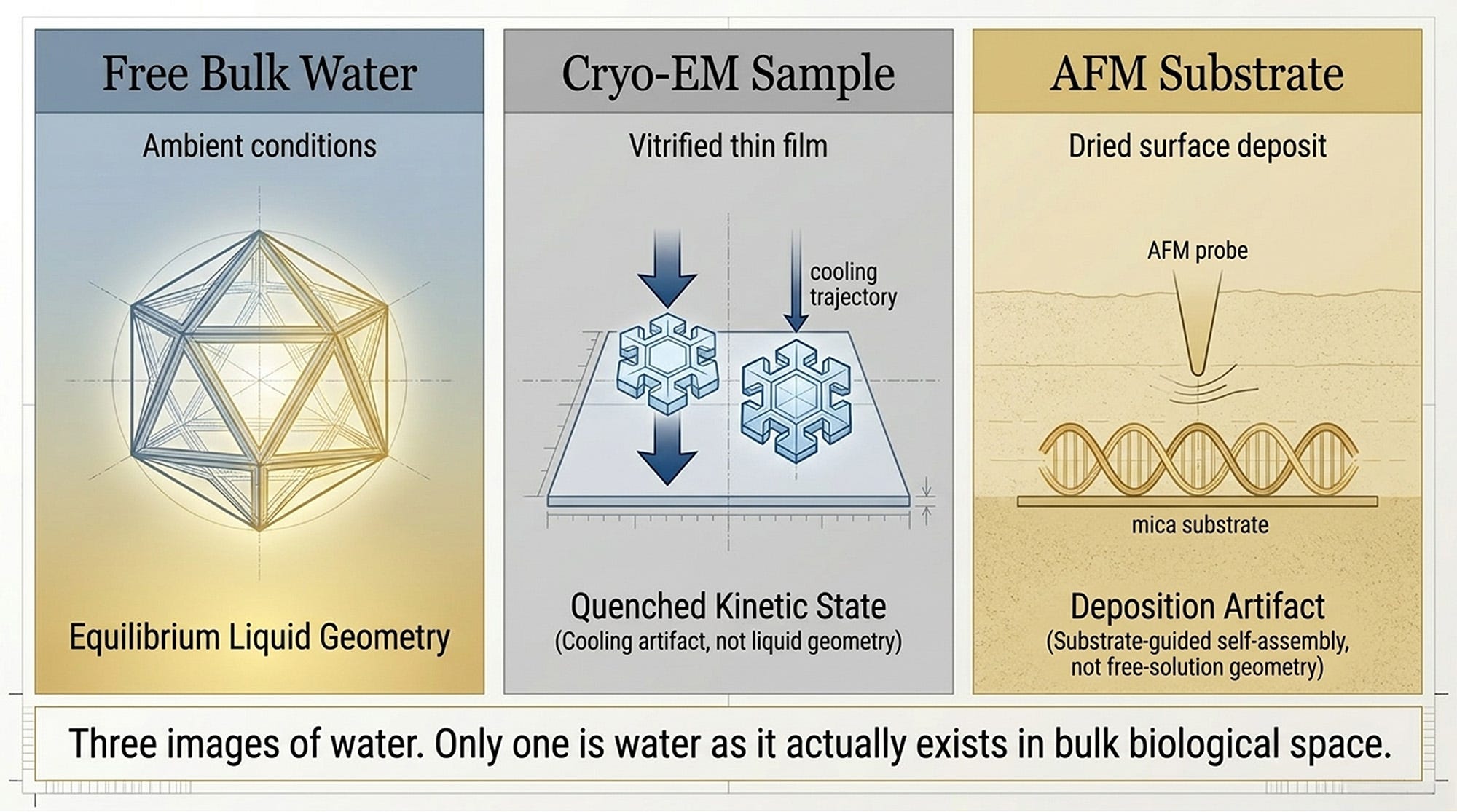
The 8-molecule foundational unit is a theoretical model, not a structure resolved by AFM. Individual water molecules within a cluster are below AFM’s practical lateral resolution in this experimental context. The geometry is inferred from the aggregate morphology of the deposited structures and from computational modelling, not read directly from the imaging data. The double helix form of the aggregates may reflect the intrinsic self-assembly tendency of the clusters under deposition conditions; it may equally reflect the substrate-guided organisation of material that had no helical form in free solution.
Cryo-electron microscopy, whose preparation paradox was identified in the Pollack discussion above, carries analogous methodological constraints of a different kind. Vitrification — the ultra-rapid cooling process that preserves the sample for electron beam imaging — operates at cooling rates of approximately 10⁵ Kelvin per second in the fastest implementations. At the sample interior, actual cooling rates are considerably slower. The hydrogen bond network, reorganizing at 200 femtoseconds, undergoes approximately 10^10 complete restructurings during even the fastest practical vitrification. The structure captured is the arrangement the network adopted during the cooling trajectory — a kinetically quenched state that reflects the glass transition dynamics of cooling water, not the equilibrium geometry of the ambient liquid phase. Additionally, cryo-EM requires sample thicknesses of tens to hundreds of nanometres: a regime where surface confinement effects substantially modify water structure relative to bulk.
X-ray and neutron diffraction avoid both of these preparation problems by working with bulk liquid samples at ambient conditions. Their limitation is different: diffraction from a liquid produces a radial distribution function — a statistical ensemble average of all pairwise atomic distances across approximately 10^23 molecules, integrated over measurement times of seconds to minutes and therefore across approximately 10^16 H-bond lifetimes simultaneously. This is a smeared ensemble average, not a structural image. Any specific cluster geometry consistent with the radial distribution function must be established by forward modelling: propose a geometry, calculate the predicted distribution function, compare with experiment. The icosahedral cluster model produces the best fit to the experimental O-O, O-H, and H-H distribution functions measured by neutron diffraction with isotopic substitution. It does so as part of Chaplin’s multi-dataset synthesis, not on the basis of diffraction data alone.
The epistemological hierarchy is therefore clear. Chaplin’s synthesis methodology — bulk samples, ambient conditions, multiple independent measurement registers, simultaneous constraint satisfaction — is the most reliable currently available approach to liquid water’s molecular architecture. The imaging techniques — AFM, cryo-EM — produce real images of real material in real geometries, but the material is in a state (dried surface deposit; vitrified thin film) that differs in important and experimentally established ways from free bulk water at ambient temperature. The geometric conclusions drawn from these images about free-solution structure are theoretical extrapolations, not direct observations.
The stable water cluster phenomenon documented by Bonavida et al. is real. The double helix aggregation observed on mica substrates is real. What requires scrutiny is the inference from surface-deposition morphology to free-solution geometry — an inference that crosses the precise methodological boundary that the preparation paradox marks.
The Convergence Argument: Why the Icosahedral Model Is the Most Probable
I have invested considerable time with the various models and the evidence behind them, and the convergence argument is the one that carries the most logical weight. It is the argument from independent derivation: when researchers working from completely different starting assumptions, using different methodologies, in different institutional contexts, arrive at the same geometric form, the probability that this convergence is coincidental approaches zero.
Plato assigned the icosahedron to water in the Timaeus on the basis of qualitative geometric reasoning about the nature of fluidity. George Adams derived the φ-based icosahedral form as the mathematical expression of the plane-pole’s spatial activity, from projective geometry, with no reference to water chemistry. Emilio Del Giudice arrived at coherent domain organisation in water from quantum field theory, finding that the phase-locked oscillation geometry of the vacuum electromagnetic field in bulk water takes the spatial form consistent with pentagonal symmetry. Martin Chaplin synthesized four decades of independent experimental measurements and found the icosahedral cluster hierarchy as the unique geometric solution satisfying all constraints simultaneously. Viktor Schauberger observed implosive vortex geometry in natural water flows over decades of careful empirical observation and found φ-spiral organisation as the water’s own preferred dynamic form. Theodor Schwenk’s flow-form research documented φ-spiral and meandering geometries as the spontaneous expression of water’s formative gesture across scales.
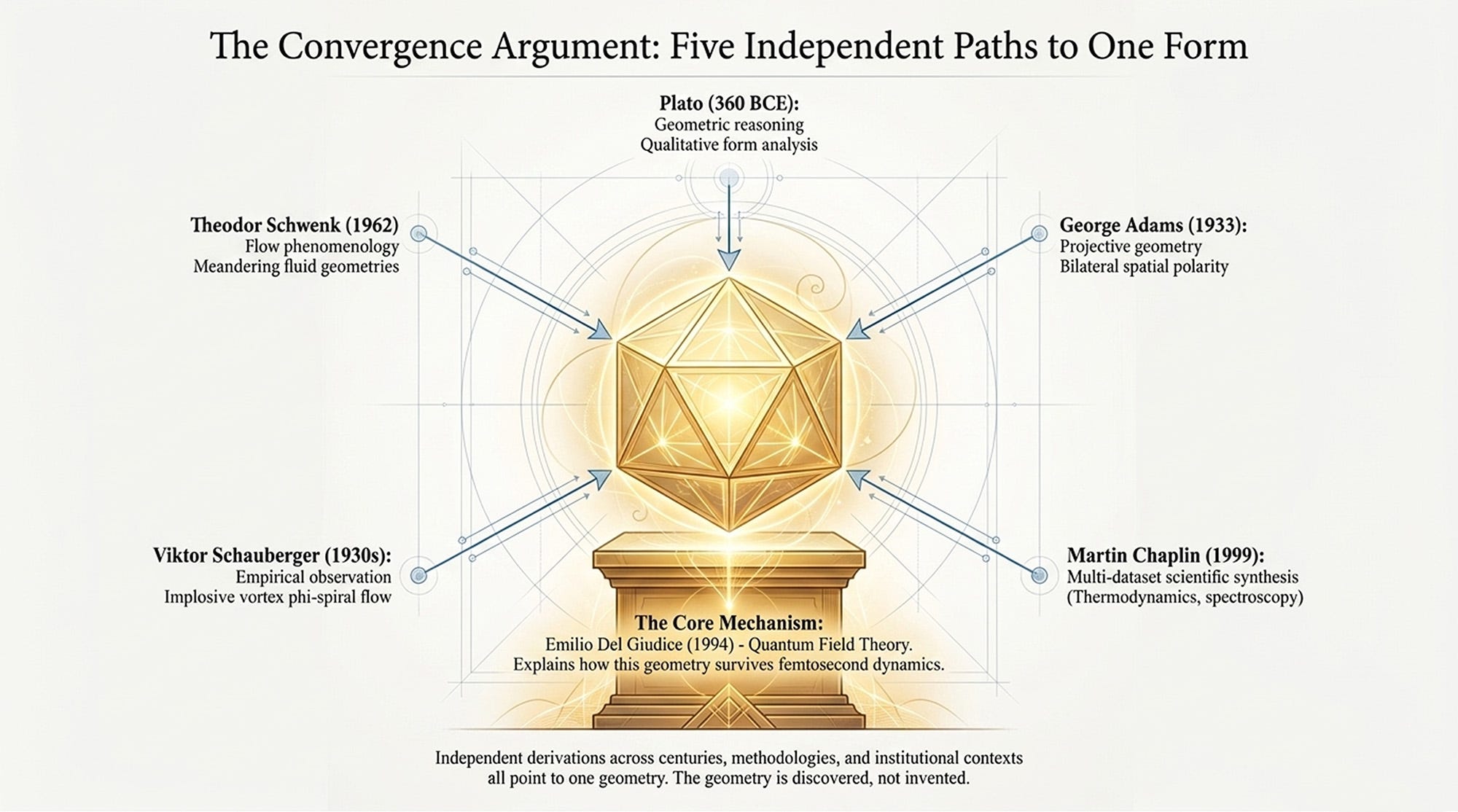
These are not one researcher’s findings extrapolated across domains. They are independent derivations, from geometry, quantum field theory, solution thermodynamics, spectroscopy, and direct empirical observation, all converging on the same answer. In the framework I am developing, this convergence is precisely what the bilateral space model predicts: the plane-pole’s spatial signature is φ-based and icosahedral, and wherever a phenomenon expresses the plane-pole’s formative activity — whether in living water, in mathematical space, in quantum field geometry, or in the careful observation of mountain streams — that signature will appear. The convergence is not coincidence. It is the same geometry being arrived at from multiple directions because it is the actual geometry of the thing.
The hexagonal and double helix models, by contrast, each represents a single researcher’s or research group’s interpretation of a single measurement modality, applied to samples in altered states. They are not wrong about the phenomena they observe. Pollack’s exclusion zones are real. Bonavida’s immune effects are real. The aggregation structures on AFM substrates are real. But the geometric interpretations placed on these real phenomena — hexagonal H₃O₂ lattice, stacked 8-molecule dipole array — are not confirmed by independent derivation. They are not constrained by multiple simultaneous datasets. They do not satisfy the femtosecond constraint. And they emerge from methodologies that have well-characterised limitations in their applicability to free bulk water structure.
The icosahedral φ-based model accounts for the real phenomena behind both competing models more completely than those models account for them themselves. The exclusion zone is more coherently explained by pentagonal coherent domains stabilized by hydrophilic surface boundary conditions than by a hexagonal quasi-crystalline sheet that the femtosecond dynamics make physically untenable. The biological activity of stable water clusters is more coherently explained by their role as concentrated regions of coherent domain organisation — the plane-pole’s spatial signature in molecular form — than by an 8-molecule dipole stack whose geometry is inferred from surface-deposition artefacts. The icosahedral framework absorbs these findings and explains them; the competing models cannot absorb each other.
The Organ of Cognition and Its Development
I want to close with a methodological observation that bears directly on why the bilateral space framework is not merely a useful interpretive tool but a necessary cognitive development for this field, as well as many other areas of science.
Conventional water science is conducted entirely within point-pole cognitive categories. The instruments are point-pole instruments: they measure from a defined location, toward a defined target, quantifying a defined parameter. The mathematical frameworks are point-pole frameworks: differential equations in Cartesian coordinates, statistical mechanics of particle ensembles, quantum mechanical wavefunctions in position space. The models that emerge from these methods will naturally tend toward point-pole geometries — toward centres, particles, lattices, defined positions — because the cognitive and instrumental apparatus brings those categories to the investigation.
This is not a failure of mainstream water science. It is a limitation inherent to any investigation conducted with a partially developed cognitive instrument. The plane-pole’s contribution to water’s organisation is invisible to purely point-pole methodology, for the same reason that a radio antenna designed to receive only one frequency is transparent to all other frequencies. The signal is present; the instrument is not calibrated to receive it.
Developing the bilateral space framework as a cognitive organ — learning to think simultaneously in both spatial modes, to perceive the plane-pole’s formative activity as directly as the point-pole’s — makes certain things visible that were previously invisible. The 26% interstitial void in icosahedral packing is no longer an incidental geometric consequence; it is the plane-pole’s signature, structurally necessary and functionally indispensable, the space through which molecular recognition, cluster interpenetration, and biological signaling operate. The femtosecond H-bond dynamics are no longer an obstacle to structural models; they are the confirmation that structure in liquid water is electromagnetic and peripheral, not molecular and central. The convergence of Plato, Adams, Schauberger, Schwenk, and Chaplin on the same geometry is no longer a remarkable coincidence; it is the expected result of independent approaches each attaining, by their own paths, sufficient fidelity to the phenomenon to perceive its actual form.
The organ of cognition I am describing is not invented. It is developed by exercise, exactly as any perceptual faculty develops through sustained and disciplined engagement with the phenomena it is designed to perceive. The bilateral nature of space is a mathematical fact established by projective geometry and accessible to anyone willing to work through the development it requires. What I am claiming is that this development, once undertaken, changes what is visible in the water data — not by imposing an interpretation, but by making it possible to receive what the data has always been offering.
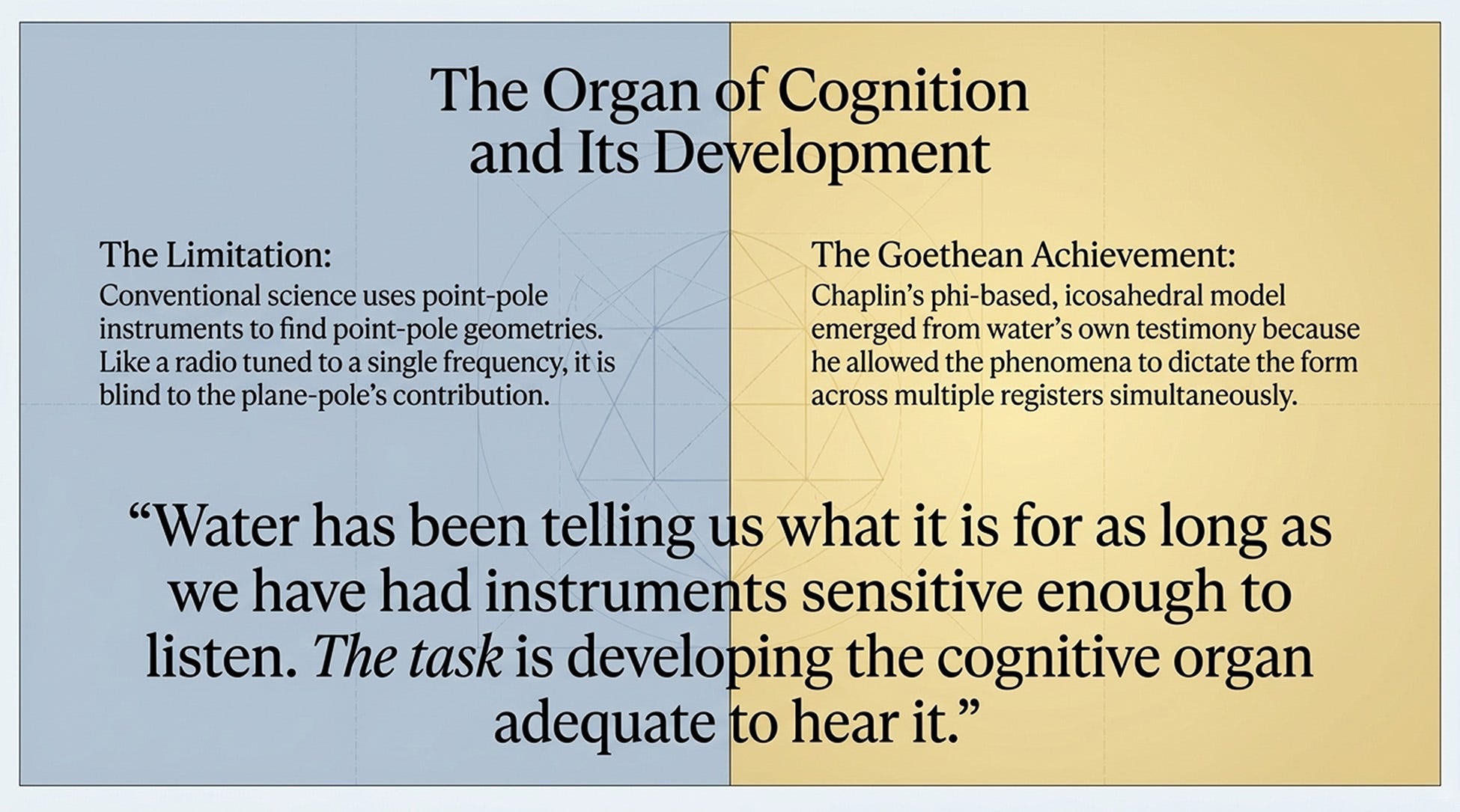
This is the sense in which Martin Chaplin’s achievement, properly understood, exceeds the boundaries of what conventional water chemistry was supposed to be able to produce. He arrived at a geometry — φ-based, icosahedral, plane-pole — by the most rigorous quantitative methods available, methods that gave him no reason to expect that particular answer, constrained only by what the data demanded across every measurement register simultaneously. Whether or not he would frame his work in these terms, the methodology that produced his model is Goethean in its essential structure: attentive, patient, multi-registered, phenomenon-driven rather than hypothesis-driven. The icosahedron emerged from the water’s own testimony, given sufficient and sufficiently varied opportunity to speak.
Water has been telling us what it is for as long as we have had instruments sensitive enough to listen. The task is developing the cognitive organ adequate to hear it.
The Sacred Geometry of Water — Workshop Masterclass
Everything argued in this article was written to confirm a thesis developed before it — built into a 4-hour masterclass that predates this analysis and holds up under it.
That is not a common thing to be able to say.
The geometry is real. The convergence is documented. The methodological critique of hexagonal water, double helix water, and non-phenomenological theoretical extensions stands on solid phenomenological ground. And at the centre of all of it: one form, one ratio, arriving independently from six directions across 2,300 years.
The workshop is where that geometry becomes visible — built figure by figure, from the molecule to the atmosphere, from Plato to the present. Four hours that will change how you see water, and through water, life itself. You will come away with a coherent picture that conventional science has not assembled — one that makes sense of phenomena you have always known were connected but never had the framework to unify.
Take the next step at

Article References
Adams, George. 1933. Space and Counterspace. London: Rudolf Steiner Press.
Adams, George. 1965. Physical and Ethereal Spaces. London: Rudolf Steiner Press.
Bono, Ivan, Emilio Del Giudice, Luca Gamberale, and Marc Henry. 2012. "Emergence of the Coherent Structure of Liquid Water." Water 4 (3): 510–32. DOI: 10.3390/w4030510.
Chaplin, Martin F. 1999. “A Proposal for the Structuring of Water.” Biophysical Chemistry 83 (3): 211–21.
Chaplin, M. Water Structure and Science. London South Bank University. https://web.archive.org/web/20200206200337/http://www1.lsbu.ac.uk/water/water_anomalies.html
Del Giudice, Emilio, and Giuliano Preparata. 1994. “Coherent Dynamics in Water as a Possible Explanation of Biological Membranes Formation.” Journal of Biological Physics 20 (1–4): 105–16.
Del Giudice, Emilio, and Vladimir Voeikov. 2015. “The Origin and the Special Role of Coherent Water in Living Systems.” In Fields of the Cell.
Elsaesser, Thomas. 2009. “Two-Dimensional Infrared Spectroscopy of Intermolecular Hydrogen Bonds in the Condensed Phase.” Accounts of Chemical Research 42 (9): 1220–28.
Eufemio, R.J., et al. 2026. “Structural Determinants of Ice Nucleation by Fungal β-Solenoid Proteins.” Science Advances. DOI: 10.1126/sciadv.aed9652.
Gann, D.L. 2004. Double Helix Water: Has the 200-Year-Old Mystery of Homeopathy Been Solved? US: D&Y Publishing.
Gan, X.H., and Benjamin Bonavida. 1998. “Induction and Regulation of Human Peripheral Blood TH1-TH2 Derived Cytokines by IE Water Preparations and Synergy with Mitogens.” Proceedings of the First International Symposium on the Physical, Chemical, and Biological Properties of Stable Water Clusters.
Hwang, S.G., et al. 2018. “Exclusion Zone and Heterogeneous Water Structure at Ambient Temperature.” PLOS ONE 13 (4): e0195057. DOI: 10.1371/journal.pone.0195057.
Lehrs, Ernst. 1985. Man or Matter: Introduction to a Spiritual Understanding of Nature on the Basis of Goethe’s Method of Training Observation and Thought. 3rd ed. Edited by Nick C. Thomas and Peter Bortoft. London: Rudolf Steiner Press. ISBN 978-1-855843-89-9.
Lo, S.Y., et al. 1996. “Physical Properties of Water with IE Structures.” Modern Physics Letters B 10 (19): 909–19.
Nibbering, Erik T.J., and Thomas Elsaesser. 2004. “Ultrafast Vibrational Dynamics of Hydrogen Bonds in the Condensed Phase.” Chemical Reviews 104 (4): 1887–1914.
Pitkänen, Matti. 2014/2019. “Pollack’s Findings about Fourth Phase of Water: TGD View.” viXra. Available at tgdtheory.fi.
Pitkänen, Matti. 2026. “Do the Icosa-Tetrahedral Tessellation of H³ and Icosahedral H₂O Supercluster Correspond to Each Other?” viXra. Available at tgdtheory.fi.
Pollack, Gerald H. 2006. Water and the Cell. Dordrecht: Springer.
Pollack, Gerald H. 2013. The Fourth Phase of Water: Beyond Solid, Liquid, and Vapor. Seattle: Ebner and Sons.
Yagihara, Shin, et al. 2019. "Physical Meanings of Fractal Behaviors of Water in Aqueous and Biological Systems with Open-Ended Coaxial Electrodes." Sensors 19 (11): 2606. DOI: 10.3390/s19112606.
⨕
Thomas Joseph Brown · alkemix.art · thomasbrown.org · ORCID 0009-0005-0105-8460
Right on Thomas. I sell Water Smackers invented by Bob Boyce™ a retired life long DOD scientist, areo space engineer and was involved with many DOD projects. https://watersmacker.com/#ormus It is also apart of the CHI BOX frequency healing Faraday Cage Room at a hospital, like a ICU room. They perfected Royal Rife's Frequency notebook and tested them all. Too bad the door to this room at a NY hospital is locked? The AMA locked it. ? because it works. https://watersmacker.com/patent.html I am just here to share this amazing drinking water device, brought out in 2015. I make them here in Cayucos, CA
Sorry your article is too confusing and you do not mention nano sized structured and micro clustered water, where the molecule is 10x smaller and looks like a snowflake, when frozen. You should check out the Water Smacker. It came out of a 10 year DOD study of nano technology and DNA, with 30 scientist and doctors. Smacked water mimics rain falling from the sky hitting the Schumann frequency low sub tone bass hum of the earth's spark jump contact of the aether, the water gets electronically changed into structured ORMUS water.
All from Bob Boyce™ a DOD scientist, aero space engineer, now retired.
Six dynamic properties of Smacked Water.
1) Your drinking water takes on a (-) charge from the Non-Hertzian Free energy all around us. It seeks outs a +mate in your body, + oxidation, rust, +pathogens, +viruses. It helps eliminate the toxins from your body. The module in the cap is DC powered but switched to a rare 100% (-)non-hertzian energy circuit. 1 to 2 watts transforms over to 7 to 14 watts.
2) Your drinking water is hydrogen (-) Ionized, that is know to grow plants faster and bigger.
3) Your drinking water molecules are now micro-clustered and nano sized. Structured into crystal snowflakes, when this type of water is frozen. The smaller water molecule seeps into our
blood streams easier. As it has a (-)charge that bonds to (+)crystals, (+)oxidation, (+)rust and helps flush out your body cells. Your body loves this (-)alkaline charge. Today so much EMT pollution we become more (+)acidic, (+)oxidized.
4) Your drinking water has the 7.8 Hz. Schumann Frequency put into the water. The low bass sub-tone hum of the earth. Many parts of our body uses this frequency, to recharge our bodies, each day. One is our skin, it helps rebuild your skin collagen, just by drinking this water.
5) Your drinking water's memory had been erased. 24 hour periods in the resonant chamber, will erase all frequencies. A new 7.8 Hz is put into the water like a natural spring water would have just coming out of the ground. When you pour out a pint of smacked water into a glass to drink. it immediately starts to take on the vibe in the room. Pray over the water, thank the water, before drinking. It accepts this vibe into the water's first memory from a new clean slate.
6) Also your drinking nano colloidal gold each time you drink smacked water. Similar to how colloidal silver keeps your immune system in tact. Gold does the same, super conductive metals are attracted by the femtosecond pulsing non-hertzian energy that is all around us in abundance. Ormus ( white powered gold) is apart of the structured, micro-clustered process. It wakes up the ORMUS that is in all water. Some waters have more ORMUS than others. Some distilled water processes take out 1/2 of the ORMUS. The Miracule Water Filtration Water System keeps the ormus and collects more and adds magnesium to your water. Ormus is brain food. Our bodies love gold. It heals our bodies and keeps our immune system strong.
WaterSmacker.com